


Sintered Metal Filtration
In industrial processing, the efficiency and reliability of a filtration system often dictate the overall quality of the final product and the longevity of downstream equipment. Sintered metal filtration has emerged as a critical technology for demanding environments where traditional polymer or disposable paper filters fail to meet requirements for temperature, pressure, or chemical resistance. By utilizing the process of sintering—where metal particles or wires are bonded through heat and pressure without reaching the melting point—manufacturers create porous structures that offer exceptional mechanical strength and precise filtration accuracy.
For engineers and procurement teams, understanding the nuances of sintered metal filtration is essential for optimizing system performance and reducing total cost of ownership. This guide explores the technical foundations, material considerations, and engineering parameters necessary to select the right filtration solution for industrial applications.
The Fundamentals of Sintered Metal Filtration Technology
Sintered metal filtration relies on a porous metal medium engineered to allow the passage of fluids (liquids or gases) while capturing solid particulate matter. Unlike surface filtration found in thin membranes, sintered media often provide a combination of surface and depth filtration, depending on the specific structure of the material.
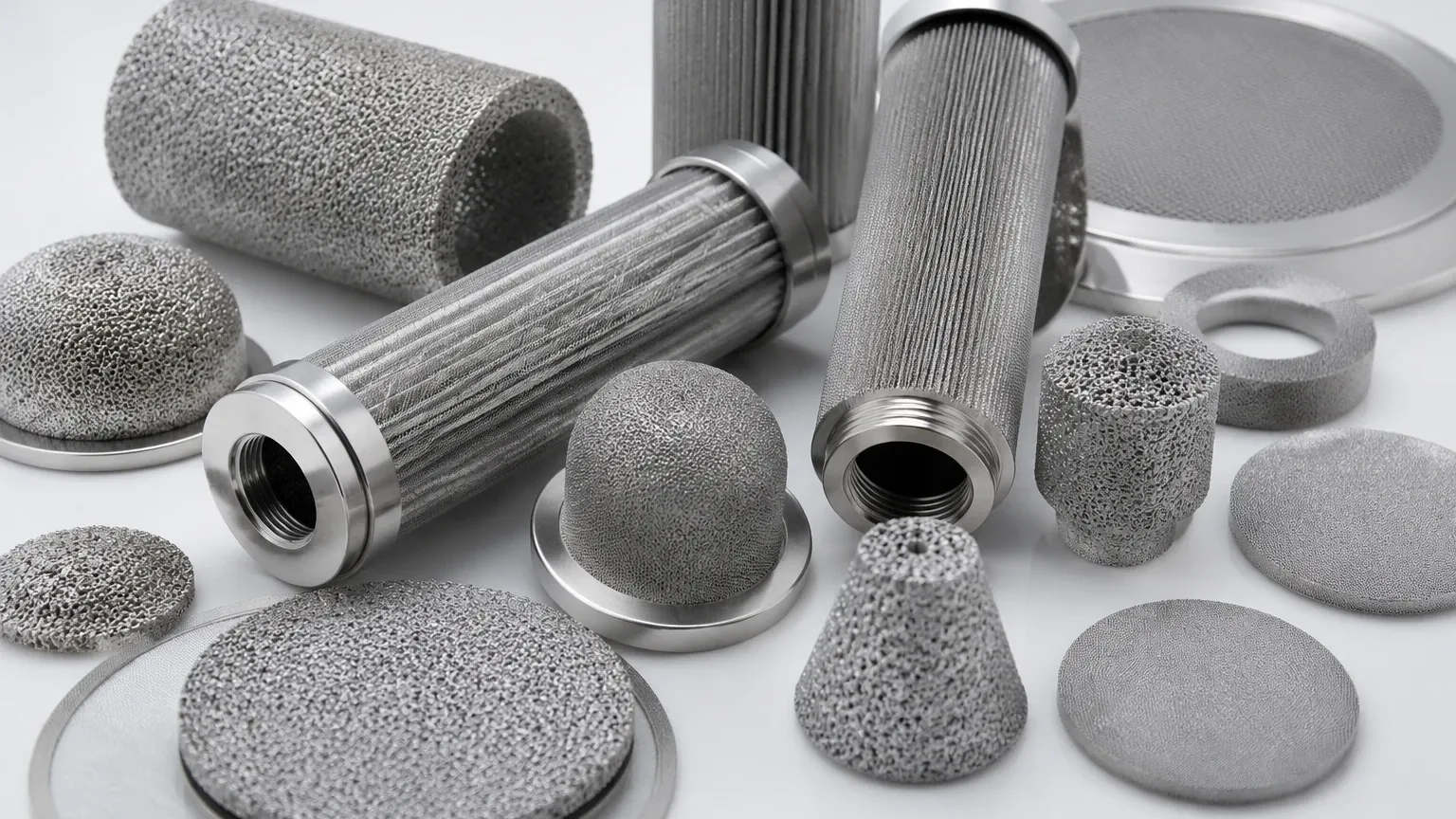
The sintering process involves taking metal powders, fibers, or multi-layered wire meshes and heating them in a controlled-atmosphere furnace. At temperatures just below the melting point, molecular diffusion occurs at the contact points of the metal components, creating high-strength welds. The result is a rigid, self-supporting structure with a stable pore geometry that does not shift under high differential pressure. This structural integrity is a primary reason why Sintered Metal Filters are preferred in high-stress hydraulic and chemical processing systems.
Comparing Sintered Media: Mesh, Powder, and Fiber
Not all sintered filters are constructed the same way. The choice of media significantly impacts flow rates, dirt-holding capacity, and cleaning cycles. There are three primary types of media used in sintered metal filtration:
1. Sintered Wire Mesh
This medium is constructed by layering multiple sheets of woven wire mesh—ranging from coarse support layers to fine filtration layers—and sintering them together. The resulting laminate provides a precise pore size and is highly resistant to migration. Sintered wire mesh is ideal for surface filtration where easy backwashing and cake discharge are required. It is commonly used in food and beverage processing and pharmaceutical applications where hygiene and cleanability are paramount.
2. Sintered Metal Powder
Produced by compacting and sintering spherical or irregular metal powders, this medium creates a tortuous path for the fluid. It excels at depth filtration, capturing particles within the thickness of the filter wall. Sintered powder filters are known for their high filtration efficiency at very fine micron ratings, making them suitable for gas sparging, steam filtration, and protecting sensitive instrumentation in chemical plants.
3. Sintered Metal Fiber (Felt)
Sintered fiber felt consists of non-woven metal fibers that are sintered to form a high-porosity mat. This structure offers a much higher void volume (up to 80%) compared to powder or mesh. The high porosity results in a lower initial pressure drop and a significantly higher dirt-holding capacity, which extends the time between cleaning cycles. This is particularly beneficial in high-viscosity polymer filtration and hydraulic systems.
Critical Engineering Parameters for Industrial Filtration
When specifying a filter for an industrial process, engineers must look beyond simple micron ratings. Several interconnected factors influence the effectiveness of sintered metal filtration.
Filtration Accuracy and Pore Size
Filtration accuracy is typically defined as either "nominal" or "absolute." A nominal rating refers to the ability of the filter to retain a majority percentage of particles of a certain size, whereas an absolute rating indicates the diameter of the largest spherical particle that can pass through the filter. In critical applications, such as pharmaceutical sterile venting, absolute ratings are mandatory to ensure process safety.
Permeability and Pressure Drop
Permeability refers to the ease with which a fluid passes through the filter medium. A high-permeability filter allows for higher flow rates at lower differential pressures (Delta P). Engineers must calculate the clean pressure drop of the system to ensure the pump or compressor can handle the resistance. As the filter accumulates contaminants, the pressure drop increases; understanding this curve is vital for setting maintenance triggers.
Mechanical Strength and Collapse Pressure
In high-pressure hydraulic systems or high-viscosity chemical processing, the filter must withstand significant mechanical stress. Sintered metal components are engineered to resist deformation and collapse even under high differential pressures. This durability prevents the bypass of unfiltered fluid, which could otherwise lead to catastrophic failure of downstream components like valves or turbines.
Chemical and Thermal Compatibility in Harsh Environments
One of the most significant advantages of sintered metal filtration is its ability to operate in environments that would destroy synthetic media. The material selection process is governed by the chemical composition of the process fluid and the operating temperature.
* Stainless Steel (304 and 316L): The most common materials used in industrial filtration. 316L is preferred for its superior corrosion resistance, particularly in environments containing chlorides or organic acids.
* Nickel and Monel: Used in applications involving highly corrosive gases or hydrofluoric acid, where stainless steel might suffer from pitting or stress corrosion cracking.
* Inconel and Hastelloy: These high-performance alloys are reserved for extreme temperatures (up to 800°C or higher) and highly aggressive chemical environments found in petrochemical refining and aerospace.
Thermal stability is another hallmark of sintered metal. Unlike polymer filters that soften or degrade at elevated temperatures, sintered metal maintains its pore structure and mechanical properties, allowing for consistent filtration performance in steam service or hot gas filtration.
Operational Efficiency: Cleaning and Service Life
While the initial cost of sintered metal filters is higher than that of disposable alternatives, the total cost of ownership is often lower due to their cleanability and longevity. Sintered metal filtration systems are designed for long-term service, reducing the frequency of filter changes and the associated downtime.
Cleaning Methods
Depending on the contaminant and the media type, several cleaning methods can be employed:
* Backpulsing/Backwashing: Using a reverse flow of clean fluid or gas to dislodge particles from the surface of the filter. This is often automated in continuous process systems.
* Ultrasonic Cleaning: Immersing the filter in an ultrasonic bath to remove fine particles trapped deep within the pores. This is highly effective for sintered powder and fiber media.
* Chemical Cleaning: Utilizing solvents, acids, or caustic solutions to dissolve organic or inorganic deposits without damaging the metal structure.
* Thermal Cleaning (Burn-off): Heating the filter in a controlled environment to carbonize and remove organic contaminants, such as polymers or resins.
Determining Replacement Cycles
Although sintered filters are cleanable, they are not infinite. Over many cycles, residual contaminants may lead to a permanent increase in the "clean" pressure drop. Engineers should monitor the recovery of the pressure drop after each cleaning. When the clean Delta P reaches a predetermined threshold (often 2-3 times the original value), the filter element should be replaced to maintain system efficiency.
Selecting the Right Sintered Solution for Your Application
Choosing the optimal filtration solution requires a comprehensive analysis of the process conditions. Before consulting with a manufacturer, technical teams should confirm the following data points:
1. Fluid Characteristics: What is the viscosity, density, and chemical composition? Is the fluid a liquid or a gas?
2. Contaminant Profile: What is the expected particle size distribution? What is the concentration of solids (ppm)? Are the particles hard, deformable, or fibrous?
3. Operating Conditions: What are the maximum and minimum operating temperatures and pressures? What is the required flow rate?
4. System Constraints: Are there specific space limitations for the filter housing? What are the connection requirements (NPT, Flange, etc.)?
By providing these details, engineers can work with filtration specialists to develop customized designs that balance filtration efficiency, flow capacity, and mechanical durability. Customization options often include specific end-cap configurations, reinforced internal cores for high-pressure applications, and specialized surface treatments to enhance corrosion resistance or reduce particle adhesion.
In conclusion, sintered metal filtration provides a robust and versatile solution for the most challenging industrial separation tasks. Whether the goal is to protect high-value equipment, ensure product purity, or recover expensive catalysts, the technical advantages of sintered metal—strength, thermal stability, and cleanability—make it an indispensable component of modern industrial engineering.
