


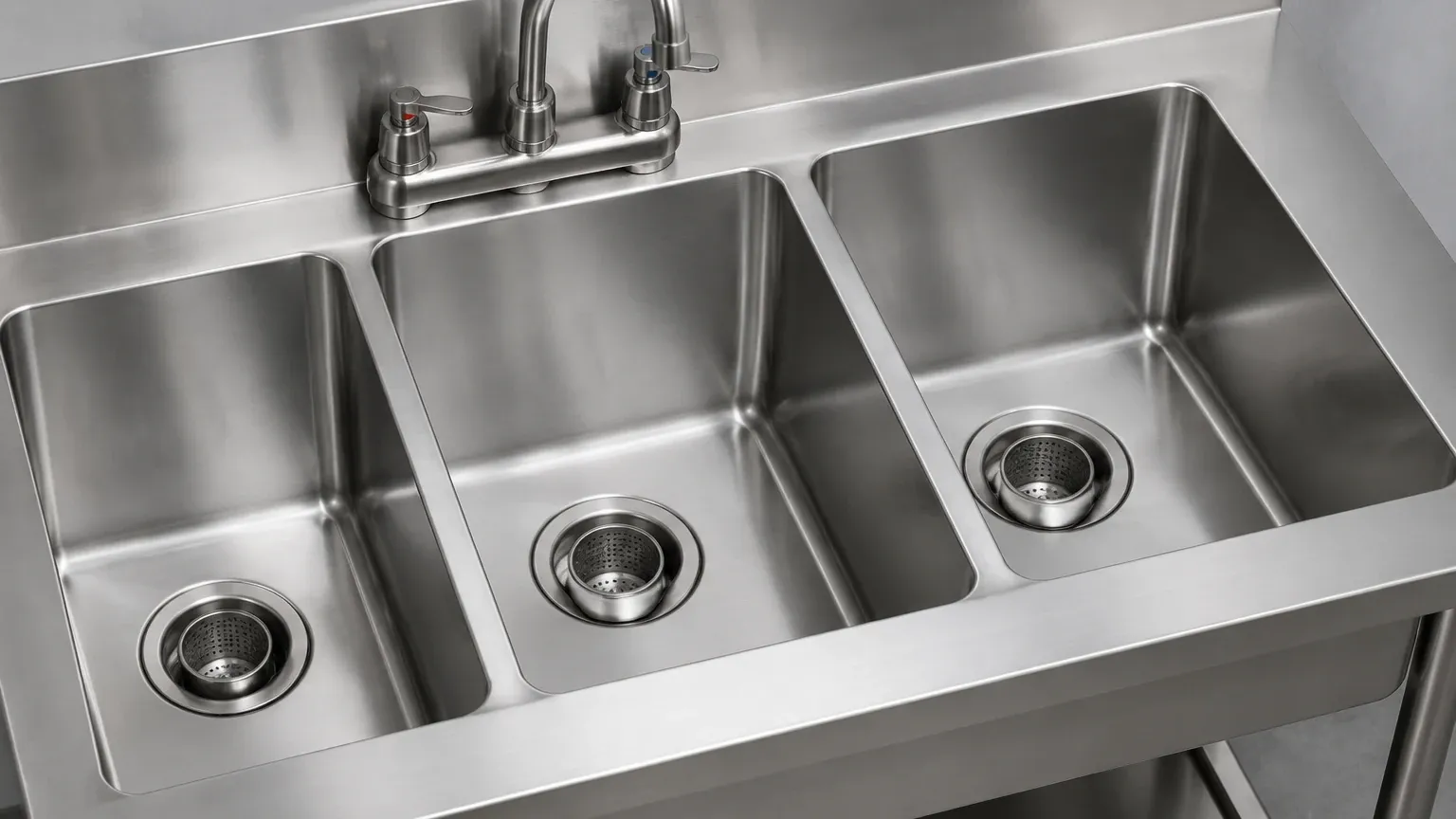
3 Compartment Sink Strainers
In industrial and commercial environments, the management of wastewater and solid waste at the point of origin is a critical engineering challenge. The 3-compartment sink is a foundational piece of equipment in food processing, pharmaceutical labs, and chemical facilities, used for the sequential process of washing, rinsing, and sanitizing. However, the operational efficiency of these systems is entirely dependent on the performance of the filtration components installed within them. Specifically, 3 compartment sink strainers serve as the primary defense mechanism, protecting facility plumbing and downstream water treatment systems from clogging and contamination.
For engineers and facility managers, selecting the right Strainers & Baskets involves more than choosing a standard off-the-shelf part. It requires an understanding of material science, fluid dynamics, and the specific mechanical stresses of an industrial environment. High-quality stainless steel filtration components ensure that solids are captured effectively without compromising flow rates or hygiene standards.
The Role of Strainers & Baskets in Industrial Fluid Management
In any facility where large volumes of water are used to clean equipment or process raw materials, the risk of pipe blockages and pump damage is significant. 3 compartment sink strainers are designed to intercept solid particles—ranging from food scraps and organic waste to metal shavings or chemical precipitates—before they enter the drainage lines.
From a technical perspective, these strainers act as a coarse filtration stage. By capturing larger debris, they reduce the Total Suspended Solids (TSS) in the effluent, which can lower the burden on secondary filtration systems or municipal wastewater treatment plants. In many jurisdictions, the use of high-efficiency strainers is a regulatory requirement to prevent the discharge of prohibited solids into the public sewer system. Kaifil specializes in manufacturing these components with precision, ensuring they meet the rigorous demands of industrial use.
Engineering Specifications for 3 Compartment Sink Strainers
When specifying 3 compartment sink strainers for an industrial application, several engineering parameters must be considered to ensure long-term reliability and performance.
1. Filtration Media: Perforated vs. Mesh
Most industrial sink strainers utilize either perforated metal or woven wire mesh. Perforated metal is typically preferred for heavy-duty applications where mechanical strength is paramount. The size of the perforations determines the smallest particle that can be captured. For finer filtration, a wire mesh lining can be integrated into the basket design. This hybrid approach allows for the capture of smaller particulates while maintaining the structural integrity of the perforated outer shell.
2. Open Area and Flow Rate
The "open area" of a strainer refers to the total area of the holes expressed as a percentage of the total surface area. A higher open area percentage allows for faster drainage, which is critical in high-volume 3-compartment sink operations. Engineers must balance the need for fine filtration (smaller holes) with the need for rapid flow. If the open area is too low, the sink will drain slowly, leading to operational bottlenecks and potential overflows.
3. Structural Reinforcement
In industrial settings, strainers are often subjected to heavy loads and frequent handling. Reinforced rims, heavy-gauge handles, and welded seams are essential features. Kaifil’s manufacturing process focuses on high-integrity welds that prevent the basket from deforming under the weight of wet solids or during the vigorous cleaning cycles common in chemical and food processing.
Material Selection: 304 vs. 316 Stainless Steel
Material selection is perhaps the most critical factor in the longevity of 3 compartment sink strainers. Because these components are constantly exposed to water, cleaning agents, and varying temperatures, they must exhibit superior corrosion resistance.
* Grade 304 Stainless Steel: This is the standard for most commercial applications. It offers excellent corrosion resistance and is easy to sanitize. It is suitable for most food service and general industrial environments where exposure to highly corrosive chemicals is limited.
* Grade 316 Stainless Steel: For more demanding environments, such as pharmaceutical manufacturing or facilities using high-chloride cleaning agents, Grade 316 is the preferred choice. The addition of molybdenum provides enhanced resistance to pitting and crevice corrosion, ensuring the strainer remains intact even in harsh chemical environments.
Choosing the correct grade of stainless steel directly impacts the replacement cycle and the total cost of ownership. Using inferior materials or low-grade alloys can lead to rust contamination, which is unacceptable in sanitary or high-purity applications.
Customization and OEM Capabilities for Precision Filtration
Every industrial facility has unique requirements based on its specific processes and existing infrastructure. Standard 3 compartment sink strainers may not always provide the necessary fit or filtration accuracy. This is where custom manufacturing and OEM capabilities become essential.
Kaifil provides tailored solutions that address specific engineering challenges, including:
* Custom Dimensions: Manufacturing strainers to fit non-standard drain sizes or deep-sump sinks common in specialized industrial wash stations.
* Variable Handle Designs: Custom handles—such as drop-handles, fixed bails, or recessed grips—can be designed to ensure the strainer is easy to remove even when wearing heavy industrial gloves.
* Specific Micron Ratings: For applications requiring precise particle retention, custom wire mesh overlays can be applied to the basket to achieve specific filtration targets.
* Surface Finishes: Depending on the application, strainers can be electropolished to improve corrosion resistance and ease of cleaning, or passivated to remove surface contaminants and enhance the protective oxide layer.
Evaluating Performance: Flow Rate vs. Particle Retention
An effective filtration system must strike a balance between capturing debris and allowing fluid to pass through. In the context of 3 compartment sink strainers, this performance is measured by the pressure drop across the strainer and the efficiency of particle capture.
In a gravity-fed system like a sink drain, the "pressure drop" is essentially the resistance the strainer offers to the falling water. If the strainer becomes blinded (clogged) too quickly, the flow rate drops significantly. To optimize performance, engineers should consider the expected volume of solids. In high-solids applications, a deeper basket design with more surface area is often necessary to prevent premature blinding.
Furthermore, the fit of the strainer within the drain housing is critical. Any gaps between the strainer rim and the drain flange allow fluid to bypass the filtration media, carrying solids directly into the plumbing. Precision manufacturing ensures a tight tolerance fit, which is a hallmark of professional-grade filtration components.
Maintenance, Hygiene, and Replacement Protocols
To maintain the performance of 3 compartment sink strainers, a rigorous maintenance and inspection schedule is required. In food and pharmaceutical industries, hygiene is the primary concern. Strainers must be designed for easy disassembly and cleaning to prevent the buildup of biofilms or bacterial colonies.
Inspection Criteria:
* Mechanical Deformation: Check for dents or warping that might compromise the seal between the strainer and the drain.
* Corrosion Signs: Even stainless steel can show signs of stress corrosion cracking or pitting if exposed to incompatible chemicals. Any sign of rust requires immediate replacement to prevent contamination.
* Mesh Integrity: For strainers with wire mesh linings, inspect for tears or fraying. A damaged mesh can release metal fragments into the waste stream and fails to provide the required filtration accuracy.
Cleaning Best Practices:
Industrial strainers should be cleaned using appropriate mechanical and chemical methods. For stainless steel, non-chlorinated cleaners are often recommended to preserve the passive layer of the metal. High-pressure washing or ultrasonic cleaning can be used for deep-cleaning perforated baskets that have become clogged with stubborn residues.
Total Cost of Ownership and Procurement Considerations
When purchasing 3 compartment sink strainers, procurement teams often focus on the initial unit price. However, for industrial operations, the Total Cost of Ownership (TCO) is a more accurate metric. TCO includes the purchase price, the cost of frequent replacements due to failure, the labor costs associated with cleaning and maintenance, and the potential costs of plumbing repairs caused by inadequate filtration.
Investing in high-quality, precision-engineered stainless steel strainers from a manufacturer like Kaifil reduces TCO in several ways:
1. Durability: Heavy-duty construction extends the service life of the component, reducing the frequency of replacement.
2. Operational Efficiency: Optimized flow rates prevent downtime caused by slow-draining sinks.
3. Risk Mitigation: Superior particle retention protects expensive downstream pumps and prevents costly plumbing blockages.
4. Compliance: Reliable filtration ensures that the facility remains in compliance with local environmental and wastewater regulations.
Engineers should confirm the material grade, the manufacturing standards (such as welding certifications), and the availability of custom design support before finalizing a supplier. By choosing a partner with deep expertise in industrial filtration, facilities can ensure their 3-compartment sinks operate at peak efficiency.
Conclusion
The humble sink strainer is a vital component in the complex ecosystem of industrial fluid management. Whether in a chemical plant, a commercial kitchen, or a pharmaceutical laboratory, 3 compartment sink strainers provide the essential first line of defense against solids contamination. By focusing on high-quality materials, precision engineering, and custom solutions, facilities can optimize their cleaning processes and protect their infrastructure. For those seeking reliable, high-performance filtration components, exploring professional options for Strainers & Baskets is the first step toward achieving long-term operational success.
