


3 Types of Strainers
In industrial fluid handling systems, the protection of downstream equipment is a critical engineering priority. Pumps, valves, flow meters, and spray nozzles are highly susceptible to damage or clogging caused by particulate matter, scale, and debris. To mitigate these risks, engineers rely on Strainers & Baskets to provide mechanical separation of solids from liquids or gases.
While the fundamental principle of a strainer—using a perforated plate or wire mesh to intercept particles—remains consistent, the physical configuration of the housing and the internal basket varies significantly based on the application. Selecting the correct equipment requires an understanding of flow rates, pressure limits, and the frequency of cleaning required. This guide examines the 3 types of strainers most commonly utilized in industrial environments: Y-strainers, Simplex basket strainers, and Duplex basket strainers.
1. Y-Strainers: Compact Protection for High-Pressure Systems
The Y-strainer is named for its "Y" shaped configuration, where the straining element is housed in a branch that intersects the main flow path at an angle. This design is widely regarded as the most versatile of the 3 types of strainers due to its compact footprint and ability to handle high pressures.
Technical Design and Orientation
Y-strainers are unique because they can be installed in either horizontal or vertical piping runs. In vertical installations, the flow must be downward so that the collected debris is trapped in the sediment leg by gravity. The compact nature of the Y-strainer makes it ideal for applications where space is at a premium, such as skid-mounted equipment or tight mechanical rooms.
High-Pressure Capabilities
Because the cylindrical screen of a Y-strainer is supported within a robust housing, it can withstand significantly higher operating pressures than many basket-style strainers. They are frequently used in steam, gas, and liquid lines where the total amount of debris is relatively low.
The Blow-Off Feature
One of the distinct advantages of the Y-strainer is the inclusion of a blow-off port in the strainer cap. By installing a blow-off valve, operators can flush out accumulated debris without stopping the flow or opening the housing. However, this is only effective for loose, non-fibrous particles. For a thorough cleaning of the mesh, the system must still be depressurized and the screen removed manually.
2. Simplex Basket Strainers: High Capacity for Liquid Applications
When the volume of debris in a system is higher, or when a lower pressure drop is required, engineers turn to Simplex basket strainers. Unlike the angled leg of a Y-strainer, a basket strainer features a vertical chamber that houses a larger, bucket-shaped straining element.
Increased Holding Capacity
The primary engineering advantage of a basket strainer is its "open area ratio." Because the basket is larger than a Y-strainer screen, it can accumulate more debris before the differential pressure reaches a critical limit. This results in longer service intervals and reduced maintenance labor.
Ease of Maintenance
Simplex basket strainers are typically used in horizontal pipelines. They are designed with a top-loading cover, which can often be removed via hand-knobs or quick-opening bolts. This allows for the easy removal of the internal basket for cleaning. Because the basket is a "bucket" design, the debris is captured inside the element; when the basket is lifted out, the debris comes with it, preventing it from falling back into the downstream piping.
Application Limitations
Simplex strainers are "batch" components. To clean the basket, the fluid flow must be shut down and the housing depressurized. This makes them suitable for systems where a temporary halt in production is acceptable or where the strainer is located on a bypass line. For critical processes that operate 24/7, a Simplex design may introduce unacceptable downtime.
3. Duplex Basket Strainers: Continuous Operation Without Shutdown
For industrial processes that cannot be interrupted, Duplex basket strainers (also known as twin-basket strainers) are the essential choice. This configuration consists of two separate Simplex strainer chambers connected by a common manifold and a diverter valve mechanism.
The Diverter Mechanism
The core of a Duplex strainer is the valve system—typically a ball valve, plug valve, or sliding gate—that directs flow into one chamber while isolating the other. When the basket in the active chamber becomes clogged (indicated by a rise in differential pressure), the operator shifts the valve to divert the flow to the clean standby chamber.
Maintenance During Operation
Once the flow is diverted, the isolated chamber can be vented, drained, and opened. The operator can clean or replace the basket while the process continues to run through the second chamber. This eliminates the need for system shutdowns and ensures that downstream equipment is protected at all times.
Engineering Complexity and Cost
Duplex strainers are the most complex of the 3 types of strainers. They require more space, involve more moving parts (the diverter valves), and represent a higher initial capital investment. However, in industries like chemical processing, power generation, and marine fuel systems, the cost of a single unscheduled shutdown far outweighs the price of a Duplex unit.
Engineering Considerations: Mesh, Materials, and Sizing
Identifying which of the 3 types of strainers is required is only the first step. To ensure reliable performance, several technical parameters must be specified during the procurement process.
Material Selection
Stainless steel is the standard for high-performance industrial filtration. At Kaifil, we focus on the use of 304 and 316L stainless steel for both the housings and the internal elements. These materials provide the necessary corrosion resistance for chemical processing and the hygienic surfaces required for food and beverage applications. For highly corrosive environments, specialized alloys may be required to prevent pitting and stress-corrosion cracking.
Filtration Accuracy: Perforation vs. Mesh
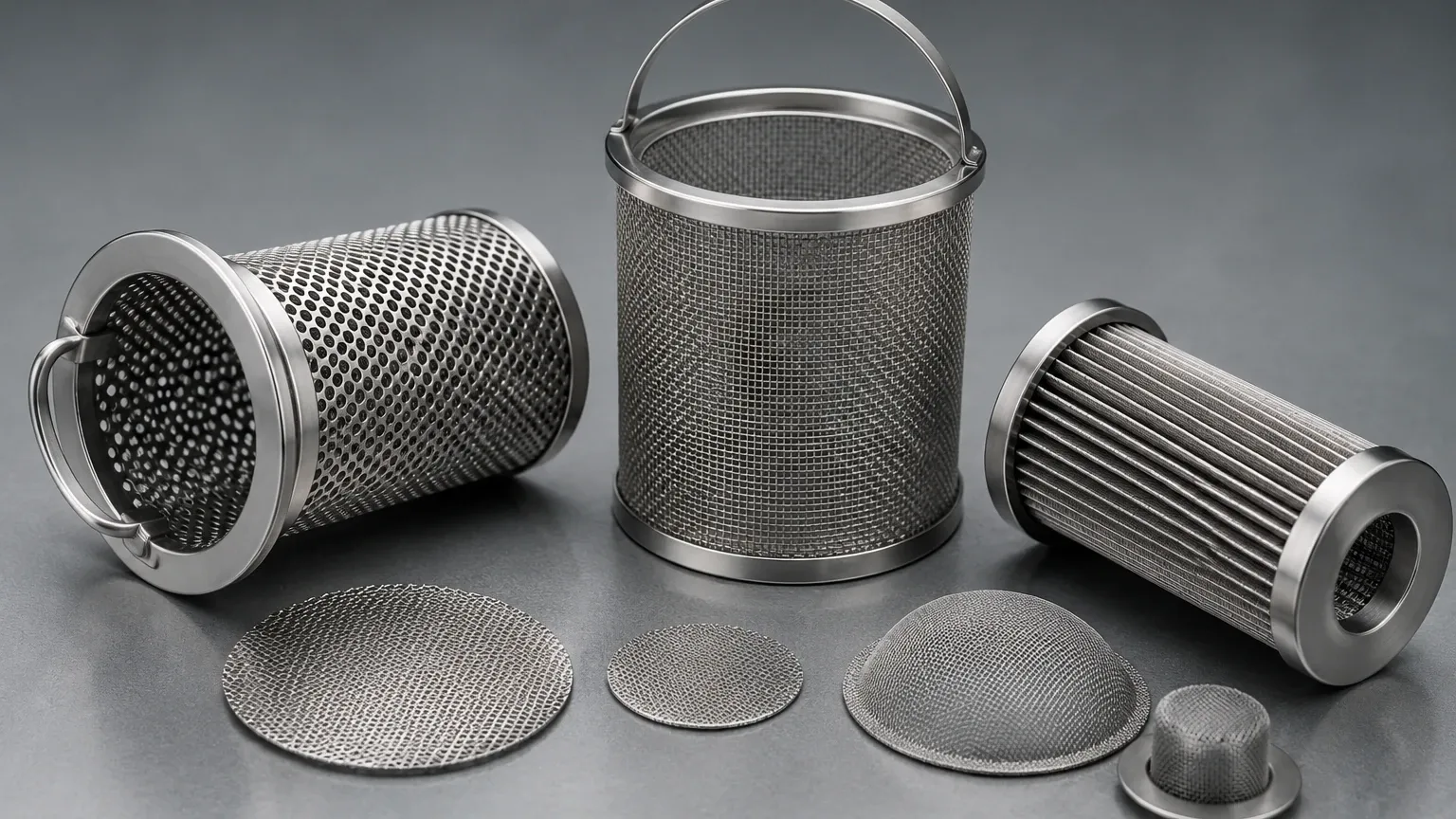
* Perforated Plate: These are used for coarse straining (removing large stones, bolts, or scale). They are durable and provide the structural backbone for finer filters.
* Wire Mesh: For finer filtration, stainless steel wire mesh is lined inside the perforated basket. This allows for the removal of particles down to the micron level. Engineers must balance the need for fine filtration with the resulting increase in pressure drop.
The Open Area Ratio (OAR)
The Open Area Ratio is the relationship between the internal cross-sectional area of the pipe and the total area of the holes in the strainer element. A well-engineered strainer should have an OAR of at least 4:1. A higher OAR ensures that as the strainer begins to clog, the pressure drop does not increase too rapidly, providing a safety margin for the system.
Common Risks in Strainer Selection
Failure to properly specify a strainer can lead to significant operational issues. One common mistake is "over-filtering"—selecting a mesh size that is much finer than necessary. While this results in cleaner fluid, it leads to extremely frequent cleaning cycles and high pressure drops that can cavitate pumps.
Another risk is neglecting the "burst pressure" of the strainer basket. If a basket becomes completely clogged and the pump continues to operate, the differential pressure can exceed the structural strength of the mesh, causing the basket to collapse. This sends both the original debris and the fragments of the destroyed basket into the downstream equipment. To prevent this, Kaifil recommends the installation of differential pressure gauges across the strainer to alert operators when cleaning is required.
Customization and OEM Solutions
In many industrial settings, standard off-the-shelf strainers do not meet the specific geometric or performance requirements of the system. Customization is often necessary, particularly regarding the internal basket design.
As a specialist manufacturer, Kaifil provides customized stainless steel filtration components tailored to specific flow dynamics. Whether you require a reinforced basket for high-viscosity fluids or a custom mesh lining for precise particle retention, our engineering team works with global customers to develop reliable OEM solutions. We focus on ensuring that the internal components of your Strainers & Baskets are optimized for the specific chemical and thermal demands of your application.
Conclusion: Choosing the Right Strainer
Selecting from the 3 types of strainers—Y-type, Simplex, or Duplex—depends entirely on your operational constraints and the nature of the fluid being processed.
* Choose a Y-Strainer for high-pressure gas or steam, or when space is limited and debris loading is minimal.
* Choose a Simplex Basket Strainer for liquid systems with moderate debris where the flow can be periodically stopped for maintenance.
* Choose a Duplex Basket Strainer for mission-critical, continuous-flow applications where downtime is not an option.
By understanding these fundamental differences and focusing on high-quality stainless steel construction, engineers can significantly extend the lifespan of their industrial equipment and reduce the total cost of ownership for their filtration systems. For technical assistance in selecting the appropriate strainer configuration or designing custom internal components, consulting with a manufacturer experienced in precision metal filtration is the most effective way to ensure system reliability.
