


4 Inch Strainers
In industrial fluid handling systems, the protection of downstream equipment is a critical engineering priority. 4 inch strainers, designed for systems with a nominal pipe size (NPS) of 4 inches (DN100), serve as the primary line of defense against particulate contamination. These components are essential for safeguarding pumps, flow meters, heat exchangers, and spray nozzles from debris that can cause mechanical wear, clogging, or catastrophic failure.
Selecting the correct strainer for a 4-inch line requires a deep understanding of fluid dynamics, material compatibility, and the specific filtration requirements of the process. For engineers and procurement teams, the decision-making process involves balancing initial pressure drop, dirt-holding capacity, and the total cost of ownership over the component's lifecycle.
Technical Fundamentals of 4 Inch Strainers
A 4 inch strainer is defined by its connection size, but its performance is dictated by its internal geometry and the filtration media employed. At this size, flow rates can be significant—often ranging from 150 to 500 gallons per minute (GPM) depending on the fluid velocity and allowable pressure drop.
The primary function of the strainer is to intercept solid particles while allowing the liquid or gas to pass through with minimal resistance. This is achieved through a removable screen or basket. In the context of Strainers & Baskets, the "basket" refers to the high-capacity internal element typically found in Simplex or Duplex configurations, which offers a larger surface area compared to the simpler screens found in Y-strainers.
Flow Velocity and Pressure Drop (Delta P)
For a 4-inch piping system, maintaining an optimal flow velocity—typically between 5 and 10 feet per second for liquids—is crucial. As fluid passes through the strainer, a pressure drop occurs. This "clean pressure drop" must be calculated during the design phase to ensure the pump has sufficient head to overcome the resistance.
Factors influencing pressure drop in 4 inch strainers include:
* Viscosity of the fluid: Higher viscosity fluids require larger perforation sizes or larger housing volumes to maintain flow.
* Ratio of open area: The ratio of the total open area of the strainer screen to the internal cross-sectional area of the 4-inch pipe. A ratio of 6:1 or higher is often preferred for high-load applications to extend the time between cleaning cycles.
* Mesh or Perforation Size: Finer filtration (higher mesh count) increases resistance and necessitates more frequent maintenance.
Material Selection for Industrial Durability
The choice of material for 4 inch strainers is governed by the chemical nature of the process fluid, the operating temperature, and the external environment. Stainless steel is the industry standard for demanding B2B applications due to its corrosion resistance and structural integrity.
Grade 304 Stainless Steel
304 stainless steel is the most common material for general-purpose industrial filtration. It provides excellent resistance to oxidation and is suitable for water treatment, cooling systems, and many food-grade applications. It is a cost-effective solution when the fluid is non-corrosive and the environment is not highly saline.
Grade 316 and 316L Stainless Steel
For chemical processing, pharmaceutical manufacturing, and marine environments, 316 stainless steel is required. The addition of molybdenum enhances resistance to pitting and crevice corrosion, particularly in chloride-rich environments. 316L (low carbon) is preferred for fabricated 4 inch strainers that require extensive welding, as it prevents carbide precipitation and maintains corrosion resistance at the weld joints.
Specialized Alloys
In extreme cases involving highly aggressive acids or high-temperature steam, exotic alloys like Monel, Hastelloy, or Duplex stainless steel may be specified. While these increase the initial capital expenditure, they prevent premature failure in environments where standard stainless steels would degrade rapidly.
Configuration Types: Y-Strainers vs. Basket Strainers
When specifying 4 inch strainers, engineers must choose a configuration based on the installation space, the expected debris load, and the frequency of cleaning.
4 Inch Y-Strainers
Y-strainers are characterized by their compact, "Y" shaped body. They are typically used in applications where the amount of debris is low. In a 4-inch line, a Y-strainer is often chosen for steam or gas applications because it can handle high pressures and can be installed either horizontally or vertically (downward flow). However, their dirt-holding capacity is lower than that of basket-style strainers, and they generally exhibit a higher pressure drop when dirty.
4 Inch Simplex Basket Strainers
Simplex basket strainers feature a vertical cylinder that houses a large, removable basket. This design is preferred for liquid applications with higher solids loading. The 4-inch simplex strainer allows for a much larger filtration surface area, meaning the system can run longer before the basket needs to be pulled and cleaned. These are strictly for batch processes where the flow can be shut down for maintenance.
4 Inch Duplex Basket Strainers
In continuous process industries—such as power generation or chemical refining—shutting down a 4-inch line for strainer cleaning is not an option. Duplex strainers consist of two separate basket chambers connected by a diverter valve. When one basket becomes clogged, the flow is diverted to the clean chamber, allowing the operator to service the dirty basket without interrupting the process.
Engineering the Internal Filtration Media
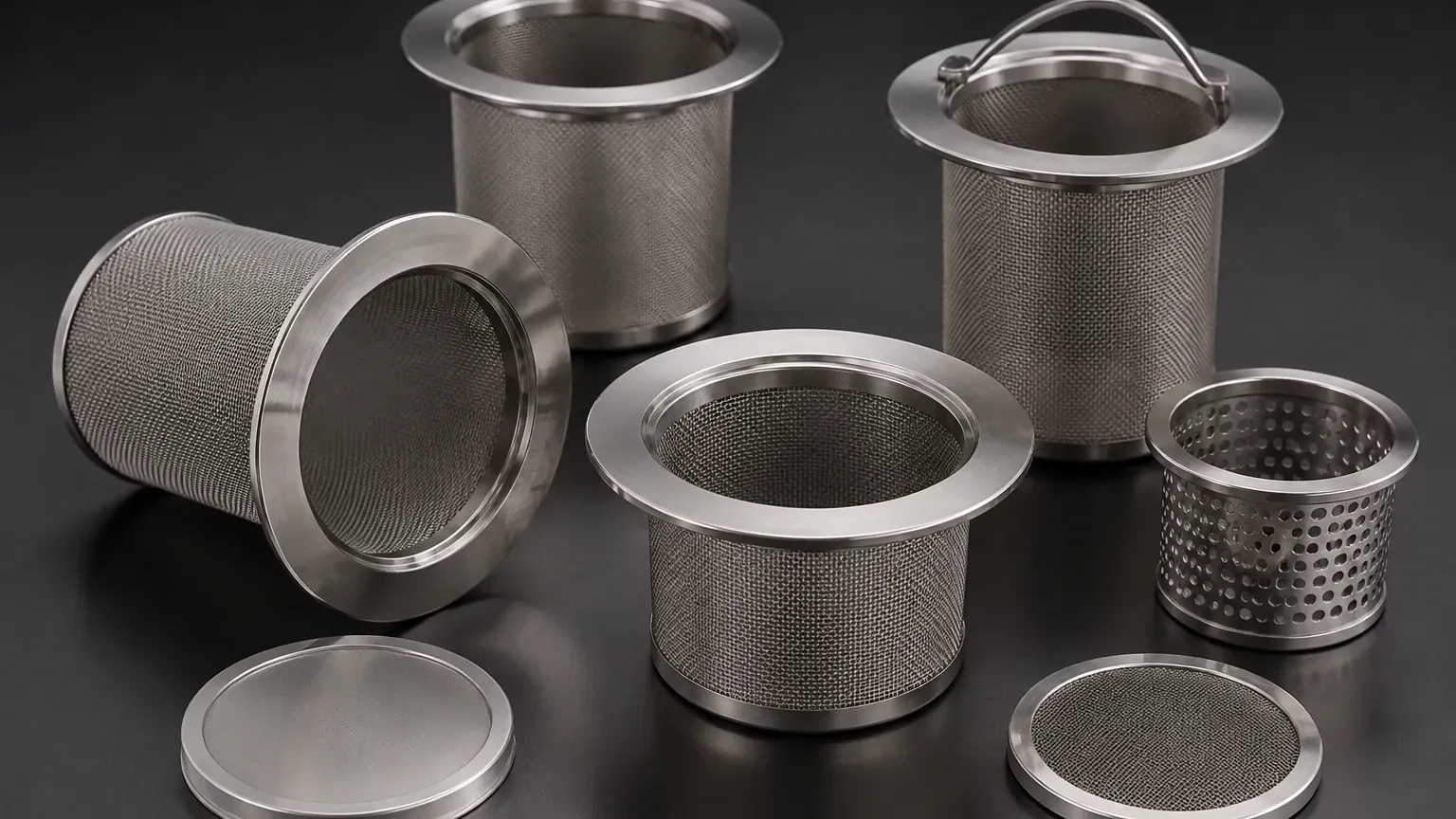
The performance of 4 inch strainers is ultimately determined by the internal element. This element can be a perforated plate, a wire mesh-lined basket, or a wedge wire screen.
Perforated Plate
Perforated plates serve as the primary support or as a coarse filter. For 4-inch systems, common perforation sizes range from 1/16" to 1/4". These are ideal for removing large debris like scale, welding slag, or stones.
Wire Mesh Liners
When finer filtration is required—down to 20 microns or less—the perforated basket is lined with stainless steel wire mesh. The mesh is precision-woven to provide specific micron ratings. In high-pressure 4-inch systems, the mesh must be securely bonded or welded to the support basket to prevent bypass or structural collapse under high differential pressure.
Wedge Wire Elements
For applications involving sticky or fibrous materials, wedge wire (V-wire) screens are often used in 4 inch strainers. The V-shaped profile of the wire prevents particles from wedging in the openings, making the baskets easier to clean via backwashing or manual scraping.
Connection Standards and Installation
In a 4-inch piping system, the method of connection is a vital safety and compatibility consideration. 4 inch strainers are most commonly supplied with flanged connections, following standards such as ANSI/ASME B16.5 (Class 150, 300, or 600).
* Flanged Connections: Provide the most secure and leak-proof seal for high-pressure and high-temperature applications. They also allow for easier removal of the entire strainer body for inspection.
* NPT/Threaded Connections: While common in smaller sizes, threaded 4-inch connections are rarer due to the difficulty of achieving a reliable seal at that diameter and the high torque required for installation.
* Butt-Weld Connections: Used in high-pressure steam or hazardous chemical lines where a permanent, leak-free joint is mandatory.
Proper installation of 4 inch strainers involves ensuring there is adequate clearance for basket removal. For a 4-inch basket strainer, this often requires a vertical clearance at least equal to the height of the strainer housing.
Maintenance and Total Cost of Ownership
The initial purchase price of 4 inch strainers is only one component of the total cost. Engineers must also consider the labor costs of cleaning, the cost of replacement gaskets and baskets, and the energy costs associated with pressure drop.
Monitoring Differential Pressure
To optimize maintenance cycles, 4 inch strainers should be equipped with differential pressure gauges. By monitoring the pressure difference between the inlet and outlet, operators can identify exactly when a basket is reaching its capacity. Cleaning a basket too early wastes labor; cleaning it too late risks basket rupture or pump cavitation.
Customization for Longevity
Standard off-the-shelf strainers may not always meet the specific needs of a complex industrial process. Custom-engineered Strainers & Baskets allow for modifications such as:
* Reinforced Baskets: To withstand high-pressure surges.
* Magnetic Inserts: To capture fine ferrous particles that might pass through a standard mesh.
* Specialized Coatings: For enhanced chemical resistance or reduced friction.
* Quick-Opening Covers: To reduce downtime during cleaning cycles without the need for specialized tools.
Industry-Specific Applications for 4 Inch Strainers
Water and Wastewater Treatment
In municipal and industrial water treatment, 4 inch strainers are used in intake lines to protect pumps from large debris and in discharge lines to ensure treated water meets specific clarity standards. Stainless steel construction is preferred to resist the corrosive effects of treatment chemicals and varied water pH.
Food and Beverage Processing
Hygiene is paramount in food and beverage lines. 4 inch strainers used here must be made from 316L stainless steel with high-quality surface finishes (often electropolished) to prevent bacterial growth. They are used to strain pulp from juices, seeds from preserves, or particulates from process water.
Chemical and Petrochemical Refining
These industries deal with aggressive fluids and high temperatures. 4 inch strainers in these sectors often require heavy-wall castings or fabricated housings that meet specific pressure vessel codes (like ASME Section VIII). They protect expensive catalyst beds and high-speed centrifugal pumps from particulate damage.
Conclusion
Selecting and implementing 4 inch strainers is a technical task that impacts the efficiency and reliability of an entire industrial facility. By focusing on material integrity, precise filtration media, and the specific flow requirements of the 4-inch line, engineers can ensure long-term protection for their critical assets. Whether the application calls for a simple Y-strainer or a complex duplex system, the quality of the internal basket remains the most important factor in achieving consistent filtration performance.
For those seeking specialized designs or high-performance replacements, exploring professional options for Strainers & Baskets ensures that the filtration solution is tailored to the exact mechanical and chemical demands of the application.
