


5 Gallon Bucket Strainers
In industrial processing, the 5 gallon bucket remains one of the most ubiquitous containers for batch handling, transport, and temporary storage of liquids. However, ensuring the purity of the contents within these containers requires specialized filtration tools. 5 gallon bucket strainers serve as a critical line of defense in various sectors, from chemical manufacturing to food processing, by removing oversized particulates, contaminants, and undissolved solids.
For engineers and procurement professionals, selecting the correct strainer involves more than just finding a component that fits the diameter of a bucket. It requires an understanding of material compatibility, micron requirements, and the mechanical stresses involved in high-viscosity filtration. As a specialized manufacturer, Kaifil provides high-performance Strainers & Baskets designed to meet these rigorous industrial standards.
Engineering Fundamentals of Bucket Filtration
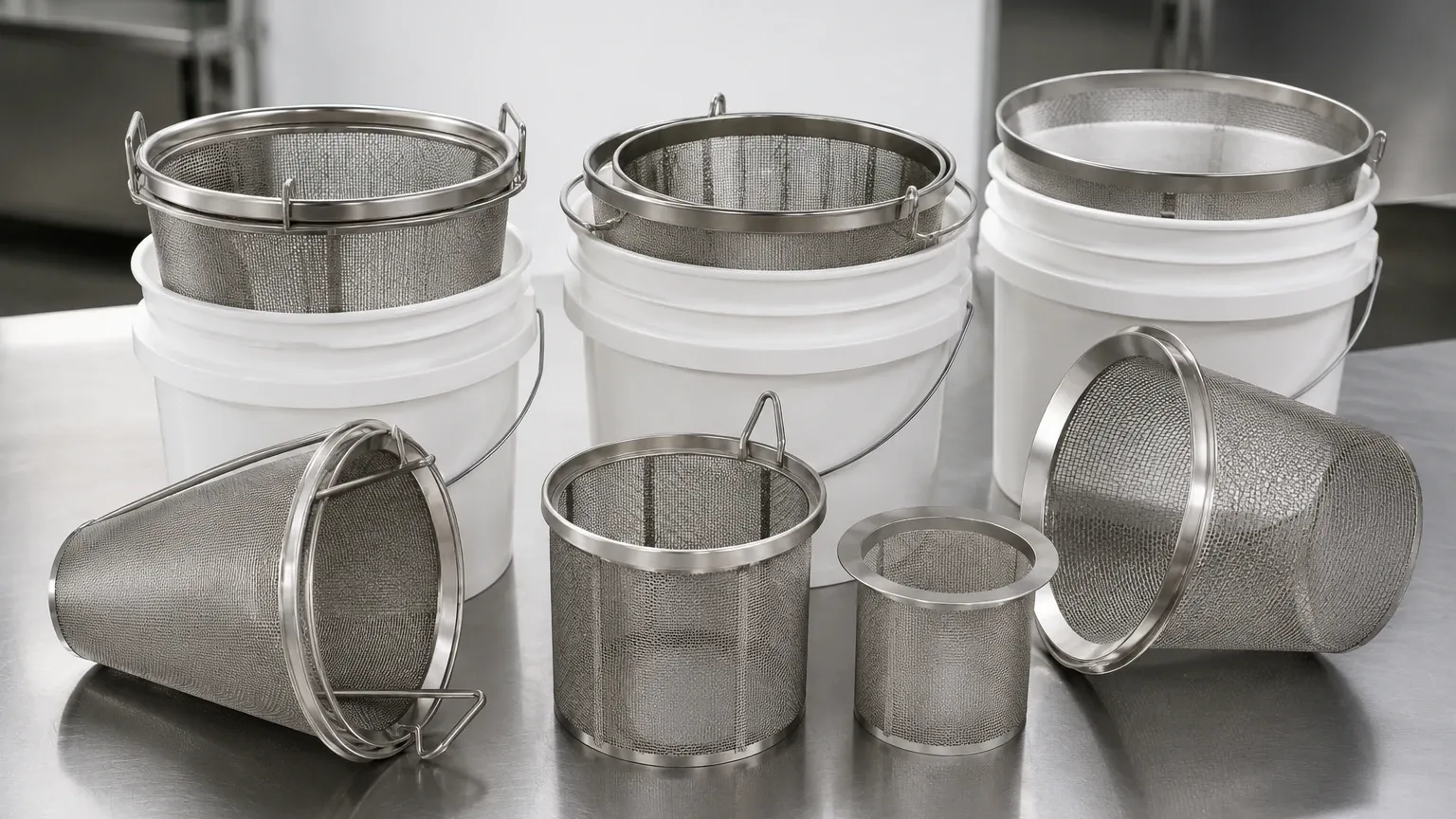
At its core, a 5 gallon bucket strainer is a gravity-fed or low-pressure filtration device. Unlike closed-loop pressurized systems, these strainers rely on the weight of the fluid and the surface area of the mesh to facilitate separation. The design typically features a flanged rim that allows the strainer to sit securely on the top edge of a standard 5-gallon (approximately 19-liter) pail.
Surface Area and Flow Dynamics
The efficiency of 5 gallon bucket strainers is largely determined by the effective filtration area. In industrial applications, a shallow strainer may clog quickly if the particulate load is high. Conversely, deep-basket designs increase the available surface area, allowing for higher flow rates and longer intervals between cleaning. When specifying a strainer, engineers must calculate the expected flow rate based on the fluid’s viscosity. High-viscosity fluids, such as resins or heavy oils, require larger mesh openings or increased surface area to prevent the "blinding" of the mesh, where particles bridge across openings and halt the flow.
Structural Integrity
Industrial-grade strainers must withstand the weight of the fluid being poured, as well as the potential accumulation of heavy solids. While consumer-grade plastic strainers may suffice for light DIY tasks, industrial environments demand stainless steel construction. Stainless steel baskets maintain their geometric integrity under load, ensuring that the mesh does not distort and allow bypass—a critical failure point where unfiltered fluid escapes around the edges of the filter media.
Material Selection: Stainless Steel vs. Synthetics
The choice of material for 5 gallon bucket strainers is dictated by the chemical nature of the fluid and the required durability of the component.
Stainless Steel (304 and 316)
Stainless steel is the gold standard for industrial filtration.
* Type 304: Offers excellent resistance to a wide range of atmospheric environments and many corrosive media. It is the standard choice for most industrial and food-grade applications.
* Type 316: Contains molybdenum, which provides superior resistance to chlorides and acids. This is essential for pharmaceutical and chemical processing where aggressive cleaning agents or corrosive fluids are present.
Stainless steel Strainers & Baskets are non-leaching, heat-resistant, and capable of being sanitized repeatedly, making them far more cost-effective over their lifecycle compared to disposable synthetic options.
Synthetic Mesh (Nylon and Polyester)
Synthetic liners are often used for one-time applications or when extremely fine filtration is needed at a low cost. However, they lack the structural support of metal. In many professional setups, a synthetic mesh bag is used in conjunction with a stainless steel support basket to combine fine filtration with mechanical strength.
Technical Specifications and Micron Ratings
Understanding the relationship between mesh count and micron rating is vital for accurate selection. The micron rating refers to the distance between the wires of the mesh, determining the size of the particle that will be retained.
| Mesh Count | Micron Rating (Approx.) | Typical Application |
| :— | :— | :— |
| 20 | 840 | Coarse pre-filtration, removing large debris |
| 60 | 250 | General purpose straining, paints, and coatings |
| 100 | 149 | Fine straining, hydraulic oils, and light chemicals |
| 200 | 74 | Precision filtration, pharmaceutical intermediates |
| 400 | 37 | Ultra-fine filtration for specialized fluids |
When selecting 5 gallon bucket strainers, engineers must balance the need for fine filtration with the risk of frequent clogging. A common strategy is to use a multi-stage approach, where a coarse strainer removes larger debris before a finer mesh is employed for the final pass.
Industrial Applications for 5 Gallon Bucket Strainers
The versatility of these components allows them to be integrated into numerous industrial workflows.
Coatings, Paints, and Resins
In the coatings industry, 5 gallon bucket strainers are indispensable. During the manufacturing or transfer process, paints can develop "skins" or collect environmental dust. Using a stainless steel basket ensures that these impurities are removed before the product reaches the application equipment, such as sprayers, where clogs can lead to expensive downtime.
Food and Beverage Processing
Food-grade filtration requires materials that are easy to clean and resistant to bacterial growth. Stainless steel strainers are used to filter honey, oils, juices, and syrups. Because they can withstand high temperatures, they are also suitable for straining hot liquids directly from processing vats into 5-gallon batches.
Chemical and Pharmaceutical Production
Precision is paramount in chemical processing. 5 gallon bucket strainers are used to recover catalysts, remove undissolved powders, and ensure that batch samples are free of contaminants before laboratory analysis. The use of 316L stainless steel ensures that the filtration process does not introduce metallic impurities into sensitive chemical reactions.
Hydraulic and Lubrication Systems
When transferring hydraulic fluids or lubricants from bulk storage to 5-gallon pails for field use, straining is a critical step in preventing system wear. Even new fluids can contain particulates from storage tanks. A fine mesh strainer ensures that only clean fluid enters the machinery, extending the life of hydraulic pumps and valves.
Maintenance, Cleaning, and Longevity
One of the primary advantages of investing in high-quality Strainers & Baskets is their reusability. However, the longevity of the component depends on proper maintenance protocols.
Cleaning Procedures
* Mechanical Cleaning: Removing large debris by hand or with soft brushes. Avoid using wire brushes that can damage the fine mesh.
* Chemical Soaking: Using solvents or caustic cleaners to dissolve resins or oils trapped within the mesh. It is vital to ensure the cleaning agent is compatible with the stainless steel grade.
* Ultrasonic Cleaning: For fine mesh (100 micron and below), ultrasonic baths are the most effective way to remove microscopic particles trapped in the wire intersections.
* Backwashing: Directing a high-pressure fluid stream from the clean side of the mesh to the dirty side to dislodge particles.
Inspection and Replacement
Engineers should implement a regular inspection cycle. Signs that a strainer needs replacement include:
1. Mesh Blinding: Permanent clogging that cannot be removed by cleaning.
2. Wire Fraying: Physical damage to the mesh that creates larger-than-specified openings.
3. Deformation: Warping of the basket or flange that compromises the seal on the bucket rim.
Customization and OEM Integration
Standard 5 gallon bucket strainers may not meet the requirements of every specialized industrial process. Customization is often necessary to optimize performance. Kaifil specializes in tailoring filtration solutions to specific engineering needs.
Custom Dimensions and Flanges
While the "5-gallon" designation is standard, the actual rim dimensions of pails can vary between manufacturers. Custom-engineered flanges ensure a snug fit, preventing bypass and providing a stable platform for heavy pouring.
Multi-Layer Mesh Configurations
For applications requiring both high strength and fine filtration, a multi-layer design can be utilized. A coarse, heavy-duty outer mesh provides the structural skeleton, while a fine inner mesh performs the actual filtration. This prevents the fine mesh from tearing under the pressure of the fluid flow.
Handle and Support Options
Adding heavy-duty handles or reinforced cross-bars allows operators to easily lift and move the strainers even when they are full of solids. This is a critical ergonomic consideration for safety in the workplace.
Selecting the Right Strainers & Baskets for Your Operation
When evaluating 5 gallon bucket strainers for your facility, consider the following checklist to ensure optimal performance and total cost of ownership:
1. Fluid Compatibility: Does the fluid require 304 or 316 stainless steel? Are there corrosive elements involved?
2. Particulate Size: What is the smallest particle that must be removed, and what is the largest particle expected in the stream?
3. Viscosity and Temperature: How will the fluid's thickness and heat affect the flow rate through the chosen micron rating?
4. Batch Volume: Is a standard depth basket sufficient, or is a high-capacity deep basket required to handle the solid load?
5. Regulatory Compliance: For food or pharma, does the strainer meet the necessary sanitary standards?
By focusing on these technical parameters, procurement teams can move beyond commodity-grade products and invest in filtration components that enhance process reliability.
Kaifil's expertise in manufacturing precision stainless steel Strainers & Baskets ensures that your industrial filtration needs are met with durability and accuracy. Whether you require standard 5 gallon bucket strainers or fully customized filtration components, our engineering-led approach provides the reliability demanded by modern industrial environments. Ensuring the integrity of your fluids starts with the right filtration partner, providing the tools necessary to maintain quality control from the first gallon to the last.
