


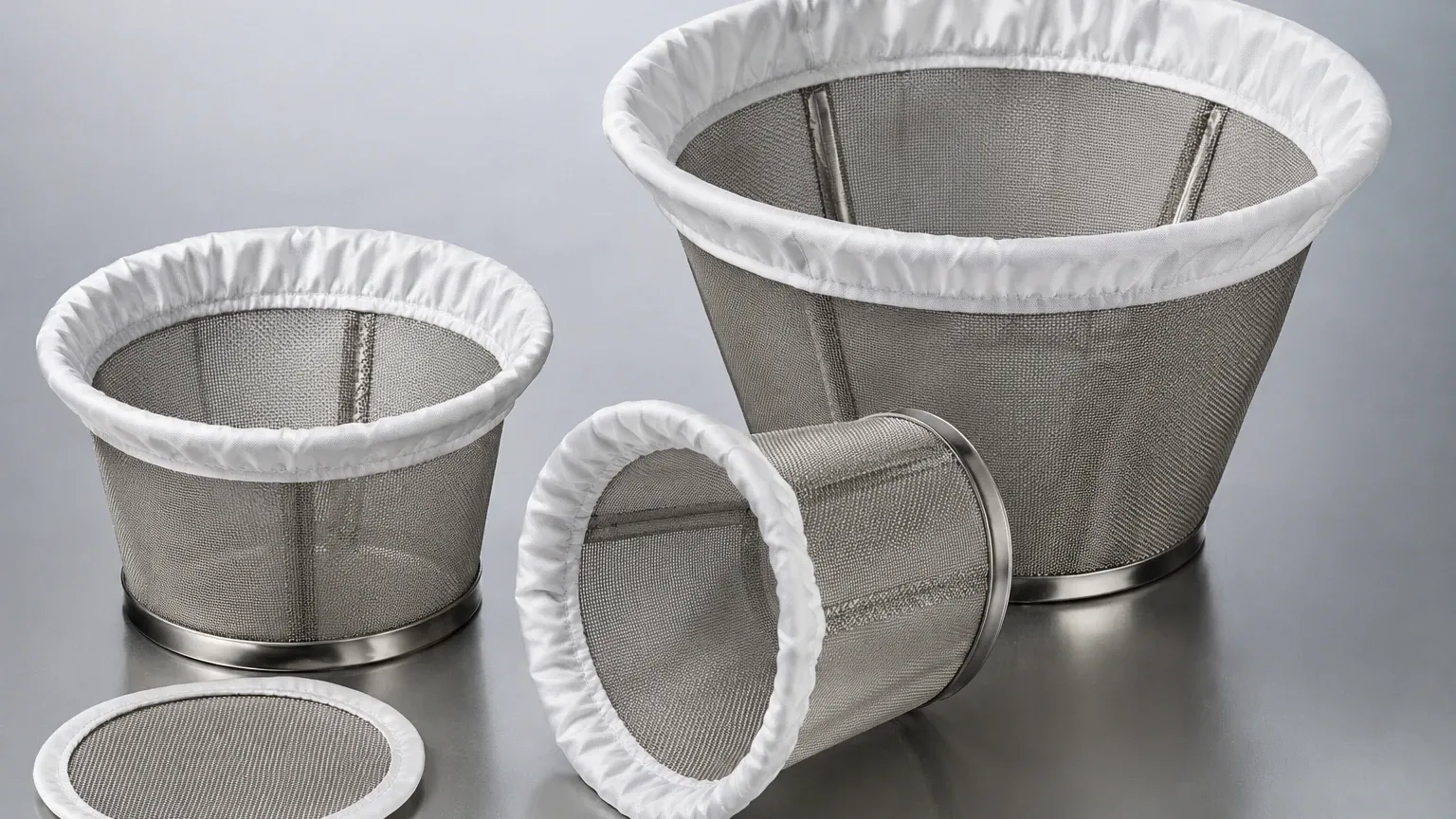
5 Gallon Elastic Top Strainers
In industrial batch processing, the 5-gallon pail serves as a ubiquitous vessel for transporting, mixing, and dispensing fluids. Whether handling high-viscosity resins, architectural coatings, or chemical intermediates, the need for effective particulate removal is constant. 5 gallon elastic top strainers represent a specialized segment of the broader Strainers & Baskets category, designed specifically to provide a secure, friction-fit filtration interface for standard open-head pails.
For engineers and procurement professionals, selecting the correct strainer involves more than just matching a diameter. It requires a technical understanding of mesh materials, micron efficiency, chemical resistance, and the mechanical stresses involved during gravity-fed or pump-assisted filtration. This guide examines the engineering considerations behind these components and how they integrate into professional fluid management systems.
Understanding the Role of 5 Gallon Elastic Top Strainers in Industrial Filtration
The primary function of a 5 gallon elastic top strainer is to remove oversized contaminants—such as skins, undissolved pigments, or environmental debris—from a liquid batch as it is poured into or out of a container. Unlike rigid basket strainers used in high-pressure piping, these flexible strainers are designed for atmospheric or low-pressure applications where ease of installation and rapid changeover are prioritized.
In the hierarchy of industrial filtration, these strainers occupy the space between coarse screening and fine cartridge filtration. They are often employed as a "pre-filtration" step to protect downstream equipment, such as spray nozzles or precision meters, from catastrophic clogging. The elastic top design is critical because it allows the strainer to be stretched over the rim of a standard 5-gallon (approximately 19-liter) pail, creating a temporary seal that prevents the filter media from falling into the container under the weight of the fluid.
Material Engineering and Chemical Compatibility
The performance of 5 gallon elastic top strainers is fundamentally dictated by the polymer or metal mesh used in their construction. Selecting the wrong material can lead to fiber migration, chemical degradation, or structural failure during the filtration process.
Nylon Monofilament (NMO)
Nylon is the most common material for these strainers due to its high tensile strength and excellent abrasion resistance. Nylon monofilament is woven with precise pore sizes, offering consistent micron ratings. It is highly compatible with water-based fluids and many alkaline solutions. However, engineers must be cautious when using nylon with strong acids or high-temperature fluids, as the fibers can swell or lose integrity.
Polyester (PEM)
Polyester is preferred for applications involving acidic environments or where moisture absorption must be minimized. It offers better dimensional stability than nylon in varying humidity levels. In industrial coatings, polyester is often selected for its resistance to specific solvents that might degrade nylon.
Stainless Steel Wire Mesh
While many elastic top strainers are disposable synthetic bags, certain high-performance applications require the durability of stainless steel. Kaifil specializes in integrating precision wire mesh into various filtration formats. For 5-gallon applications, stainless steel mesh provides unmatched temperature resistance and chemical inertness, making it suitable for aggressive solvents or food-grade processing where synthetic fiber shedding is a risk.
Key Performance Metrics: Micron Ratings and Flow Efficiency
When specifying 5 gallon elastic top strainers, the micron rating is the most critical technical parameter. This rating defines the size of the particles the mesh is designed to retain. Common ratings for 5-gallon pails range from 15 microns (very fine) to 800 microns (coarse).
Nominal vs. Absolute Filtration
It is important to distinguish between nominal and absolute ratings. Most elastic top strainers provide nominal filtration, meaning they will trap a high percentage of particles at the specified micron size but may allow some larger particles to pass through if they are elongated or if the mesh deforms under pressure. For critical applications, engineers should look for high-efficiency monofilament weaves that maintain pore geometry even when loaded with solids.
Flow Rate and Viscosity
The flow rate through a strainer is inversely proportional to the fluid's viscosity and the fineness of the mesh. A 100-micron strainer will flow significantly faster than a 25-micron strainer. In industrial settings, if the flow rate is too slow, it can create bottlenecks in production. Conversely, if the flow is too fast, it may indicate that the mesh is too coarse or that bypass is occurring. Calculating the "clean pressure drop" is essential when integrating these strainers into a gravity-fed line to ensure the process remains within timed parameters.
Comparing Flexible Strainers with Permanent Stainless Steel Basket Systems
While 5 gallon elastic top strainers are excellent for batch-to-batch versatility and minimizing cleanup, they are often compared to permanent Strainers & Baskets made from rigid stainless steel. Understanding when to use each is vital for operational efficiency.
1. Durability: Rigid stainless steel baskets are designed for years of service and can withstand high differential pressures. Elastic top strainers are typically intended for single-use or limited-use scenarios where the cost of cleaning a permanent filter exceeds the cost of a replacement bag.
2. Pressure Handling: Elastic top strainers are limited by the strength of the elastic band and the fabric. They are not suitable for pressurized housings. If a process requires pumping fluid at high velocity, a rigid basket strainer within a dedicated housing is the safer engineering choice.
3. Containment: Flexible strainers conform to the shape of the pail, maximizing the available filtration surface area within the container. This is particularly useful for high-solids loading where a rigid basket might fill up too quickly.
Kaifil provides technical guidance on transitioning from disposable bags to permanent stainless steel filtration components when a process scales or when waste reduction becomes a corporate priority.
Risk Assessment: Avoiding Bypass and Structural Failure
The most common failure point for a 5 gallon elastic top strainer is "bypass." This occurs when the fluid finds a path around the filter media rather than through it. In an elastic top design, bypass usually happens for three reasons:
* Overloading: If the strainer is filled with too much heavy sediment, the weight can pull the elastic band off the rim of the pail, causing the entire assembly to collapse into the fluid.
* Incorrect Sizing: If the strainer is designed for a smaller diameter container and is stretched too thin over a 5-gallon pail, the pores of the mesh can distort (stretch), effectively increasing the micron rating and allowing larger contaminants to pass.
* Thermal Softening: If the fluid temperature exceeds the operating limit of the elastic or the synthetic mesh, the material may soften and lose its grip on the pail rim.
To mitigate these risks, engineers should specify strainers with double-stitched seams and high-tension elastic. For heavy-duty applications, a "bonnet" style strainer with a reinforced rim may be necessary to ensure the filter stays seated during the entire pour.
Procurement and Customization: Selecting the Right Filter for the Application
For purchasing departments and plant engineers, the procurement of 5 gallon elastic top strainers should be based on a clear set of application data. Before placing an order, the following factors must be confirmed:
* Chemical Environment: List all solvents, surfactants, and pH levels the strainer will encounter.
* Temperature Range: Confirm both the ambient temperature and the temperature of the fluid at the moment of filtration.
* Target Particle Size: Identify the smallest particle that must be removed to protect downstream processes.
* Batch Volume and Frequency: Determine if a disposable synthetic strainer is more cost-effective than a cleanable stainless steel component over the long term.
Customization is often required when standard off-the-shelf strainers do not meet the specific dimensions of specialized industrial pails. Custom mesh counts, different elastic tensions, and varying bag depths can be engineered to optimize the filtration area and prevent premature blinding (clogging) of the mesh.
The Kaifil Advantage in Industrial Filtration
As a professional manufacturer of stainless steel filtration solutions, Kaifil understands that every component in a fluid handling system—no matter how simple it appears—plays a role in the final product's quality. While 5 gallon elastic top strainers are often used for manual batching, they represent the same principles of precision and reliability found in our high-end Strainers & Baskets.
Our expertise in wire mesh and precision metal components allows us to support customers who require more than just a standard bag. We provide the technical insight necessary to select materials that withstand demanding industrial environments, ensuring that your filtration process is both effective and economical. Whether you are filtering paints, chemicals, or food ingredients, choosing a strainer backed by engineering knowledge reduces the risk of batch contamination and equipment downtime.
By focusing on the technical specifications of mesh geometry, material compatibility, and structural integrity, engineers can ensure that their 5-gallon filtration steps are a robust link in their production chain rather than a point of failure.
