


6 Basket Strainer Dimensions
In industrial fluid handling, the 6-inch basket strainer is a critical component for high-capacity filtration. Often utilized in cooling water systems, chemical processing lines, and large-scale pharmaceutical manufacturing, the physical dimensions of these units dictate everything from installation footprint to hydraulic efficiency. Understanding 6 basket strainer dimensions requires looking beyond the nominal pipe size (NPS) to evaluate the internal basket geometry, housing clearance, and flange specifications.
For engineers and procurement teams, selecting a 6-inch strainer involves balancing the flow requirements of a 6-inch pipeline with the physical constraints of the facility. This guide examines the technical specifications, engineering considerations, and customization options for Strainers & Baskets to ensure optimal performance in demanding B2B environments.
Nominal Pipe Size vs. Physical Housing Dimensions
The term "6-inch basket strainer" refers to the nominal diameter of the inlet and outlet ports. However, the external dimensions of the strainer housing are significantly larger to accommodate the internal basket and provide sufficient volume for debris collection without causing excessive pressure drop.
Standard 6-inch simplex basket strainers typically feature a face-to-face (FTF) dimension—the distance from the inlet flange face to the outlet flange face—ranging from 18 to 24 inches, depending on the pressure rating (e.g., ASME Class 150 vs. Class 300). The overall height of the unit is equally critical, as it must account for the depth of the basket and the clearance required to lift the basket out of the housing for cleaning.
Key Dimensional Variables
1. Face-to-Face (FTF): Essential for piping layout and retrofitting existing systems.
2. Center-to-Bottom: The distance from the centerline of the pipe to the lowest point of the strainer body. This determines the ground clearance or support structure height.
3. Center-to-Top: The distance from the centerline to the top of the cover. This is vital for overhead clearance.
4. Basket Removal Clearance: Often overlooked, this dimension specifies the additional vertical space needed to pull the basket assembly entirely out of the housing.
Detailed Analysis of 6 Basket Strainer Dimensions
When evaluating 6 basket strainer dimensions, it is necessary to differentiate between standard cast units and custom-fabricated stainless steel strainers. Fabricated strainers, such as those manufactured by Kaifil, offer greater flexibility in height and width to meet specific Open Area Ratio (OAR) requirements.
Standard ASME Class 150 Dimensions
For a standard 6-inch Class 150 flanged basket strainer, the following dimensions are typical in the industry:
* Face-to-Face: ~18.5 inches (470 mm)
* Overall Height: ~28 to 32 inches (710 to 810 mm)
* Basket Diameter: Approximately 7 to 9 inches
* Basket Depth: Approximately 12 to 18 inches
* Weight: Can range from 150 lbs to 250 lbs depending on material (Stainless Steel vs. Carbon Steel).
The Role of Flange Ratings
The thickness and diameter of the flanges change based on the pressure class. A 6-inch Class 300 strainer will have thicker flanges and a larger bolt circle than a Class 150 unit, which may slightly increase the overall face-to-face length and total weight. Engineers must confirm that the flange dimensions align with the existing piping standards (ANSI/ASME B16.5) to ensure a leak-proof seal.
Engineering the Internal Basket: Surface Area and Flow
The internal dimensions of the basket are arguably more important than the external housing dimensions for filtration efficiency. The goal of a 6-inch strainer is to protect downstream equipment (pumps, valves, nozzles) while maintaining a low pressure drop (Delta P).
Open Area Ratio (OAR)
The OAR is the relationship between the total open area of the basket mesh and the cross-sectional area of the inlet pipe. For a 6-inch pipe (approx. 28.3 square inches of area), a high-performance basket strainer should ideally provide an OAR of at least 6:1. This means the basket must have an internal surface area large enough to allow fluid to pass through even when the basket is 50% or 70% clogged.
To achieve this in a 6-inch system, the basket dimensions must be carefully calculated. If the housing is too narrow, the basket will be tall and thin, potentially leading to structural instability under high flow velocities. Conversely, a wider housing allows for a larger diameter basket, which increases surface area and extends the time between cleaning cycles.
Material Selection and Wall Thickness
Kaifil specializes in stainless steel filtration solutions, where material selection directly impacts the physical dimensions and durability of the strainer. Using Grade 304 or 316L stainless steel allows for thinner, high-strength walls compared to cast iron, which can lead to a more compact footprint for the same pressure rating.
* 304 Stainless Steel: Suitable for general industrial water and mildly corrosive fluids.
* 316L Stainless Steel: Preferred for pharmaceutical and food-grade applications due to its superior corrosion resistance and ease of sterilization.
In high-pressure applications, the wall thickness of the 6-inch housing must be increased. This adds to the outer diameter (OD) of the unit. When space is at a premium, engineers must account for these slight variations in 6 basket strainer dimensions to ensure the unit fits within the designated skid or mechanical room.
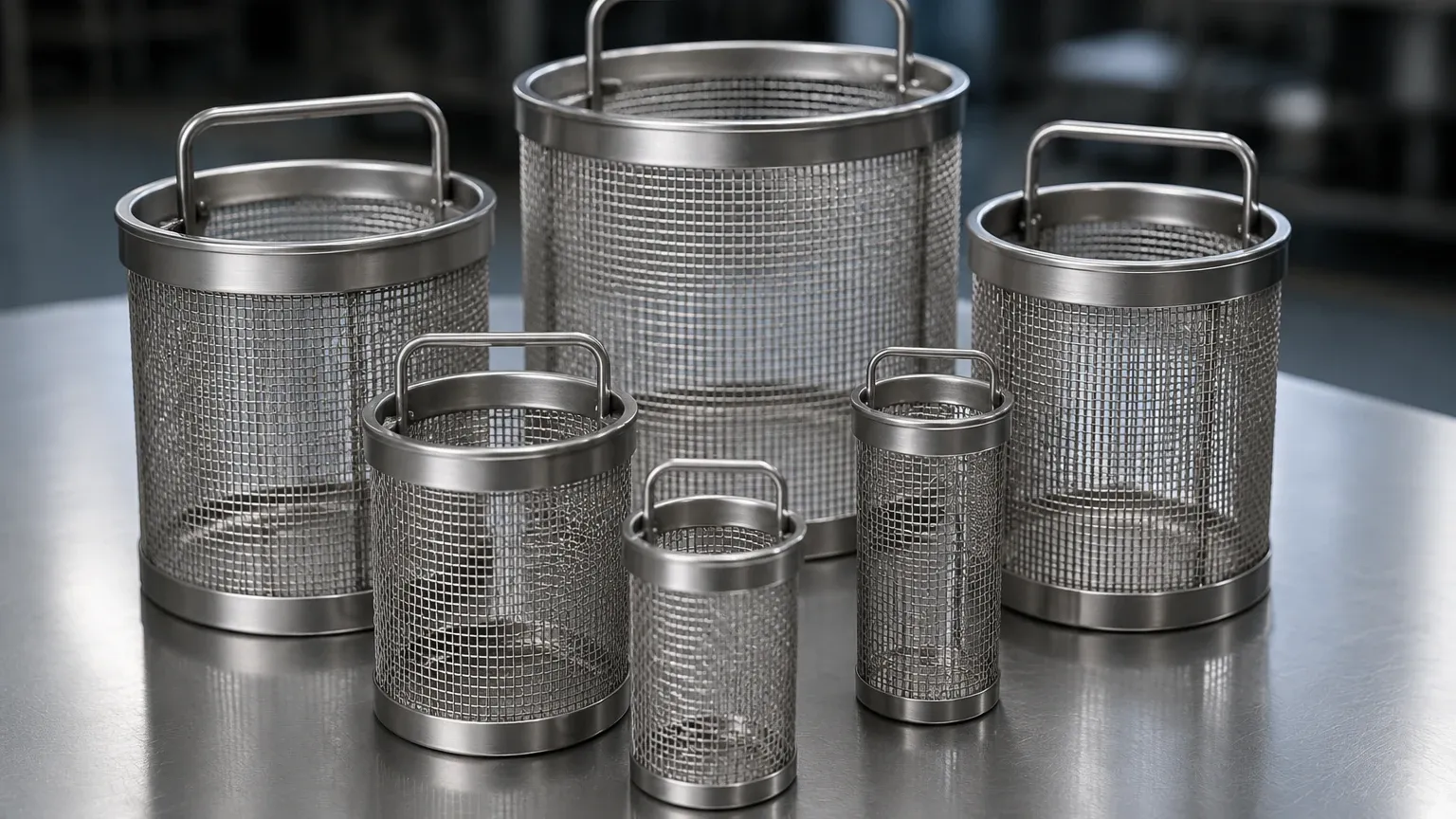
Customization for Retrofit and OEM Applications
In many industrial scenarios, a standard off-the-shelf strainer does not fit the available space. This is common in marine applications, existing chemical plants, or integrated OEM machinery. Custom-fabricated Strainers & Baskets allow for the modification of dimensions without sacrificing filtration performance.
Offset Connections
If the inlet and outlet piping are not on the same horizontal plane, custom 6-inch strainers can be designed with offset nozzles. This eliminates the need for additional elbows and piping, reducing the total system pressure drop.
Extended Baskets
For systems with high solids loading, the vertical dimension of the strainer can be extended to accommodate a "high-capacity" basket. This increases the dirt-holding capacity, which is critical for continuous processes where downtime for cleaning must be minimized.
Installation and Maintenance Considerations
Correctly interpreting 6 basket strainer dimensions is vital for long-term maintenance. If a 6-inch strainer is installed in a tight corner without considering the basket removal clearance, maintenance teams will struggle to service the unit, leading to neglected cleaning and eventual equipment failure.
Clearance Checklist for Engineers:
* Vertical Clearance: Ensure there is at least 1.5 times the basket height available above the cover.
* Drain Plug Access: 6-inch strainers usually include a 1/2" or 1" NPT drain. There must be enough space below the unit to install a drain valve and bucket or hose.
* Vent Port: The top cover should have a vent to release pressure before opening. Ensure this is accessible.
* Support Legs: Large 6-inch units often require floor-mounted support legs. The footprint of these legs must be factored into the floor plan.
Performance Expectations and Pressure Drop
A 6-inch basket strainer is designed to handle flow rates typically between 400 and 1,000 gallons per minute (GPM), depending on the allowable pressure drop. The dimensions of the basket—specifically the mesh size and the percentage of open area—dictate the clean pressure drop.
When the basket is clean, the pressure drop should ideally stay below 2 PSI. As debris builds up, the effective dimensions of the flow path decrease, causing the pressure drop to rise. By selecting a strainer with a larger internal basket volume (increased depth or diameter), facilities can significantly reduce the frequency of manual intervention.
Conclusion: Selecting the Right 6-inch Strainer
Choosing the correct 6-inch basket strainer is an engineering decision that balances pipe size, flow velocity, and physical space. While the nominal 6-inch size is the starting point, the specific 6 basket strainer dimensions—including face-to-face length, height, and removal clearance—are what determine the success of the installation.
Kaifil provides precision-engineered stainless steel filtration components designed to meet these rigorous industrial standards. Whether you require a standard 6-inch simplex unit or a custom-designed basket for a unique housing, focusing on dimensional accuracy and material quality ensures reliable, long-term protection for your industrial equipment.
Before finalizing a purchase, engineers should confirm the exact flange specifications, the required open area ratio, and the available maintenance envelope to ensure the selected strainer provides the total cost of ownership and performance efficiency required for the application.
