


Alberta Strainers
In the demanding landscape of industrial fluid handling, the protection of downstream equipment is a critical engineering priority. Alberta strainers represent a category of robust filtration components designed to remove unwanted solids from liquid or gas streams. These components are essential in sectors ranging from oil and gas processing to municipal water treatment and chemical manufacturing. By acting as a physical barrier, these strainers prevent debris from damaging sensitive components such as pumps, control valves, meters, and heat exchangers.
Selecting the right filtration solution requires a deep understanding of fluid dynamics, material science, and the specific operational requirements of the application. For engineers and procurement teams, the choice of Strainers & Baskets often dictates the long-term reliability and maintenance costs of an entire system. This guide examines the technical nuances of alberta strainers, focusing on engineering specifications, material selection, and performance evaluation.
Fundamentals of Alberta Strainers in Heavy Industry
Alberta strainers are typically characterized by their heavy-duty construction and ability to withstand high-pressure environments. In regions with significant industrial activity, such as the energy sectors of Western Canada, filtration equipment must meet rigorous safety and performance standards. These strainers are not merely simple screens; they are precision-engineered pressure vessels designed to house a removable filtration element.
The primary function of these units is to provide coarse filtration, typically capturing particles larger than 40 microns, although finer filtration is possible with specialized mesh linings. Unlike filters that are often disposable, the internal baskets of these strainers are designed to be cleaned and reused, making them a cost-effective solution for high-volume fluid processing. The design must account for the "Open Area Ratio" (OAR), which is the relationship between the internal cross-sectional area of the strainer and the total open area of the mesh or perforated plate. A higher OAR generally results in lower initial pressure drops and longer intervals between cleaning cycles.
Technical Specifications for Strainers & Baskets
When specifying alberta strainers, engineers must evaluate several key technical parameters to ensure system compatibility. The configuration of the strainer—whether Y-type, T-type, or basket type—depends largely on the piping layout and the expected solids loading.
1. Y-Strainers: These are compact and ideal for applications with low concentrations of solids. They are often installed in steam or gas lines where the amount of debris is minimal. Their design allows for installation in both horizontal and vertical pipelines.
2. Basket Strainers: These offer a much larger holding capacity compared to Y-strainers. They are the preferred choice for liquid applications where a higher volume of debris is expected. Because the basket is serviced from the top, maintenance is simplified, and the risk of fluid spill is reduced.
3. Duplex Strainers: For systems that cannot be shut down for cleaning, duplex configurations allow for continuous operation. A valve system redirects flow from one basket to another, permitting the operator to clean the offline basket without interrupting the process.
For most industrial applications, the internal components of Strainers & Baskets are fabricated from reinforced wire mesh or perforated metal. The choice between a single-layer mesh and a multi-layer sintered structure depends on the required mechanical strength and the nature of the contaminants.
Material Integrity and Chemical Compatibility
Material selection is perhaps the most critical factor in the longevity of alberta strainers. In industrial environments where fluids may be corrosive, abrasive, or subject to extreme temperatures, the housing and the internal element must be chemically compatible with the medium.
Stainless steel is the industry standard for high-performance filtration. Grade 304 stainless steel offers excellent resistance to many chemicals and is widely used in food and beverage and general industrial applications. However, in more aggressive environments—such as those involving chlorides or highly acidic solutions—Grade 316L stainless steel is preferred due to its superior corrosion resistance.
Beyond the metal itself, engineers must consider the sealing materials. O-rings and gaskets made from Viton, EPDM, or PTFE are selected based on their temperature range and chemical resistance. A failure in the seal can lead to bypassing, where unfiltered fluid escapes around the basket, or external leaks that pose safety risks. In the context of alberta strainers, ensuring that all materials meet the relevant ASME or API standards is a baseline requirement for operational safety.
Performance Metrics: Flow Rate and Pressure Drop
A common challenge in the implementation of alberta strainers is balancing filtration efficiency with system pressure requirements. Every strainer introduces a degree of resistance to the flow, known as pressure drop ($ΔP$). An excessively high pressure drop can lead to cavitation in pumps, reduced flow rates, and increased energy consumption.
Engineers use the $C_v$ (flow coefficient) value to calculate the expected pressure drop across a clean strainer. Factors influencing $ΔP$ include:
* Fluid Viscosity: Thicker fluids require more force to pass through the mesh, necessitating larger strainers or coarser mesh sizes.
* Mesh Micron Rating: Finer mesh provides better protection but increases resistance.
* Solids Loading: As the basket fills with debris, the available open area decreases, causing the pressure drop to rise exponentially.
In many alberta strainers, differential pressure gauges are installed to monitor the status of the internal basket. A standard rule of thumb is to clean or replace the basket when the pressure drop reaches a predetermined limit, typically between 5 to 10 psi above the clean pressure drop. Ignoring these metrics can result in the collapse of the internal mesh or damage to the strainer housing.
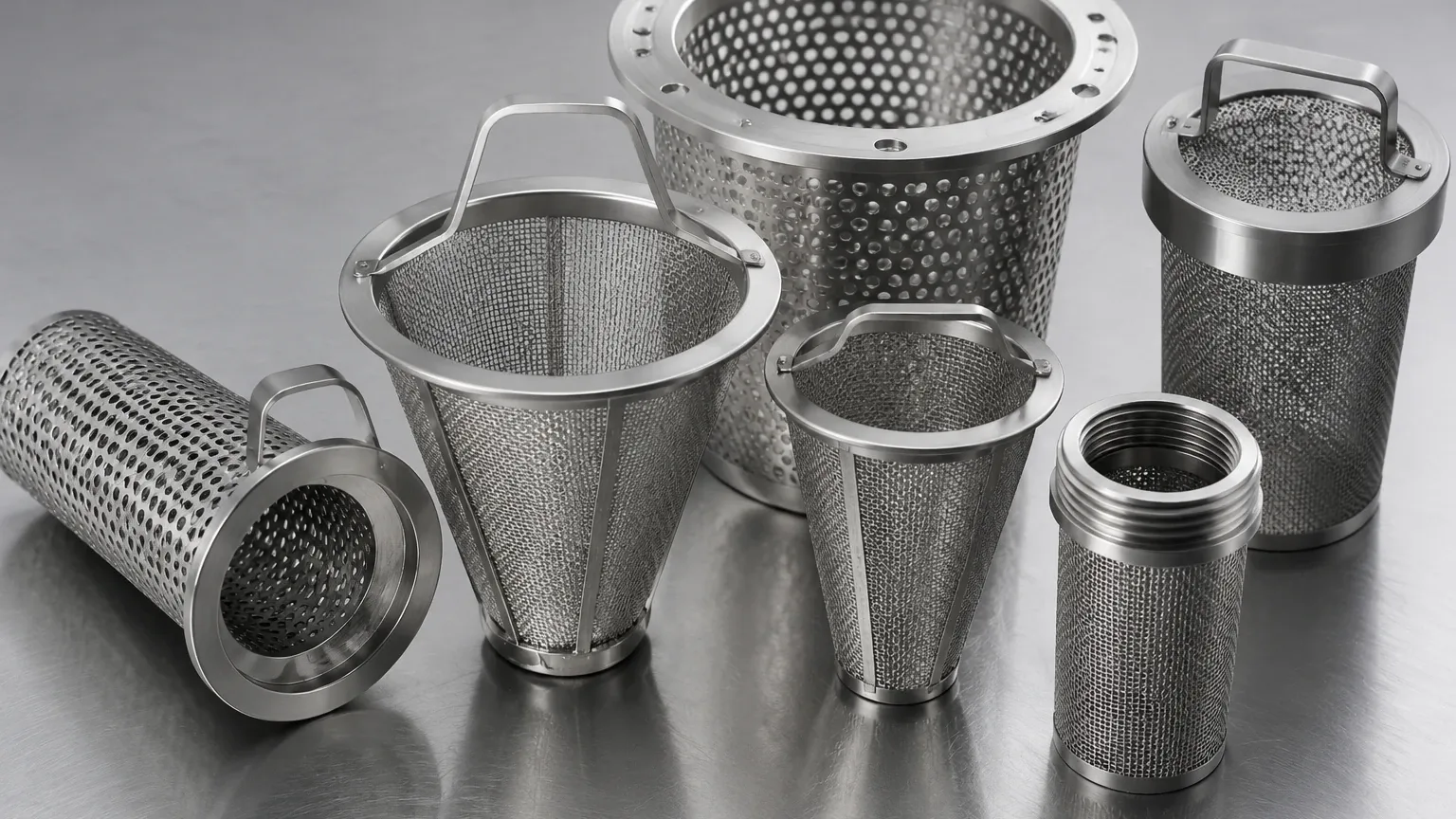
Custom Design and OEM Manufacturing Capabilities
Standard off-the-shelf solutions are not always sufficient for specialized industrial processes. This is where custom manufacturing and OEM capabilities become vital. Manufacturers like Kaifil specialize in developing tailored Strainers & Baskets that meet specific spatial constraints or unique filtration requirements.
Customization options often include:
* Specialized End Connections: While flanged connections are standard, some applications may require threaded, socket weld, or quick-disconnect fittings.
* Reinforced Baskets: For high-pressure applications where the risk of basket deformation is high, internal support structures or heavier gauge perforated metal can be used to reinforce the wire mesh.
* Magnetic Inserts: In systems where fine iron or steel particles are present (such as in hydraulic systems or machining coolant), magnetic rods can be added to the basket to capture metallic debris that might otherwise pass through the mesh.
* Unique Geometries: In retrofit scenarios where space is limited, custom-shaped housings can be engineered to fit existing piping without compromising filtration surface area.
By working closely with a manufacturer during the design phase, engineers can ensure that the alberta strainers they install are optimized for the specific fluid characteristics and flow conditions of their facility.
Maintenance Protocols and Operational Longevity
The total cost of ownership for alberta strainers is heavily influenced by maintenance requirements. A well-designed strainer should allow for rapid access to the internal element to minimize downtime. For basket strainers, quick-opening covers (such as swing bolts or clamped lids) are often preferred over bolted flanges in high-maintenance applications.
Proper cleaning procedures are essential to prevent the buildup of stubborn contaminants. In many cases, ultrasonic cleaning or high-pressure steam cleaning is used to restore the mesh to its original condition. However, it is important to inspect the mesh for signs of fatigue, such as broken wires or thinning metal, which can occur over many cleaning cycles.
In the context of alberta strainers used in remote locations or critical infrastructure, maintaining a stock of replacement baskets is a standard risk-mitigation strategy. Having identical spare Strainers & Baskets on-hand ensures that the system can be returned to service immediately while the dirty elements are being cleaned or evaluated.
Conclusion: Selecting the Right Solution
Alberta strainers are a fundamental component in the protection of industrial assets. Whether the application involves protecting a municipal water pump or ensuring the purity of a chemical feedstock, the selection of the strainer must be guided by factual engineering data. By focusing on material compatibility, pressure drop calculations, and the specific needs of the application, technical teams can implement filtration solutions that enhance system reliability and reduce long-term operational costs.
When evaluating suppliers, it is essential to partner with manufacturers who understand the complexities of industrial filtration. Precision-engineered Strainers & Baskets provide the first line of defense against system failure, making them one of the most important investments in any fluid handling process. Through careful selection and proactive maintenance, these components ensure that industrial systems continue to operate at peak efficiency, even in the most demanding environments.
