


Basket Strainer 10
In industrial fluid handling, the designation "basket strainer 10" typically refers to one of two critical specifications: a 10-inch nominal pipe size (NPS) strainer housing or a strainer element utilizing a 10-mesh screen. Both interpretations are vital for engineers and procurement teams tasked with maintaining system integrity in high-flow or heavy-debris environments. As a professional manufacturer specializing in custom stainless steel filtration solutions, Kaifil provides the technical expertise required to navigate these specifications, ensuring that filtration components meet the rigorous demands of chemical processing, water treatment, and hydraulic systems.
Selecting the correct basket strainer involves more than matching pipe diameters; it requires a deep understanding of flow dynamics, material compatibility, and particle retention requirements. This guide explores the engineering considerations behind 10-inch and 10-mesh filtration solutions to assist in optimized selection and long-term operational efficiency.
Understanding the Technical Scope of the Basket Strainer 10
When an engineering specification calls for a basket strainer 10, the first step is clarifying whether the requirement pertains to the physical dimensions of the intake/outlet or the coarseness of the internal filter media.
10-Inch Nominal Pipe Size (NPS 10)
A 10-inch basket strainer is a heavy-duty component designed for large-scale industrial pipelines. These units are engineered to handle high volumetric flow rates while providing a large surface area for debris collection. The primary goal of a 10-inch housing is to minimize the frequency of cleaning cycles by offering a high "dirt-holding capacity," which is essential in continuous process industries where downtime is costly.
10-Mesh Filtration Media
Conversely, a "10-mesh" specification refers to the number of openings per linear inch of the wire cloth. A 10-mesh screen has relatively large openings (approximately 2,000 microns or 2.0 mm), making it ideal for primary filtration or pre-filtration. It is commonly used to protect downstream equipment like pumps and heat exchangers from large particulates, scale, or foreign objects without significantly impeding flow velocity.
Flow Capacity and Pressure Drop Considerations for 10-Inch Systems
In any 10-inch piping system, managing the pressure drop (ΔP) is critical. A basket strainer 10 must be sized to ensure that the clean pressure drop does not exceed system tolerances, typically keeping it below 2 PSI in most liquid applications.
Flow Coefficient (Cv)
The Cv value represents the volume of water (in GPM) that will flow through the strainer with a 1 PSI pressure drop. For a standard 10-inch basket strainer, Cv values can range significantly depending on the internal basket design and the ratio of the open area of the screen to the pipe area. High-performance stainless steel baskets from Kaifil are designed to maximize this ratio, often achieving a 6:1 or 8:1 open area ratio, which ensures minimal resistance even as the basket begins to fill with debris.
Velocity Limits
Engineers must also consider the fluid velocity within the 10-inch housing. To prevent erosion of the stainless steel mesh and to ensure effective particle settling, velocities are generally kept below 10 feet per second (fps) for liquids. If the application involves abrasive slurries, lower velocities are recommended to extend the service life of the internal components.
Material Engineering: Stainless Steel Selection for Durability
For industrial applications, the choice of material for both the housing and the internal Strainers & Baskets is paramount. Kaifil specializes in high-grade stainless steel alloys, which offer superior mechanical strength and corrosion resistance compared to cast iron or carbon steel alternatives.
1. Stainless Steel 304: This is the standard grade for general industrial use. It provides excellent resistance to atmospheric corrosion and is suitable for most water treatment and food-grade applications. It is a cost-effective solution for non-corrosive chemical environments.
2. Stainless Steel 316/316L: For applications involving chlorides, acids, or high-temperature steam, SS316 is the preferred choice. The addition of molybdenum enhances its resistance to pitting and crevice corrosion, making it the industry standard for pharmaceutical and marine applications.
3. Specialty Alloys: In extreme environments, such as highly acidic chemical processing, custom baskets can be manufactured from Duplex stainless steel or Monel to ensure structural integrity over long service cycles.
10-Mesh Filtration: Particle Retention and Screen Design
When the focus is on a basket strainer 10-mesh configuration, the engineering emphasis shifts to the structural design of the mesh itself. A 10-mesh screen is robust, but it still requires proper support to withstand the differential pressure that builds up as it captures debris.
Wire Diameter and Open Area
A standard 10-mesh screen might use a wire diameter of 0.025 inches, resulting in an open area of approximately 56%. Increasing the wire diameter improves the strength of the basket but reduces the open area, which in turn increases the pressure drop. Kaifil engineers balance these factors by utilizing precision weaving techniques and, where necessary, adding a perforated metal backup layer to the mesh to prevent "ballooning" or bursting under high-pressure surges.
Multi-Layer Configurations
In some custom applications, a 10-mesh outer layer is used as a support for a much finer inner mesh (e.g., 100-mesh or 200-mesh). This "composite" basket design allows for fine filtration while maintaining the physical rigidity required for a large 10-inch housing. This is particularly common in hydraulic systems where both large-scale protection and fine-particle removal are required simultaneously.
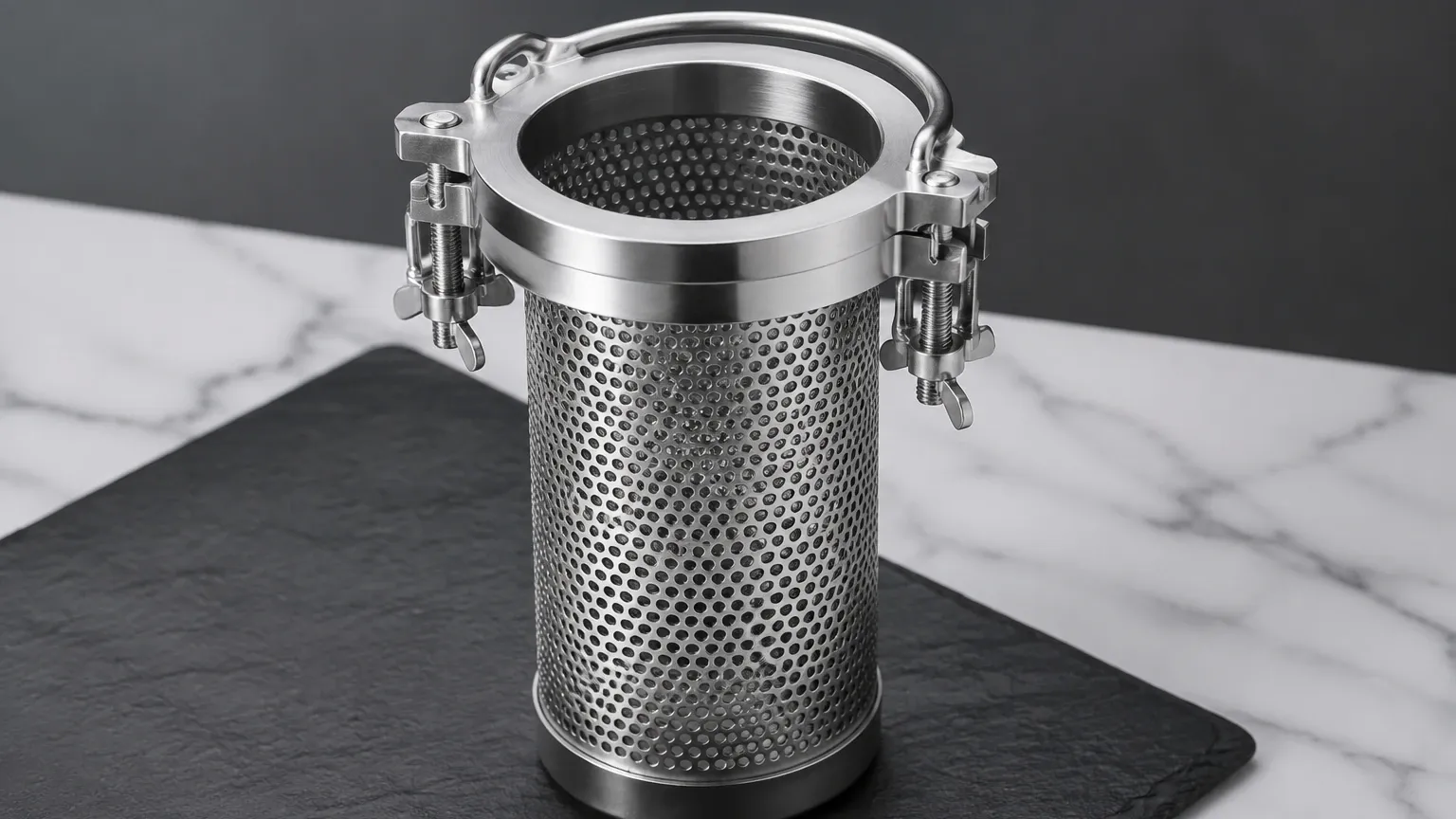
Custom Design and OEM Integration for Industrial Equipment
One of the primary advantages of working with a specialized manufacturer like Kaifil is the ability to customize the basket strainer 10 to fit specific spatial or functional requirements. Standard off-the-shelf strainers often fail to meet the unique constraints of complex industrial skids.
Connection Types
While standard ANSI flanges are common for 10-inch lines, many OEM applications require specialized connections such as DIN flanges, JIS standards, or custom victaulic couplings. Customization ensures a leak-proof integration into existing infrastructure.
Cover Designs
For systems requiring frequent cleaning, a bolted cover may be replaced with a quick-opening "swing-bolt" or "clamp-style" cover. This reduces the labor time required for maintenance. Conversely, for high-pressure hazardous chemical lines, a reinforced bolted cover is often mandated by safety protocols to prevent accidental release.
Internal Modifications
Customizations can include the addition of magnetic inserts to capture fine ferrous particles that might otherwise pass through a 10-mesh screen. Furthermore, slanted baskets or offset nozzles can be engineered to accommodate specific flow directions in tight mechanical rooms.
Operational Maintenance and Total Cost of Ownership
The total cost of ownership (TCO) for a basket strainer 10 is determined not just by the initial purchase price, but by the maintenance requirements and the durability of the internal components.
Differential Pressure Monitoring
Installing differential pressure gauges across the strainer is the most effective way to determine when a basket needs cleaning. For a 10-inch system, a common rule of thumb is to initiate a cleaning cycle when the pressure drop increases by 5-10 PSI over the clean reading. Operating beyond this point risks damaging the basket or starving downstream pumps of fluid.
Cleaning Protocols
Stainless steel baskets are designed to be reusable. Cleaning typically involves removing the basket and using a high-pressure water jet or ultrasonic bath to dislodge trapped particles. Because Kaifil uses precision-welded stainless steel, these baskets can withstand repeated cleaning cycles without losing their structural shape or filtration accuracy.
Gasket and Seal Selection
The performance of a 10-inch strainer is also dependent on its seals. Depending on the fluid and temperature, gaskets may be made from EPDM, Viton (FKM), or PTFE. For 10-inch housings, ensuring a proper seal is vital to prevent bypass—where unfiltered fluid escapes around the edges of the basket.
Choosing the Optimal Strainers & Baskets for Industrial Applications
Selecting the right filtration component requires a holistic view of the process. Whether the goal is to protect a multi-million dollar turbine or to ensure the purity of a food-grade liquid, the basket strainer 10 serves as a critical line of defense.
When evaluating suppliers, engineers should confirm:
* Material Certifications: Ensure the stainless steel meets ASTM standards.
* Pressure Ratings: Verify the housing can handle the maximum system pressure, including potential surges.
* Filtration Accuracy: Confirm that the 10-mesh or custom micron rating is appropriate for the smallest particle that must be removed to protect downstream equipment.
* Lead Times and Customization: For OEM projects, the ability to modify dimensions or connection types is often more valuable than a lower unit price on a non-compliant standard part.
Kaifil’s commitment to quality and engineering precision makes us a trusted partner for global industries. By focusing on durable materials and customized designs, we provide filtration solutions that enhance system reliability and reduce long-term operational costs. For technical consultations on sizing, material compatibility, or custom basket designs for your specific application, reviewing professional product options is the first step toward optimized system performance.
