


Basket Strainer 2 Inch
In industrial fluid handling, the protection of downstream equipment such as pumps, meters, and control valves is a critical engineering priority. Among the various mechanical separation tools available, the basket strainer 2 inch remains one of the most versatile and widely utilized components for medium-flow piping systems. Designed to remove larger particles from liquids through a perforated or wire mesh basket, these strainers provide a high-capacity debris collection point that is easy to service and maintain.
As a core component of the broader Strainers & Baskets category, the 2-inch variant is frequently specified in pilot plants, chemical processing lines, and water treatment facilities. Understanding the technical nuances of material selection, filtration area ratios, and pressure drop dynamics is essential for engineers tasked with optimizing system performance and longevity.
Engineering Fundamentals of a Basket Strainer 2 Inch
A basket strainer 2 inch is typically a simplex-style strainer, meaning it consists of a single chamber containing a removable basket. The "2 inch" designation refers to the nominal pipe size (NPS) of the inlet and outlet ports. In industrial applications, this size is a standard for lines handling flow rates that require more surface area than a standard Y-strainer can provide but do not yet necessitate the massive housings of 6-inch or 8-inch systems.
The primary advantage of the basket design over a Y-strainer is the orientation of the debris collection chamber. In a basket strainer, the fluid enters the top of the basket and flows through the sides, allowing the basket to trap solids at the bottom. This design facilitates a larger holding capacity and a lower pressure drop. Furthermore, because the basket sits vertically, it can be serviced without the contents of the strainer spilling out, provided the system is properly depressurized and drained.
Material Selection and Metallurgical Considerations
For industrial environments, material selection is the most significant factor in determining the service life of a basket strainer 2 inch. Stainless steel is the industry standard due to its superior corrosion resistance and structural integrity under high pressure. Kaifil specializes in manufacturing these components using high-grade alloys to ensure compatibility with various process fluids.
Stainless Steel 304 (SS304)
SS304 is the most common material for general-purpose industrial filtration. It offers excellent resistance to atmospheric corrosion and is suitable for most water treatment, food and beverage, and light chemical applications. It provides a cost-effective solution for systems where highly aggressive chemicals are not present.
Stainless Steel 316 (SS316/316L)
For more demanding environments, such as marine applications, pharmaceutical processing, or systems handling corrosive chemicals like chlorides, SS316 is preferred. The addition of molybdenum in SS316 enhances its resistance to pitting and crevice corrosion. SS316L (low carbon) is often specified for welded components to prevent carbide precipitation during the welding process, ensuring the structural integrity of the strainer housing and basket.
Gasket and Seal Materials
The choice of sealing material is just as vital as the metal housing. Depending on the temperature and chemical nature of the fluid, engineers may specify EPDM, Nitrile (Buna-N), Viton (FKM), or PTFE. For high-temperature steam or aggressive solvents, PTFE or metallic gaskets are often required to prevent leaks at the cover interface.
Understanding Filtration Efficiency and Mesh Sizing
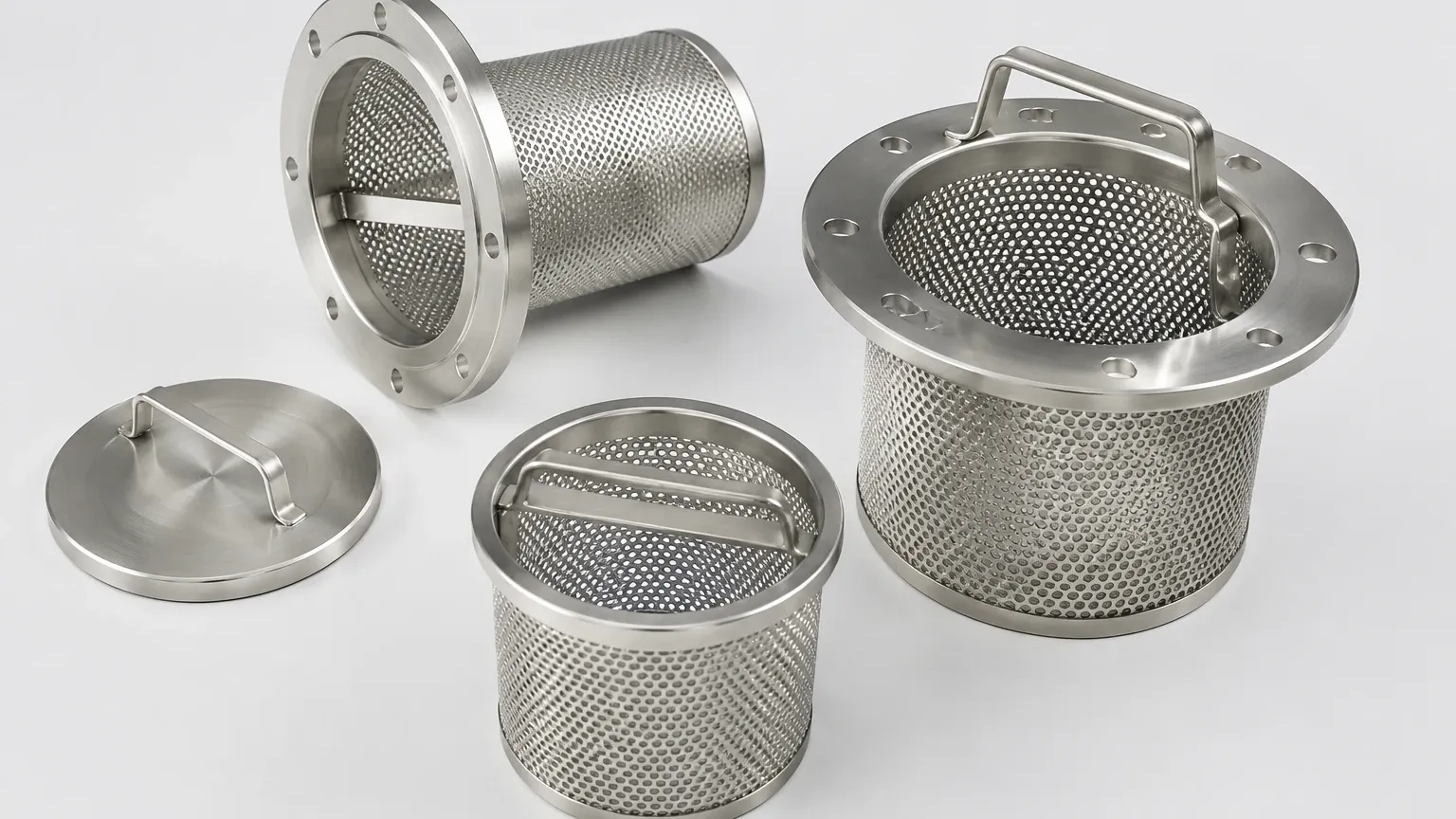
The performance of a basket strainer 2 inch is defined by its internal basket. The basket usually consists of a perforated metal sheet that provides structural support, often lined with a fine wire mesh to achieve the desired filtration rating.
Perforation vs. Mesh
* Perforated Plate: This is the "rough" filtration layer. Common hole sizes range from 1/32 inch to 1/4 inch. It is used for removing large scale, stones, or welding slag.
* Wire Mesh: For finer filtration, a stainless steel wire mesh is sintered or welded to the perforated plate. Mesh sizes are measured by the number of openings per linear inch. A 20-mesh screen might be used for general protection, while a 200-mesh screen (74 microns) is used for high-precision applications.
The Importance of the Open Area Ratio
A critical engineering metric for any basket strainer 2 inch is the ratio of the open area of the basket to the cross-sectional area of the inlet pipe. A high-quality industrial strainer should offer an open area ratio of at least 6:1. This high ratio ensures that even as the basket begins to fill with debris, the pressure drop across the unit remains within acceptable limits, preventing cavitation in downstream pumps and reducing the frequency of cleaning cycles.
Installation and Connection Types for 2-Inch Systems
The method of connecting a basket strainer 2 inch to the piping system depends on the pressure rating and the requirement for frequent removal.
Threaded Connections (NPT/BSPT)
Threaded connections are common in smaller systems where the pressure is relatively low (typically under 300 PSI). They are easy to install but can be prone to leaks if the threads are damaged or if the system is subject to significant thermal expansion and contraction.
Flanged Connections (ANSI/DIN)
For most industrial B2B applications, flanged connections are the standard. Flanges (such as ANSI Class 150 or 300) provide a robust, leak-proof seal and allow for easier removal of the entire strainer body for inspection. Flanged units are also better suited for high-pressure and high-temperature environments where threaded joints might fail.
Socket Weld and Butt Weld
In high-pressure steam or hazardous chemical lines where zero leakage is mandatory, the strainer may be welded directly into the line. While this provides the highest level of security, it makes the initial installation more complex and prevents the removal of the housing without cutting the pipe.
Evaluating Pressure Drop and Flow Performance
Every basket strainer 2 inch introduces a restriction in the flow path, resulting in a pressure drop (Delta P). Engineers must calculate this drop to ensure the system pump has sufficient head to overcome the resistance. The pressure drop is influenced by several factors:
1. Fluid Velocity: Pressure drop increases with the square of the flow velocity.
2. Viscosity: Thicker fluids (like oils or syrups) create significantly more resistance than water.
3. Specific Gravity: Heavier fluids require more energy to move through the mesh.
4. Mesh Loading: As debris accumulates, the effective open area decreases, causing the pressure drop to rise exponentially.
To manage this, many 2-inch strainers are equipped with differential pressure (DP) gauges. A common industrial practice is to clean the basket when the pressure drop reaches 5-10 PSI above the "clean" baseline. Operating beyond this point risks collapsing the basket or forcing debris through the mesh.
Maintenance Protocols and Operational Longevity
The primary maintenance task for a basket strainer 2 inch is cleaning the basket. In a simplex design, this requires the flow to be temporarily shut down. The process involves:
1. Isolation: Closing the upstream and downstream valves.
2. Depressurization: Opening the vent valve or drain plug to release internal pressure.
3. Cover Removal: Loosening the bolts or the quick-opening clamp.
4. Cleaning: Removing the basket and washing it. For sticky or hardened debris, ultrasonic cleaning or chemical soaking may be necessary.
5. Inspection: Checking the basket for broken wires or distorted perforations. A damaged basket must be replaced immediately to prevent bypass.
By following these protocols, the service life of a stainless steel strainer can extend for decades, provided the housing is not subjected to pressures or temperatures beyond its design limits.
Customization Options for Specialized Industrial Applications
While standard off-the-shelf models exist, many industrial processes require customized Strainers & Baskets to meet specific spatial or performance constraints. Kaifil provides extensive OEM capabilities to tailor the basket strainer 2 inch to unique requirements.
Magnetic Inserts
For systems handling fluids with fine iron or steel particles (such as lubricating oil systems), magnetic rods can be placed inside the basket. These magnets capture sub-micron ferrous particles that might otherwise pass through the mesh.
Specialized Coatings
In cases where even SS316 is insufficient, strainers can be lined with materials like ETFE or coated with specialized epoxy to resist highly aggressive acids or bases.
Steam Jacketing
For fluids that solidify at room temperature (like bitumen or certain resins), a steam-jacketed housing can be provided. This keeps the fluid at a consistent temperature, ensuring it remains liquid enough to pass through the filtration media.
Summary of Selection Criteria for Engineers
When specifying a basket strainer 2 inch, purchasing teams and engineers should confirm the following data points with their manufacturer:
* Design Pressure and Temperature: Must meet or exceed the maximum system parameters.
* Required Micron Rating: Based on the sensitivity of downstream equipment.
* Fluid Properties: Including viscosity and chemical composition to determine material compatibility.
* Connection Standard: Ensuring the flanges or threads match existing piping.
* Space Constraints: Confirming the "face-to-face" dimensions and the clearance required to remove the basket.
By focusing on these technical details, industrial operators can ensure that their filtration system provides reliable protection, minimizes downtime, and maintains the efficiency of the entire process line. For high-performance, precision-engineered solutions, Kaifil’s expertise in stainless steel fabrication ensures that every basket strainer 2 inch meets the rigorous demands of modern industry.
