


Basket Strainer Bathtub
In industrial and commercial fluid management, the efficiency of drainage and filtration systems often hinges on the performance of specialized components designed to handle high volumes of liquid while capturing solid debris. The basket strainer bathtub configuration, frequently utilized in large-scale hospitality, healthcare facilities, and specialized industrial hygiene stations, represents a critical intersection of plumbing engineering and precision filtration. Unlike standard residential drains, these industrial-grade components must withstand constant use, corrosive cleaning agents, and high flow rates without compromising the integrity of the downstream piping system.
For engineers and facility managers, selecting the appropriate filtration hardware requires a deep understanding of material science, fluid dynamics, and mechanical design. This guide examines the technical specifications and engineering considerations essential for integrating high-performance Strainers & Baskets into professional environments.
The Role of Basket Strainers in Commercial and Industrial Drainage
A basket strainer is a closed-vessel or open-drainage component that uses a perforated or wire mesh screen to remove solids from a liquid stream. In the context of a basket strainer bathtub or large-scale drainage sump, the primary objective is to protect the plumbing infrastructure from clogs and mechanical wear. In commercial settings—such as industrial laundries, food processing plants, or large-scale aquatic centers—the volume of debris (including fibers, hair, and particulates) can quickly overwhelm standard filtration systems.
The "basket" design is preferred over flat strainers because it offers a significantly larger surface area. This increased area allows for a higher dirt-holding capacity, meaning the system can operate for longer periods between cleaning cycles without experiencing a significant drop in flow velocity. From an engineering perspective, this translates to reduced maintenance labor and more consistent system performance.
Engineering Considerations: Flow Rate and Open Area Ratio
When specifying a basket strainer bathtub assembly for industrial use, the Open Area Ratio (OAR) is one of the most critical metrics. The OAR is the relationship between the total area of the holes in the strainer basket and the cross-sectional area of the inlet pipe. A well-engineered basket strainer typically maintains an OAR of at least 4:1, though high-performance industrial models may reach 6:1 or higher.
A high OAR ensures that:
1. Minimal Pressure Drop: As fluid passes through the mesh or perforations, resistance is minimized, preventing backflow and ensuring rapid drainage.
2. Extended Service Life: A larger surface area allows debris to accumulate without immediately sealing off the flow path.
3. Pump Protection: In systems where drainage is pumped to a treatment facility, the strainer prevents cavitation and mechanical damage to pump impellers by ensuring a steady supply of filtered liquid.
Engineers must calculate the expected flow rate (measured in gallons per minute or liters per second) and match it against the hydraulic capacity of the strainer. For specialized applications like industrial foot-baths or chemical neutralization tanks, the viscosity of the fluid and the specific gravity of the expected debris must also be factored into the selection of the mesh size.
Material Selection: Why Stainless Steel is the Standard
In the production of a basket strainer bathtub, material selection determines the component's resistance to corrosion, temperature fluctuations, and mechanical stress. While residential components often utilize plastic or chrome-plated brass, industrial applications demand the durability of stainless steel.
Grade 304 Stainless Steel
Grade 304 is the most common material for general commercial drainage. It provides excellent resistance to oxidation and is suitable for most water-based applications where exposure to harsh chemicals is limited. It is widely used in the hospitality industry due to its balance of cost and durability.
Grade 316 Stainless Steel
For environments involving saline solutions, high-chlorine concentrations (such as in commercial pools or spas), or aggressive cleaning chemicals used in pharmaceutical and food processing, Grade 316 stainless steel is required. The addition of molybdenum in 316 stainless steel significantly enhances its resistance to pitting and crevice corrosion, which is essential for maintaining the structural integrity of the basket strainer over decades of service.
Manufacturing Techniques
Beyond the alloy itself, the manufacturing process—such as TIG (Tungsten Inert Gas) welding and electropolishing—plays a vital role. Electropolishing, in particular, removes surface impurities and creates a smooth, chromium-rich oxide layer that prevents bacterial growth and makes the basket easier to clean, a critical requirement in sanitary applications.
Design Features of High-Capacity Basket Strainers
The geometry of a basket strainer bathtub component is engineered to balance filtration efficiency with ease of use. Several design features distinguish industrial-grade baskets from standard commercial hardware:
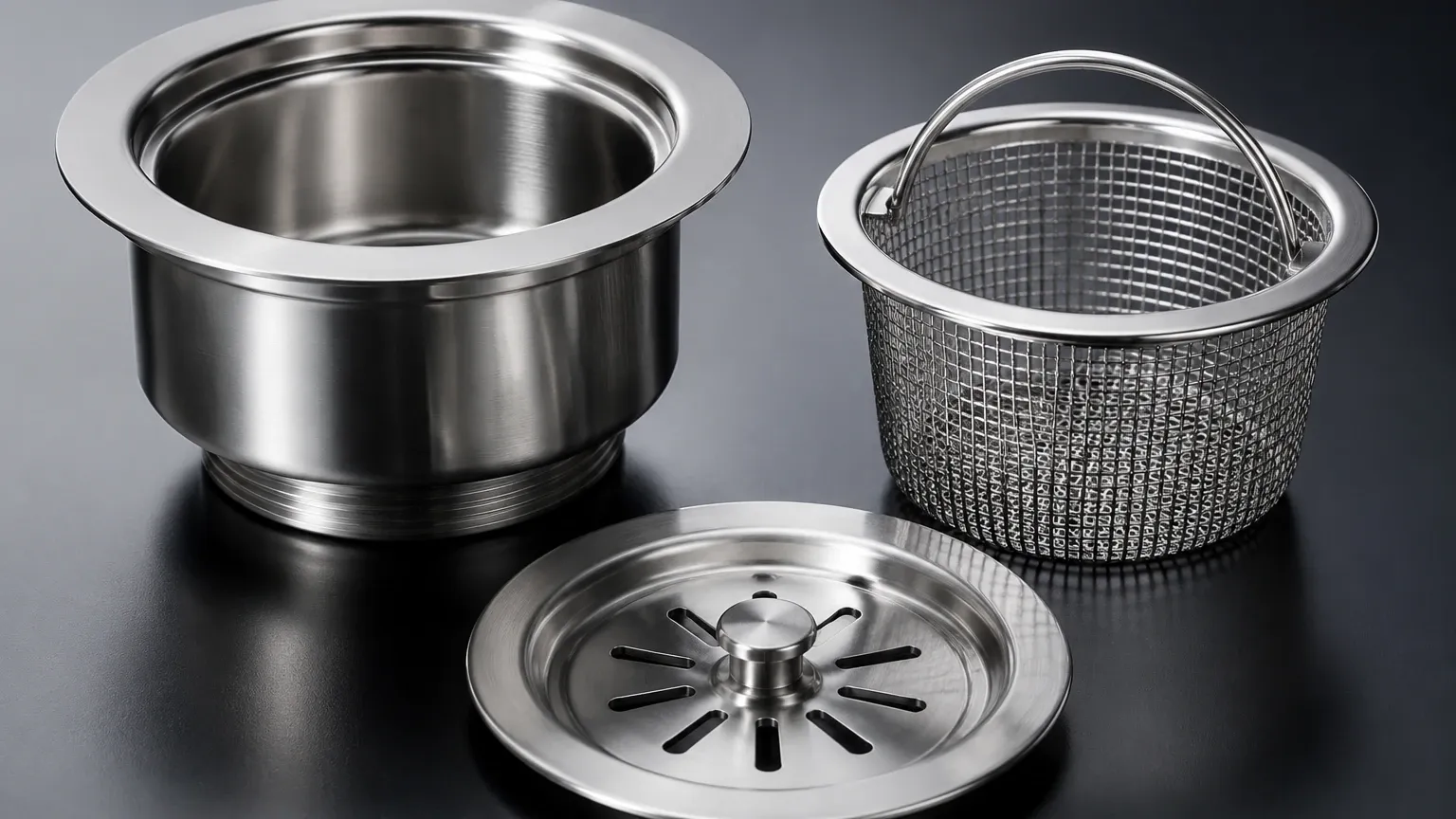
* Reinforced Rims: To prevent deformation under the weight of accumulated debris or high-pressure flow, the top rim of the basket is typically reinforced with a solid stainless steel ring.
* Handle Integration: For B2B applications, ease of maintenance is paramount. Baskets are equipped with heavy-duty handles (often drop-down or fixed bridge styles) that allow facility staff to remove, empty, and replace the strainer quickly, even when wearing protective gloves.
* Dual-Stage Filtration: Some advanced designs incorporate a perforated outer basket for structural strength and a fine wire mesh inner liner for precise particulate capture. This allows the strainer to capture fine sediments while maintaining the rigidity needed for high-volume drainage.
* Tapered Geometry: A slightly tapered basket design facilitates easier removal from the housing or drain body, reducing the risk of the basket becoming wedged due to thermal expansion or debris buildup.
Technical Evaluation Criteria for Procurement
For purchasing teams and engineers, evaluating a basket strainer bathtub supplier requires looking beyond the initial unit cost. The total cost of ownership (TCO) is influenced by the component's longevity and the frequency of replacement. Key technical specifications to confirm before procurement include:
1. Micron Rating or Mesh Count: Determine the size of the smallest particle that must be captured. For drainage, this is often expressed in inches or millimeters of perforation, but for fine filtration, a mesh count (wires per linear inch) is used.
2. Chemical Compatibility: Ensure the stainless steel grade and any gasket materials (such as EPDM, Viton, or PTFE) are compatible with the fluids and cleaning agents used in the facility.
3. Load Bearing Capacity: In floor-level drainage or industrial sumps, the strainer and its cover must be rated for the expected traffic, whether it is pedestrian or heavy machinery.
4. Regulatory Compliance: Confirm that the components meet relevant standards, such as NSF/ANSI for food safety or specific building codes for commercial plumbing.
Maintenance and Longevity in Demanding Environments
The durability of a basket strainer bathtub is heavily dependent on a structured maintenance regimen. In industrial settings, the buildup of bio-films, mineral scale, or industrial byproducts can lead to "blinding" of the mesh—a condition where the openings are completely obstructed.
Regular cleaning protocols should involve:
* Visual Inspections: Checking for signs of mechanical wear, such as broken wires in the mesh or cracked welds.
* Ultrasonic Cleaning: For fine mesh baskets used in pharmaceutical or high-precision industrial applications, ultrasonic cleaning can remove microscopic particles that manual scrubbing cannot reach.
* Passivation Treatments: Periodic chemical passivation can restore the protective oxide layer on stainless steel components that have been exposed to harsh environments, significantly extending their service life.
By selecting a high-quality stainless steel basket, facilities can avoid the common risks associated with inferior products, such as sudden drainage failure, downstream blockages, and the need for frequent, costly replacements.
Customization and OEM Solutions for Filtration
Every industrial facility has unique drainage requirements based on its floor plan, fluid volume, and the nature of the waste produced. Standard off-the-shelf solutions often fail to meet the specific needs of complex systems. This is where custom manufacturing and OEM capabilities become essential.
Customization options for a basket strainer bathtub may include:
* Bespoke Dimensions: Tailoring the diameter, depth, and flange configuration to fit existing non-standard drainage housings.
* Variable Perforation Patterns: Engineering specific hole sizes and spacings to optimize the balance between flow rate and filtration accuracy.
* Specialized Coatings: Applying PTFE or other non-stick coatings to the basket to prevent the adhesion of sticky or oily residues.
* Integrated Sensors: For automated facilities, baskets can be designed to work with differential pressure sensors that alert maintenance teams when a cleaning cycle is required.
Working with a manufacturer that understands the nuances of industrial filtration ensures that the resulting components provide reliable, long-term performance in demanding environments. When engineers specify Strainers & Baskets, they are investing in the protection of their entire fluid handling infrastructure.
In conclusion, while the term basket strainer bathtub may originate from commercial plumbing, its implementation in B2B and industrial contexts requires a rigorous technical approach. By focusing on high-grade materials, optimized flow dynamics, and precise manufacturing standards, facility managers can ensure efficient drainage and robust protection for their downstream systems.
