


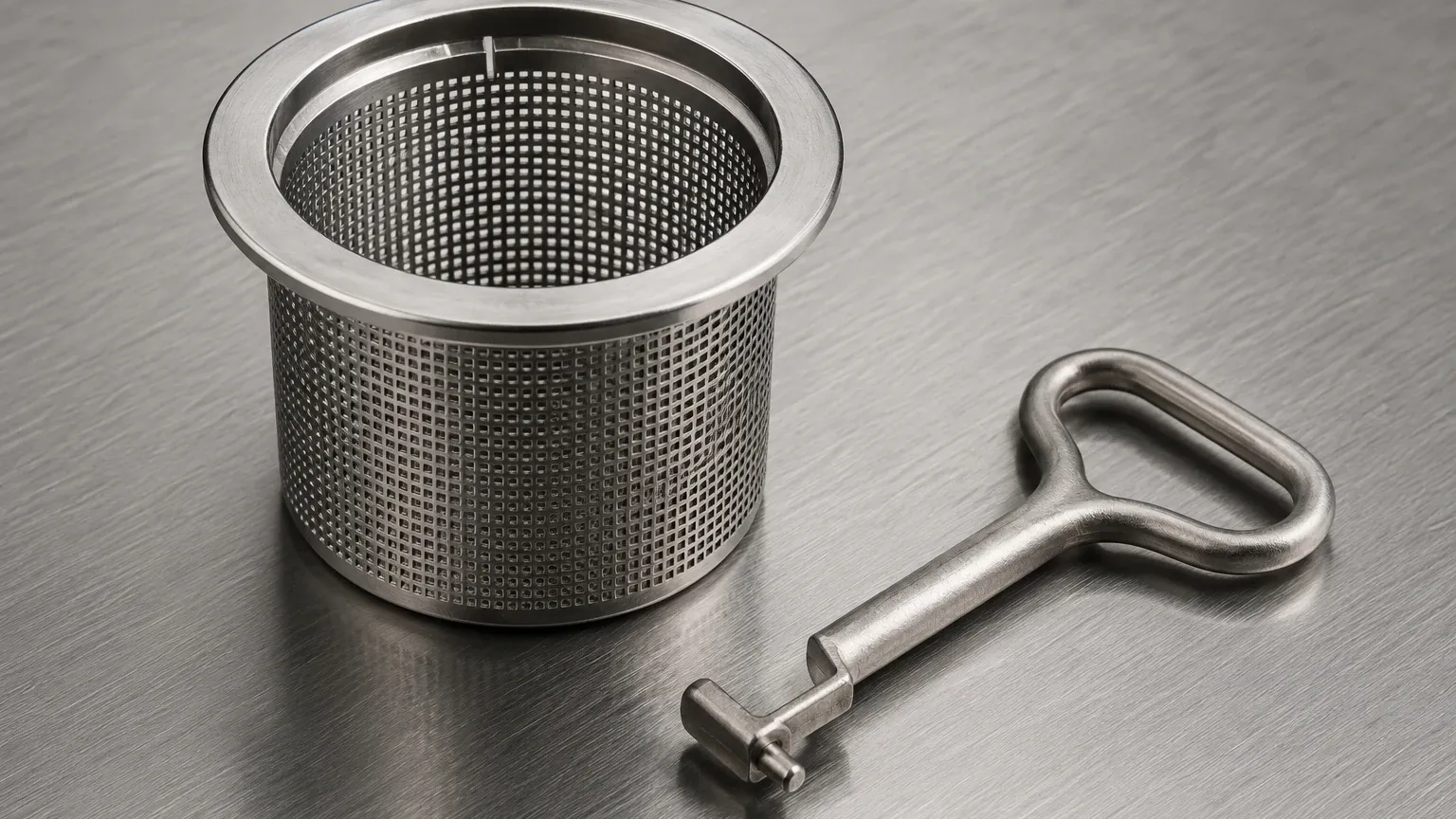
Basket Strainer Key
In industrial fluid management, the efficiency of a piping system often depends on the reliability of its protection components. Among these, the basket strainer stands as a primary line of defense, capturing solid contaminants that could otherwise damage pumps, valves, and heat exchangers. When engineers discuss a "basket strainer key," they are typically referring to two distinct but equally important concepts: the physical tools required for maintenance access and the critical engineering parameters that serve as the "key" to optimal filtration performance.
For technical professionals and procurement teams, understanding these keys is essential for ensuring system uptime and minimizing the total cost of ownership. This guide examines the technical specifications, maintenance requirements, and selection criteria for Strainers & Baskets in demanding industrial environments.
The Physical Basket Strainer Key: Maintenance and Access
In heavy-duty industrial applications, basket strainers are designed to handle high flow rates and significant debris loads. Unlike smaller Y-strainers, basket strainers feature a larger storage capacity, which necessitates a larger housing and cover. The physical "key" or tool used to access the internal basket is a vital part of the operational workflow.
Cover Closure Mechanisms
Depending on the pressure rating and the frequency of cleaning required, different closure types are employed. Each requires a specific approach or tool for access:
1. Bolted Covers: These are standard for high-pressure applications. A torque wrench or specialized socket key is required to ensure the cover is sealed according to manufacturer specifications. Engineers must confirm the torque requirements to prevent gasket deformation or bypass leakage.
2. Swing Bolt Closures: These allow for faster access without removing the bolts entirely from the housing. While often designed for hand-tightening, a basket strainer key or wrench may be used to provide the final leverage needed for a high-pressure seal.
3. Quick-Opening Covers: Some modern designs utilize a T-bolt or a hand-knob system that requires no external tools. However, in high-viscosity or high-temperature applications, a specialized spanner key may still be provided to assist in breaking the seal after long periods of operation.
Selecting the right closure method is a key decision during the design phase. If a process requires frequent cleaning (e.g., more than once per shift), a tool-less or quick-access design is often preferred to reduce downtime.
Engineering Keys: Critical Design Parameters
Beyond the physical tools, the success of a filtration installation relies on several "key" engineering factors. These parameters dictate how the strainer will behave under load and how effectively it will protect downstream equipment.
The Open Area Ratio (OAR)
One of the most critical metrics in strainer design is the Open Area Ratio. This is the ratio of the total open area of the basket (the sum of all the holes or mesh openings) to the internal cross-sectional area of the inlet pipe.
* Standard OAR: Most industrial strainers aim for an OAR of 6:1 or 8:1.
* High-Solid Loads: In systems with high levels of particulate matter, a higher OAR is required to prevent the basket from clogging too quickly, which would lead to frequent maintenance intervals.
* Pressure Drop Implications: A low OAR results in a higher initial pressure drop (clean differential pressure). If the OAR is too low, the system may reach its maximum allowable pressure drop shortly after being put into service.
Material Selection and Compatibility
In industries such as chemical processing or pharmaceutical manufacturing, the material of the strainer and its internal basket is a key determinant of longevity. Kaifil specializes in stainless steel solutions, typically utilizing Grade 304 or 316L.
* Grade 304 Stainless Steel: Suitable for general industrial use, water treatment, and food-grade applications where corrosion risk is moderate.
* Grade 316L Stainless Steel: Preferred for marine environments, acidic chemical processing, and applications involving high chlorides. The "L" (low carbon) designation is crucial for components that require welding, as it prevents carbide precipitation and maintains corrosion resistance at the weld joints.
* Specialty Alloys: For highly aggressive media, alloys like Hastelloy or Monel may be required, though stainless steel remains the industry standard for the majority of Strainers & Baskets due to its balance of cost and performance.
Filtration Accuracy: Mesh vs. Perforation
The "key" to effective particle removal is the configuration of the basket media. This is generally divided into two categories: perforated metal and wire mesh linings.
Perforated Baskets
Perforated baskets serve as the structural foundation. They are manufactured by punching holes into a metal sheet. Common hole sizes range from 1/32" to 1/2". Perforated baskets are excellent for removing large debris like scale, stones, or welding slag. However, they are limited in their ability to capture fine particulates.
Mesh-Lined Baskets
When finer filtration is required, a wire mesh liner is added to the interior or exterior of the perforated basket. The perforated metal provides the mechanical strength to withstand the differential pressure, while the mesh provides the filtration accuracy.
* Micron Ratings: Mesh can be woven to provide filtration down to 5 microns or even finer.
* Durability: In high-flow applications, the mesh must be securely bonded or welded to the perforated support to prevent "fluttering" or fatigue failure.
Operational Performance: Managing Pressure Drop
For any engineer, the pressure drop (ΔP) across the strainer is a key performance indicator. A basket strainer is essentially a controlled restriction in the pipeline. As the basket collects debris, the available open area decreases, and the pressure drop increases.
Monitoring the "Key" Differential
Installing differential pressure gauges across the inlet and outlet of the strainer is standard practice.
1. Clean ΔP: The pressure drop when the basket is new or freshly cleaned. Ideally, this should not exceed 2 psi (0.14 bar).
2. Dirty ΔP: The pressure drop at which the basket must be cleaned. Usually, this is set between 5 and 10 psi.
3. Terminal ΔP: The point at which the structural integrity of the basket may be compromised. If the pressure differential becomes too high, the basket may collapse, sending all collected debris downstream—a catastrophic failure for pumps and valves.
Customization and OEM Integration
In many industrial OEM projects, a standard off-the-shelf strainer may not meet the spatial or performance requirements of the system. Customization is a key service provided by manufacturers like Kaifil.
Custom Dimensions and Connections
Engineers often face tight footprints in skid-mounted systems. Customizing the face-to-face dimensions or the orientation of the inlet/outlet (e.g., offset or angled) can be the key to fitting a high-capacity strainer into a compact space. Furthermore, connection types—whether ANSI flanges, NPT threads, or hygienic tri-clamp fittings—must be specified to match existing piping standards.
Structural Reinforcements
For high-viscosity fluids or systems prone to pressure surges (water hammer), the basket may require additional reinforcement. This can include heavier gauge perforated metal, longitudinal support ribs, or reinforced top rings to ensure the basket seats perfectly within the housing, preventing bypass.
The Role of Basket Strainers in Specific Industries
The requirements for a basket strainer key and its associated hardware vary significantly by sector:
* Food and Beverage: The key focus here is hygiene. Strainers must have polished surfaces (Ra < 0.8 µm) and be free of crevices where bacteria can grow. Quick-release covers are essential for daily cleaning cycles.
* Chemical Processing: Chemical compatibility and pressure ratings are the primary keys. The use of PTFE or Viton gaskets alongside 316L stainless steel is common.
* Water Treatment: In large-scale municipal or industrial water intake, the key is high-volume capacity and the ability to handle varying debris loads without constant manual intervention.
Conclusion: Selecting the Right Solution
Identifying the correct basket strainer key—whether it is the physical tool for the maintenance team or the engineering specifications for the design team—is fundamental to industrial process efficiency. By focusing on the open area ratio, material compatibility, and appropriate filtration media, engineers can ensure that their Strainers & Baskets provide reliable protection for years of service.
When evaluating suppliers, it is important to confirm their capability to provide detailed technical documentation, including pressure drop curves and material certifications (MTRs). As a professional manufacturer, Kaifil provides the engineering expertise and manufacturing precision necessary to develop customized filtration solutions that meet the rigorous demands of modern industry. Whether you require a standard simplex strainer or a complex custom-engineered basket, focusing on these key factors will lead to a more robust and cost-effective system.
