


Basket Strainer vs Cartridge Filter
In industrial fluid handling systems, the selection between a basket strainer and a cartridge filter is a fundamental engineering decision that directly impacts system longevity, operational costs, and product purity. While both components serve the primary function of removing solid contaminants from a liquid stream, they operate on different mechanical principles and are designed for distinct stages of the filtration process.
Understanding the nuances of basket strainer vs cartridge filter performance is essential for engineers and procurement teams in sectors such as chemical processing, water treatment, and food production. Choosing the wrong technology can lead to frequent downtime, premature equipment failure, or insufficient filtration accuracy. This guide provides a technical breakdown of these two solutions to help professionals make informed selection decisions based on specific application requirements.
Defining the Core Technologies
Before comparing performance metrics, it is necessary to define the structural and functional characteristics of each device.
What is a Basket Strainer?
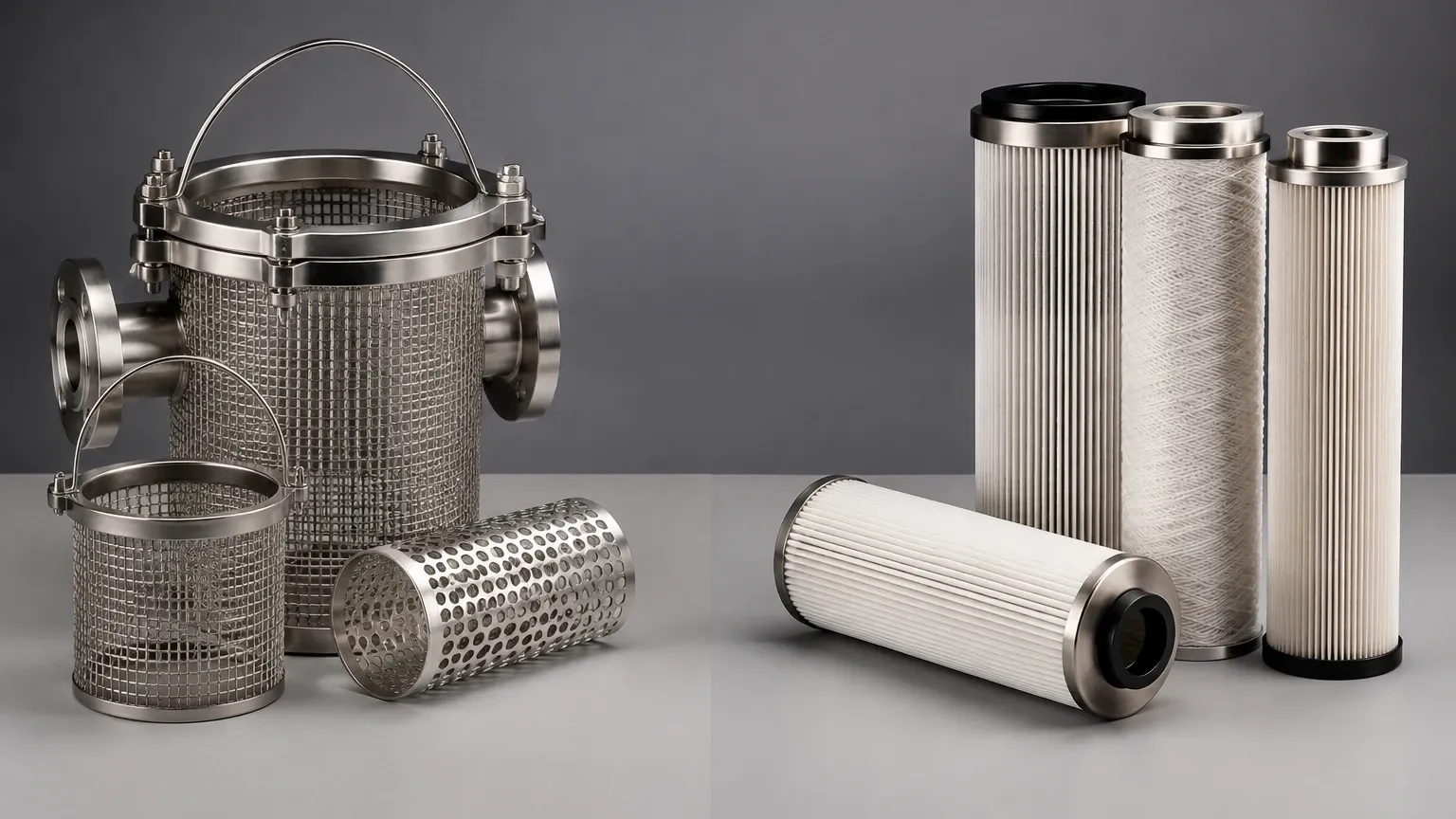
A basket strainer is a closed vessel with a cleanable, removable screen or basket that traps particulate matter. It is typically installed in piping systems to protect downstream equipment—such as pumps, valves, and flow meters—from damage caused by pipe scale, welding slag, or other large debris.
In many heavy-duty industrial environments, Strainers & Baskets are constructed from stainless steel (304 or 316) to provide corrosion resistance and structural integrity under high pressure. The filtration medium is usually a perforated metal sheet or a fine wire mesh. Because the basket is reusable, the primary operational cost is the labor required for periodic cleaning.
What is a Cartridge Filter?
Cartridge filters are modular filtration components that utilize either depth filtration or surface filtration to remove fine particles. They are housed within a pressure vessel and are generally designed to be disposable, although some high-end stainless steel cartridges can be cleaned via ultrasonic baths or backwashing.
Cartridge filters typically offer much higher surface areas than strainers, often through pleated designs. They are employed when the objective is "polishing" a fluid—removing sub-micron or low-micron particles that a standard strainer would allow to pass through.
Technical Comparison: Basket Strainer vs Cartridge Filter
When evaluating these two options, engineers must look beyond the initial purchase price and analyze technical performance indicators such as micron rating, solids loading capacity, and pressure drop.
1. Filtration Accuracy and Micron Ratings
The most significant differentiator is the size of the particles each can effectively remove.
* Basket Strainers: Generally used for coarse filtration. While custom wire mesh can achieve ratings down to 40 or 50 microns, strainers are most efficient in the range of 75 microns to several millimeters. They are designed for "macro-filtration."
* Cartridge Filters: These are the standard for fine filtration. They can achieve absolute ratings as low as 0.1 microns. If your process requires the removal of bacteria, fine silt, or microscopic chemical precipitates, a cartridge filter is the necessary choice.
2. Solids Loading and Flow Capacity
Solids loading refers to the amount of contaminant a filter can hold before the pressure drop becomes unacceptable.
* Basket Strainers: Designed for high-flow applications with relatively high concentrations of large solids. The open area of a basket is typically much larger than the cross-section of the pipe, allowing for significant debris accumulation without a rapid increase in differential pressure.
* Cartridge Filters: While pleated cartridges offer high surface area, they are generally intended for fluids with low concentrations of solids (typically less than 0.01% by weight). If used in a high-solids environment without pre-filtration, cartridges will clog rapidly, leading to frequent and expensive replacements.
3. Pressure Drop (Delta P)
Every filtration component introduces a restriction to the flow, resulting in a pressure drop.
* Basket Strainers: Typically exhibit a lower initial pressure drop because the mesh or perforated media offers less resistance than the dense matrices found in cartridge filters.
* Cartridge Filters: Due to the tight pore structure required for fine filtration, the clean pressure drop is higher. As the filter loads with fine particles, this pressure drop increases exponentially, signaling the need for a change-out.
Maintenance and Operational Considerations
For maintenance teams, the choice between basket strainer vs cartridge filter is often a question of labor versus consumable costs.
Cleaning vs. Replacement
A standard basket strainer is a permanent asset. When the pressure gauge indicates a high differential, the system is bypassed or shut down, the basket is removed, rinsed or scrubbed, and reinstalled. This makes strainers an environmentally friendly and cost-effective choice for long-term operations where large debris is common.
In contrast, most cartridge filters are consumables. Once they reach their terminal pressure drop, they are discarded and replaced with new units. This creates a recurring operational expense (OpEx) and generates a waste stream. However, the replacement process is often faster than cleaning a large, heavy strainer basket, which can reduce labor time during maintenance windows.
Total Cost of Ownership (TCO)
* Initial Capital Expenditure (CapEx): Strainers and their housings are often more robust and may have a higher initial cost than simple plastic cartridge housings. However, stainless steel cartridge housings for industrial use are comparable in price to strainer housings.
* Ongoing Expenses: The TCO for a basket strainer is primarily labor-based. The TCO for a cartridge filter includes the cost of the replacement cartridges, shipping, storage, and disposal of used units. In high-load applications, the cost of replacement cartridges can exceed the initial housing cost within the first year of operation.
Engineering Selection Criteria
To determine the appropriate solution, engineers should follow a systematic evaluation process based on the following criteria:
Nature of the Contaminant
If the contaminants are hard, large, or fibrous (such as metal chips, scale, or plastic shards), a basket strainer is the correct choice. If the contaminants are soft, gelatinous, or microscopic (such as algae, fine carbon dust, or chemical residues), a cartridge filter is required.
Downstream Sensitivity
What are you protecting? If you are protecting a centrifugal pump, a 40-mesh basket strainer is usually sufficient to prevent impeller damage. However, if you are protecting a high-pressure spray nozzle with a 100-micron orifice, or a reverse osmosis membrane, a 5-micron cartridge filter is mandatory to prevent clogging and fouling.
Continuous vs. Batch Processing
In continuous processes where downtime is not permitted, duplex configurations are used for both strainers and cartridge filters. A duplex system allows flow to be diverted to a secondary housing while the first is being cleaned or replaced. Because basket strainers generally require more manual cleaning time, the ergonomic design of the basket removal mechanism is a critical factor for operators.
The Role of Material Selection: Why Stainless Steel?
In industrial B2B environments, material compatibility is non-negotiable. Kaifil specializes in stainless steel filtration solutions because of the material's versatility. Whether choosing a basket or a cartridge, stainless steel (304, 316, or 316L) offers:
1. Thermal Stability: Unlike plastic cartridges, stainless steel components can withstand temperatures exceeding 500°F (depending on seals and gaskets).
2. Chemical Resistance: Essential for chemical processing and pharmaceutical applications where corrosive fluids would degrade polymer-based filters.
3. Sanitary Standards: In the food and beverage industry, stainless steel is required for its ability to be sterilized and its resistance to bacterial growth.
4. Structural Strength: High-pressure hydraulic systems require the collapse-resistance that only metal media can provide.
Common Risks and Mitigation
One of the most common mistakes in system design is using a cartridge filter as a primary catch-all for large debris. This leads to "blinding" the filter surface, causing the system to reach terminal pressure in hours rather than weeks.
The Hybrid Approach: In many optimized industrial systems, the basket strainer and cartridge filter are used in series. The basket strainer acts as a pre-filter, removing 90% of the solids by mass (the large particles), while the cartridge filter performs the final polish to achieve the required purity. This configuration extends the life of the expensive cartridges and ensures the highest level of equipment protection.
Conclusion: Making the Final Decision
When deciding between a basket strainer vs cartridge filter, the decision-maker must balance the need for filtration fineness against the reality of maintenance frequency and operational budget.
* Choose a Basket Strainer if you need to protect pumps and valves from large debris, require a reusable/washable solution, and have a high solids load.
* Choose a Cartridge Filter if you need high-purity fluid, have a low solids load, or need to remove particles smaller than 40 microns.
For engineers looking to optimize their filtration stages, confirming the particle size distribution of the fluid and the required flow rate is the first step. By selecting the correct Strainers & Baskets or precision cartridges, facilities can ensure efficient operation, minimize waste, and protect their most valuable mechanical assets. At Kaifil, we provide the technical expertise and custom manufacturing capabilities to develop filtration components tailored to these demanding industrial requirements, ensuring that your selection—whether a strainer or a filter—delivers dependable performance in the field.
