


Basket Strainers Home Depot
In the procurement landscape for industrial filtration, the search for basket strainers home depot often represents a critical junction between immediate maintenance needs and long-term engineering strategy. For facility managers, plant engineers, and procurement specialists, the availability of off-the-shelf components at retail outlets offers a tempting solution for urgent repairs. However, when transitioning from residential or light commercial plumbing to heavy-duty industrial processes, the technical requirements for Strainers & Baskets undergo a significant shift in complexity, material integrity, and performance expectations.
Industrial filtration is not merely about stopping debris; it is about protecting multi-million dollar downstream assets, maintaining flow efficiency, and ensuring the purity of the final product. While retail-grade products serve their intended purpose in domestic settings, industrial environments demand a level of precision and durability that standard consumer hardware cannot provide. This article explores the engineering distinctions, material science, and total cost considerations that separate professional industrial strainers from the products typically found in a general hardware inventory.
The Technical Gap: Industrial Engineering vs. Retail Availability
When evaluating basket strainers home depot options, it is essential to understand the fundamental design differences. Retail basket strainers are primarily designed for gravity-fed or low-pressure drainage systems, such as kitchen sinks or utility basins. Industrial basket strainers, conversely, are pressure-vessel components designed to be integrated into high-velocity pipelines.
Structural Integrity and Pressure Ratings
Industrial systems often operate at pressures exceeding 150 PSI, with some hydraulic or chemical lines reaching much higher. A standard retail strainer is manufactured from thin-gauge metal—often less than 0.5mm thick—which lacks the hoop strength to withstand the mechanical stresses of industrial flow. Industrial baskets are engineered with reinforced rims, heavy-duty longitudinal welds, and often a perforated metal backing to support finer wire mesh. This multi-layered construction prevents the basket from "bursting" or collapsing when it becomes loaded with contaminants, a failure mode that would allow debris to bypass the filter and destroy sensitive components like turbine flow meters or high-pressure pumps.
Open Area Ratio (OAR)
One of the most critical engineering metrics is the Open Area Ratio. This is the ratio of the total open area of the strainer basket to the internal cross-sectional area of the pipe. A high-quality industrial basket typically maintains an OAR of at least 6:1. This ensures that even as the basket collects debris, the pressure drop (ΔP) remains manageable, preventing cavitation in pumps and maintaining system throughput. Retail products rarely specify an OAR, as they are not intended for precision flow control, often leading to restricted flow and increased energy consumption in industrial pumps.
Material Science in Filtration: Beyond Basic Stainless Steel
A primary reason industrial buyers look beyond basket strainers home depot listings is the requirement for specific metallurgical properties. While a retail product might be labeled as "stainless steel," industrial applications require verified alloys that can withstand specific chemical environments.
SS304 vs. SS316 and the Importance of 316L
In industrial chemical processing or marine environments, the difference between SS304 and SS316 is the difference between a component that lasts five years and one that fails in five weeks. SS316 contains molybdenum, which provides superior resistance to chloride-induced pitting and crevice corrosion. Furthermore, for components that require extensive welding—common in custom basket fabrication—SS316L (low carbon) is often specified. The lower carbon content prevents carbide precipitation during the welding process, ensuring that the heat-affected zones remain as corrosion-resistant as the base metal. Kaifil specializes in these high-grade alloys to ensure compatibility with aggressive process fluids.
Chemical Compatibility and Passivation
Industrial strainers undergo rigorous passivation processes to remove free iron from the surface, enhancing the protective oxide layer. In industries like pharmaceuticals or food and beverage, this is a non-negotiable requirement to prevent contamination. Retail strainers are rarely passivated to industrial standards, posing a risk of rust streaks or metallic leaching into the process stream. When sourcing Strainers & Baskets, engineers must verify that the material certificates (MTRs) match the specific requirements of the handled media, a level of documentation unavailable at consumer-grade retail outlets.
Filtration Precision: Understanding Mesh and Micron Ratings
The ability to capture specific particle sizes is the core function of any strainer. A search for basket strainers home depot usually yields products with fixed, coarse perforations designed to stop large food waste or hair. Industrial processes, however, require high-precision filtration.
Wire Mesh vs. Perforated Plate
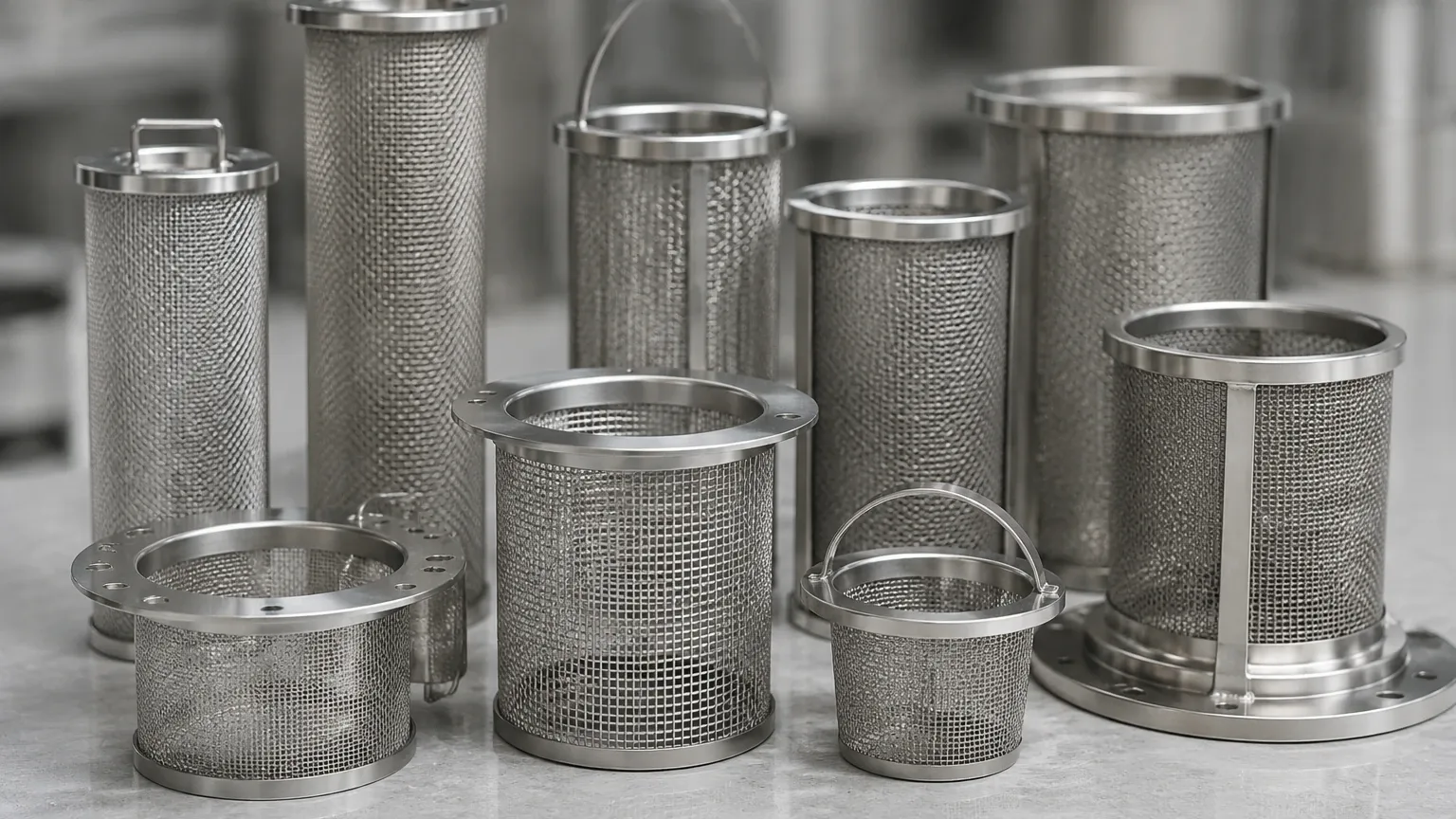
Industrial baskets often utilize a dual-media approach. The outer layer is a heavy-duty perforated plate that provides structural support, while the inner lining is a precision-woven wire mesh. This mesh can be specified in various weave types:
* Plain Weave: Suitable for general-purpose filtration with a high open area.
* Dutch Weave: Provides a much tighter pore structure for fine filtration down to 5-10 microns while maintaining high mechanical strength.
* Twill Weave: Allows for thicker wires in a fine mesh, increasing the durability of the filter surface.
Micron Accuracy and Particle Retention
In applications like ink manufacturing or fine chemical synthesis, allowing a 50-micron particle through a 20-micron spec can ruin an entire batch. Industrial manufacturers provide verified micron ratings and retention efficiencies. Retail strainers do not offer this level of granularity, making them unsuitable for any process where particle size distribution is a critical quality attribute (CQA).
Customization and OEM Integration
One of the most significant limitations of the basket strainers home depot model is the lack of dimensional flexibility. Industrial machinery is rarely standardized to the point where a generic off-the-shelf basket will provide a perfect seal.
Tailored Dimensions for Existing Housings
Many industrial facilities operate legacy equipment where the original manufacturer may no longer exist. In these cases, custom-fabricated baskets are required to fit existing strainer housings. This involves precise measurements of the flange diameter, basket depth, and the type of handle required for extraction. Customization also allows for the inclusion of specialized features such as:
* Magnetic Inserts: Essential for capturing fine ferrous particles in hydraulic systems that mesh alone might miss.
* Conical Bottoms: Designed to increase the collection capacity and improve flow distribution in vertical installations.
* Reinforced Lifting Handles: Engineered to withstand the weight of a fully loaded basket during maintenance, preventing worker injury or dropped loads.
OEM Partnership and Engineering Support
For manufacturers of industrial equipment, sourcing Strainers & Baskets involves a collaborative design phase. This ensures that the filtration component is optimized for the specific flow dynamics of the machine. Kaifil works directly with engineering teams to develop prototypes and production runs that meet exact CAD specifications, providing a level of technical support that a retail transaction cannot offer.
Maintenance, Cleaning, and Total Cost of Ownership (TCO)
From a B2B perspective, the initial purchase price of a component is often the smallest part of its total cost. The search for basket strainers home depot might be motivated by a low sticker price, but the long-term financial impact of using sub-standard filtration can be catastrophic.
Reusability and Cleaning Protocols
Industrial-grade stainless steel baskets are designed as long-term assets. They are built to withstand aggressive cleaning methods, including ultrasonic baths, high-pressure steam (SIP), and chemical CIP (Clean-In-Place) cycles. Because of the high-quality welds and heavy-gauge materials, these baskets can be cleaned and reused hundreds of times without losing their shape or filtration accuracy. Retail strainers, made from thinner materials, often deform or tear during cleaning, leading to frequent replacements and higher long-term costs.
Preventing Downstream Failures
The primary "cost" of a poor strainer is not the strainer itself, but the equipment it protects. If a low-quality basket fails in a cooling water line, the resulting scale or debris can clog a heat exchanger, leading to a thermal excursion and a plant-wide shutdown. The cost of one hour of unplanned downtime in a chemical refinery or a pharmaceutical plant can exceed the cost of a high-quality industrial strainer by a factor of a thousand. Investing in precision-engineered filtration is, in effect, an insurance policy for the entire production line.
Industry-Specific Compliance and Standards
Finally, the regulatory environment of modern industry makes the use of generic hardware nearly impossible in many sectors. When sourcing Strainers & Baskets, compliance with international standards is often a legal or safety requirement.
* Food and Beverage: Requires 3A Sanitary Standards or FDA-compliant materials and finishes (typically a Ra < 32 surface finish) to prevent bacterial growth.
* Pharmaceutical: Demands full traceability of materials and often requires electro-polished finishes to ensure no contaminants can adhere to the metal surface.
* Oil and Gas: May require compliance with ASME Section VIII or specific API standards for pressure-containing components.
Retail outlets like Home Depot do not stock components with the necessary documentation, such as Mill Test Reports (MTRs) or Certificates of Conformance (CoC), which are required for ISO-certified quality management systems.
Conclusion: Prioritizing Engineering Excellence
While the convenience of searching for basket strainers home depot is undeniable for minor household repairs, industrial filtration requires a more rigorous approach. The technical demands of modern manufacturing—ranging from chemical compatibility and pressure resistance to micron-level precision—necessitate a partnership with a specialized manufacturer.
By choosing professional Strainers & Baskets from an expert like Kaifil, procurement teams and engineers ensure they are receiving components designed for the rigors of the industrial environment. This commitment to quality protects critical infrastructure, reduces maintenance overhead, and ensures that the filtration system performs reliably under the most demanding conditions. In the world of B2B filtration, the right component is defined by its engineering specifications, not its retail availability.
