


Strainer Basket Heavy Duty
In industrial fluid handling systems, the reliability of downstream equipment such as pumps, heat exchangers, and sensitive instrumentation depends heavily on the efficiency of the primary filtration stage. A strainer basket heavy duty design is engineered to withstand the rigorous demands of high-pressure environments, high-viscosity fluids, and significant debris loads that would typically cause standard baskets to deform or fail. As a critical component in Strainers & Baskets, these heavy-duty variants provide the structural integrity necessary for continuous industrial operation.
Selecting the right filtration component requires a deep understanding of the mechanical stresses involved. For engineers and procurement teams, the distinction between a standard commercial filter and an industrial-grade heavy-duty basket lies in the material thickness, reinforcement methods, and the precision of the filtration media. This guide examines the technical considerations essential for specifying heavy-duty strainer baskets in demanding industrial applications.
Understanding the Role of Heavy-Duty Strainer Baskets in Industrial Filtration
The primary function of a strainer basket is to remove unwanted solids from a liquid stream. However, in "heavy duty" applications, the basket must do more than just filter; it must act as a structural pressure vessel component. When a basket begins to clog, the differential pressure across the mesh increases. A standard basket might collapse under this pressure, sending both the debris and the damaged filter media into the downstream system, potentially causing catastrophic pump failure.
A strainer basket heavy duty construction is designed to handle a high "burst pressure" or collapse rating. This is achieved through the use of heavier gauge perforated metals and reinforced longitudinal and circumferential welds. These components are common in sectors such as chemical processing, oil and gas, and large-scale water treatment, where system downtime is prohibitively expensive.
Material Engineering and Structural Integrity
Material selection is the foundation of heavy-duty performance. Most industrial applications require stainless steel due to its balance of mechanical strength and chemical resistance.
Stainless Steel Grades
* SS304/304L: The industry standard for general-purpose heavy-duty applications. It offers excellent strength and good corrosion resistance in non-acidic environments.
* SS316/316L: Preferred for marine environments, chemical processing, and pharmaceutical applications. The addition of molybdenum provides superior resistance to chloride-induced pitting and crevice corrosion.
* Specialty Alloys: For extreme environments, materials like Duplex stainless steel or Monel may be used to ensure the basket does not succumb to stress corrosion cracking or high-temperature oxidation.
Construction Techniques
Heavy-duty baskets are rarely made from a single layer of mesh. Instead, they utilize a multi-layered approach. A thick perforated metal plate serves as the "skeleton" or support cage, providing the necessary mechanical strength. The actual filtration media—often a fine stainless steel wire mesh—is then bonded or welded to the interior or exterior of this cage. In a strainer basket heavy duty configuration, the seams are typically TIG (Tungsten Inert Gas) welded rather than spot welded to ensure maximum joint efficiency and longevity under thermal cycling.
Key Technical Specifications for High-Performance Selection
When evaluating Strainers & Baskets for heavy-duty service, engineers must look beyond simple dimensions. Several technical parameters dictate how the basket will perform under load.
Open Area Ratio (OAR)
One of the most critical metrics is the ratio of the open area of the basket to the cross-sectional area of the inlet pipe. A standard strainer might have an OAR of 2:1 or 3:1. However, for heavy-duty applications involving high solids loading, an OAR of 6:1 or even 8:1 is often required. A higher OAR results in a lower initial pressure drop and allows for longer intervals between cleaning cycles, reducing the labor costs associated with maintenance.
Micron Rating and Mesh Selection
The filtration accuracy, measured in microns or mesh count, must be balanced against the flow requirements. In a heavy-duty setup, the wire diameter used in the mesh is often larger than standard to provide better erosion resistance against abrasive particles. Engineers must calculate the "velocity through the mesh" to ensure that the fluid speed does not cause wire thinning or premature fatigue of the filter media.
Pressure Drop (ΔP) Considerations
Every filter introduces a pressure drop into the system. For a strainer basket heavy duty, the design must minimize this drop while maximizing particle retention. Factors influencing ΔP include fluid viscosity, flow rate, and the percentage of the basket that is currently blinded by debris. Heavy-duty designs often incorporate pleated media to increase the surface area within the same footprint, effectively lowering the ΔP.
Operational Challenges and Risk Mitigation
Operating heavy-duty filtration systems involves managing risks that could lead to system failure. Understanding these challenges allows for better specification during the procurement phase.
Media Blindage and Cleaning
In heavy-duty applications, the particles being removed are often sticky or irregular. This can lead to "blindage," where the particles wedge themselves into the mesh openings. A heavy-duty basket must be robust enough to withstand aggressive cleaning methods, such as high-pressure backwashing or ultrasonic cleaning, without losing its dimensional stability.
Flow Surges and Water Hammer
Industrial systems often experience flow surges or "water hammer" effects when valves are opened or closed rapidly. A standard strainer basket might be torn from its seating or crushed by the sudden pressure spike. A strainer basket heavy duty includes reinforced top rings (flanges) and bottom plates to ensure the basket remains seated and intact during these transient events.
Corrosion and Erosion
High-velocity fluids containing abrasive solids can erode the filter media over time. Heavy-duty baskets often feature sacrificial wear plates or thicker leading edges to combat this erosion, extending the service life of the component in harsh environments like mining or sand filtration.
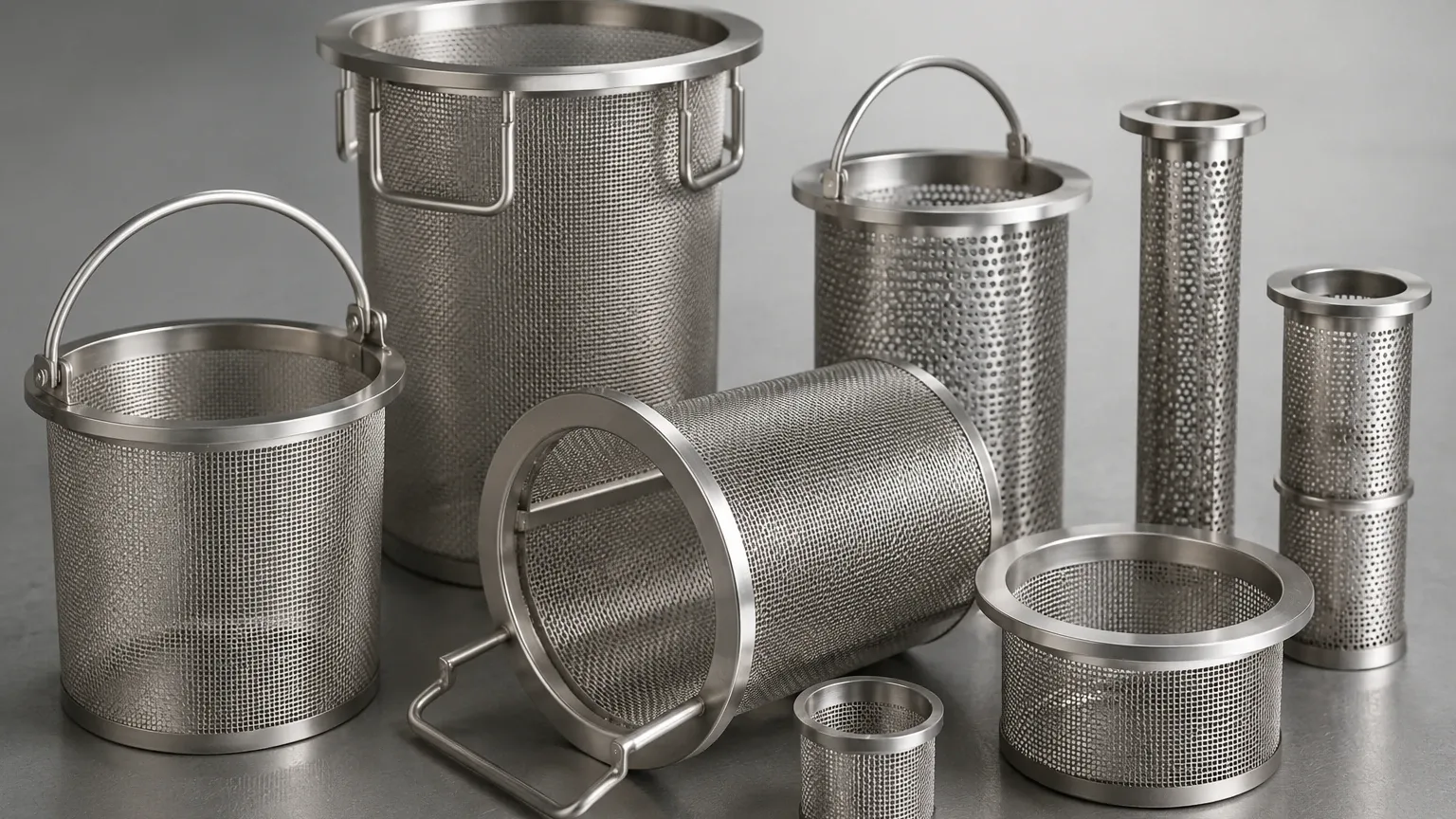
Customization and OEM Integration for Specific Applications
No two industrial processes are identical, which is why customization is a hallmark of heavy-duty filtration solutions. Manufacturers like Kaifil specialize in tailoring these components to meet specific engineering requirements.
Custom Dimensions and Handle Designs
While standard basket sizes exist, many legacy systems or specialized machinery require custom diameters and lengths. Furthermore, the handle design is a functional safety feature. For heavy-duty baskets that may hold several kilograms of debris, heavy-duty lifting bails or dual-handle designs are necessary to ensure operators can safely remove the basket for cleaning.
Gasket and Seal Compatibility
A heavy-duty basket is only as effective as its seal. If fluid bypasses the basket, the filtration is nullified. Custom baskets can be designed with specialized seating surfaces to accommodate O-rings or flat gaskets made from Viton, EPDM, or PTFE, depending on the chemical and temperature requirements of the process.
Support Cages and Internal Baffles
For extremely high-flow applications, internal baffles can be added to the basket to distribute the flow more evenly across the mesh surface. This prevents localized high-velocity zones that could lead to premature wear of the mesh. External support cages can also be added to provide a secondary layer of protection against collapse in high-differential pressure scenarios.
Maintenance Protocols for Industrial Longevity
To maximize the ROI of a strainer basket heavy duty, a structured maintenance program is essential. Unlike disposable filters, these stainless steel components are designed for years of service if handled correctly.
1. Differential Pressure Monitoring: The most effective way to manage a heavy-duty basket is through ΔP gauges. Baskets should be cleaned when the pressure drop reaches a pre-determined limit (typically 5-10 psi over the clean pressure drop) to prevent structural stress.
2. Visual Inspection for Fatigue: During cleaning, baskets should be inspected for signs of "mesh pulling" or broken welds. In heavy-duty service, the vibration of the fluid can cause fatigue at the weld points.
3. Proper Cleaning Agents: When cleaning stainless steel baskets, it is vital to avoid chlorine-based cleaners on 304 or 316 grades, as this can lead to rapid pitting. Using compatible chemical baths ensures the passive oxide layer of the steel remains intact.
4. Spare Parts Strategy: Even the most durable heavy-duty basket will eventually require replacement. Maintaining a stock of custom-sized baskets ensures that a damaged filter does not result in extended facility downtime.
Conclusion: Selecting a Reliable Manufacturing Partner
Specifying a strainer basket heavy duty is a critical decision for any engineer tasked with protecting expensive industrial assets. The complexity of material science, fluid dynamics, and structural engineering involved means that off-the-shelf solutions are often inadequate for high-stakes environments.
By focusing on robust construction, optimized open area ratios, and application-specific materials, organizations can significantly reduce maintenance costs and improve system reliability. For those seeking precision-engineered Strainers & Baskets, partnering with a manufacturer that understands the nuances of heavy-duty industrial filtration is the most effective way to ensure long-term performance. Whether you are dealing with high-viscosity chemicals or high-volume water intake, the right heavy-duty basket is the foundation of a stable and efficient process.
