


Basket Strainers Plumbing
In industrial fluid handling, the term "basket strainers plumbing" refers to the critical integration of debris-removal components within a piping system. Unlike standard residential fittings, industrial basket strainers are engineered to protect expensive downstream equipment—such as pumps, valves, flow meters, and heat exchangers—from damage caused by scale, weld beads, metal shavings, or organic matter.
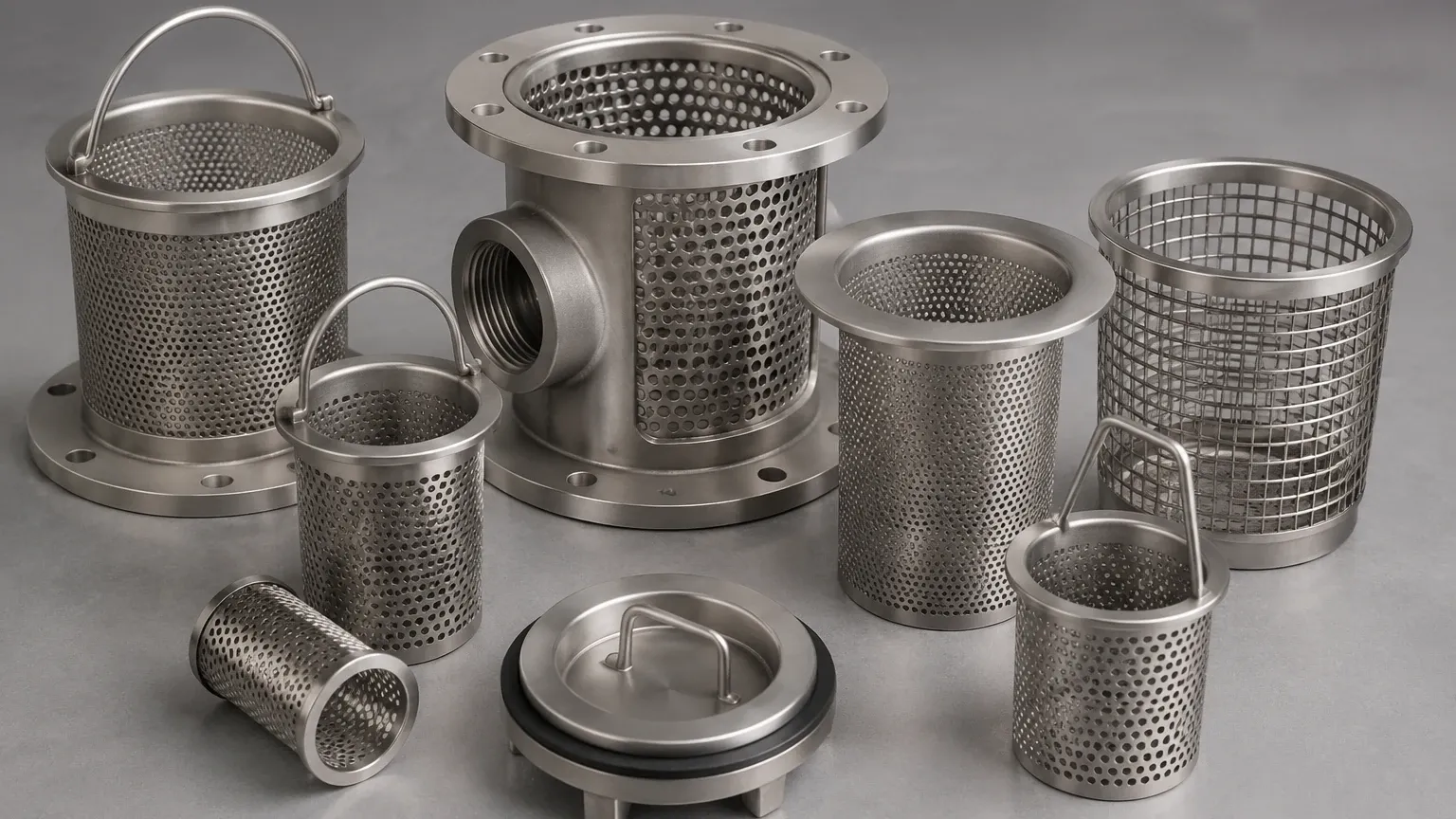
For engineers and procurement professionals, selecting the correct strainer involves more than matching pipe diameters. It requires a deep understanding of fluid dynamics, material compatibility, and the specific mechanical requirements of the process line. As a specialized manufacturer of stainless steel filtration solutions, Kaifil provides high-performance Strainers & Baskets designed to meet these rigorous industrial standards.
The Functional Role of Basket Strainers in Industrial Systems
The primary objective of a basket strainer in a plumbing or piping circuit is the mechanical removal of solids from a flowing liquid. The "basket" design is preferred in many industrial applications because it offers a significantly larger surface area compared to Y-strainers. This increased area results in a lower initial pressure drop and longer intervals between cleaning cycles.
In a typical industrial plumbing setup, the strainer is installed upstream of sensitive components. As the fluid enters the strainer housing, it is directed into a perforated metal or wire mesh basket. The solids are trapped inside the basket while the clean fluid passes through the discharge port. Because the debris is collected within the basket, it can be easily removed and cleaned without the debris falling back into the main pipeline—a common issue with horizontal Y-strainer installations.
Engineering Considerations: Filtration Accuracy and Open Area Ratio
When specifying basket strainers for industrial plumbing, engineers must balance the need for fine filtration with the requirement for high flow rates. Two key metrics define this balance: filtration accuracy (mesh/perforation size) and the Open Area Ratio (OAR).
Filtration Accuracy
Filtration accuracy is determined by the size of the openings in the basket. For coarse filtration, perforated plate baskets are used, with hole diameters typically ranging from 1/32" to 1/2". For finer filtration, a stainless steel wire mesh liner is added to the interior of the perforated basket. This provides the structural integrity of the plate with the precision of the mesh. Selection depends on the smallest particle size that could potentially damage downstream equipment.
Open Area Ratio (OAR)
The OAR is the ratio of the total open area of the strainer basket to the internal cross-sectional area of the inlet pipe. A high OAR (typically 4:1 or higher) is desirable because it ensures that the strainer does not become a bottleneck in the system. A low OAR leads to rapid clogging and high pressure drops, which can cavitate pumps and reduce overall system efficiency. When designing custom solutions, Kaifil engineers calculate the OAR to ensure the longevity of the filtration cycle under specific flow conditions.
Material Selection for Durability and Chemical Resistance
Material choice is perhaps the most critical factor in the longevity of basket strainers in plumbing systems. Industrial environments often involve corrosive fluids, high temperatures, or strict hygiene requirements. Stainless steel is the industry standard for these demanding applications.
* Grade 304 Stainless Steel: This is the standard choice for general-purpose industrial plumbing. It offers excellent strength and good corrosion resistance for water treatment, hydraulic oils, and mild chemical applications.
* Grade 316/316L Stainless Steel: For more aggressive environments, such as chemical processing, marine applications, or pharmaceutical manufacturing, Grade 316 is required. The addition of molybdenum enhances resistance to pitting and crevice corrosion, particularly in chloride-rich environments.
* Gasket and Seal Compatibility: Beyond the metal housing and basket, the seals (O-rings or flat gaskets) must be compatible with the process fluid. Common materials include EPDM, Viton (FKM), and PTFE. Selecting the wrong seal material can lead to bypass leakage or external leaks, compromising the safety of the plumbing system.
Comparing Simplex and Duplex Basket Strainer Configurations
In industrial plumbing design, the decision between a simplex and a duplex strainer depends entirely on whether the process can tolerate downtime for maintenance.
Simplex Basket Strainers
A simplex strainer is used in systems where the flow can be interrupted. When the pressure drop across the basket reaches a predetermined limit (usually indicated by a differential pressure gauge), the system is shut down, the strainer is depressurized, and the basket is removed for cleaning. These are cost-effective solutions for batch processes or systems with redundant piping runs.
Duplex Basket Strainers
In continuous-flow applications—such as cooling water for power plants or fuel lines for industrial burners—shutting down the system is not an option. Duplex strainers consist of two separate strainer chambers connected by a diverting valve. When one basket becomes clogged, the operator switches the flow to the clean chamber without interrupting the process. This allows for "on-the-fly" maintenance and ensures 100% uptime for the plumbing circuit.
Pressure Drop and Flow Dynamics
Every component added to a plumbing system introduces a pressure drop ($ΔP$). For basket strainers, the total pressure drop is the sum of the drop through the housing and the drop through the clean basket. As the basket collects debris, the $ΔP$ increases.
Engineers must ensure that the pump's Total Dynamic Head (TDH) can account for the maximum allowable pressure drop of the strainer. If the $ΔP$ becomes too high, it can lead to:
1. Reduced Flow Rates: Impeding the efficiency of the industrial process.
2. Structural Damage: Excessive pressure can collapse the strainer basket if it is not designed with sufficient structural support.
3. Pump Cavitation: If the strainer is on the suction side of the pump, a high pressure drop can cause the fluid to vaporize, leading to catastrophic pump failure.
Kaifil's manufacturing process emphasizes the precision of the basket fitment within the housing to prevent "bypass"—where fluid escapes around the edges of the basket rather than passing through the filtration media.
Maintenance and Replacement Cycles
Proper maintenance of basket strainers in plumbing systems is essential for operational safety. A common mistake in industrial facilities is waiting for a complete loss of flow before cleaning the strainer.
Monitoring Differential Pressure
The most effective way to manage maintenance is through differential pressure monitoring. By installing gauges upstream and downstream of the strainer, operators can see the exact moment the basket begins to load. Typically, a basket should be cleaned when the pressure drop increases by 5-10 psi over the clean-start pressure.
Cleaning Procedures
Stainless steel baskets are valued for their cleanability. Unlike disposable cartridge filters, a stainless steel basket can be backwashed, ultrasonically cleaned, or manually scrubbed and returned to service. This significantly reduces the total cost of ownership (TCO) over the life of the plumbing system. However, baskets should be inspected during every cleaning cycle for signs of wire fraying, perforated plate fatigue, or seal degradation.
Customization in Industrial Filtration
Standard off-the-shelf strainers often fail to meet the specific needs of specialized OEM equipment. Customization allows engineers to optimize the strainer for unique space constraints, unusual flow rates, or specific filtration targets.
At Kaifil, customization options for Strainers & Baskets include:
* Custom Dimensions: Tailoring the height and diameter of the basket to fit existing housings or restricted spaces.
* Reinforced Structures: Adding internal supports or heavier gauge perforated plate for high-viscosity or high-pressure applications.
* Specialty Connections: Providing flanged, NPT threaded, or sanitary tri-clamp connections to match the existing plumbing infrastructure.
* Multi-Stage Filtration: Designing baskets with multiple layers of mesh to capture a range of particle sizes in a single pass.
Summary for Procurement and Engineering Teams
When evaluating basket strainers for industrial plumbing, the focus should remain on technical performance and long-term reliability. A low-quality strainer may save on initial capital expenditure but will likely lead to higher costs through frequent maintenance, equipment damage, and process downtime.
Key confirmation points before purchase include:
1. Fluid Compatibility: Ensure both the metal grade and the seal material are rated for the process fluid.
2. Flow Rate vs. Pressure Drop: Verify that the strainer's OAR is sufficient for the intended flow.
3. Maintenance Access: Ensure there is enough clearance to remove the basket for cleaning.
4. Structural Integrity: For high-pressure systems, confirm the basket is reinforced to prevent collapse.
By prioritizing these engineering factors and partnering with an experienced manufacturer like Kaifil, industrial facilities can ensure their plumbing systems remain protected and efficient. Whether for water treatment, chemical processing, or food and beverage production, the right basket strainer is a fundamental component of a resilient fluid handling system.
