


Different Types of Strainers
In industrial fluid handling systems, the protection of sensitive downstream equipment—such as pumps, valves, flow meters, and spray nozzles—is paramount. Strainers serve as the primary line of defense, removing coarse particles from liquid or gas streams. Unlike fine filters, which are often designed to remove microscopic contaminants, strainers are typically used to capture larger debris that could cause mechanical failure or process interruptions.
Selecting the correct equipment requires a deep understanding of the different types of strainers available and how their mechanical designs interact with specific flow conditions, pressure requirements, and maintenance schedules. This guide examines the engineering characteristics of various strainer configurations to help technical professionals optimize their filtration systems.
The Fundamental Role of Industrial Strainers
A strainer is a closed vessel with a cleanable screen or basket designed to remove and retain foreign particles. The primary distinction between a strainer and a filter is the size of the particles removed. Strainers generally handle larger particles (measured in mesh sizes or millimeters) and are often reusable after cleaning, whereas filters often target smaller particles (microns) and may involve disposable media.
From a B2B procurement perspective, the choice of strainer impacts the Total Cost of Ownership (TCO). A poorly selected strainer can lead to excessive pressure drops, increased energy costs for pumping, and frequent downtime for cleaning. Conversely, a well-engineered solution ensures long-term system integrity and process efficiency.
Y-Strainers: Versatility for High-Pressure Systems
The Y-strainer is perhaps the most common configuration used in industrial piping. Named for its "Y" shape, it features a straining element positioned at an angle to the main flow path. This design allows the unit to be installed in either horizontal or vertical pipelines, provided the "leg" of the Y points downward to collect debris.
Key Characteristics of Y-Strainers
* Pressure Rating: Y-strainers are often designed to handle significantly higher pressures than other types, making them ideal for steam, high-pressure gas, and liquid applications.
* Compact Footprint: Their streamlined shape allows for installation in tight spaces where larger basket-style units would not fit.
* Blow-off Capability: Many Y-strainers include a plug in the strainer cap that can be replaced with a blow-off valve. This allows the screen to be cleaned without stopping the flow or opening the vessel, provided the debris is not wedged too tightly.
However, Y-strainers have a smaller dirt-holding capacity compared to basket-style units. They are best suited for applications where the concentration of solids is low, or where the system can tolerate the pressure drop associated with a smaller screen surface area.
Basket Strainers: High Capacity and Ease of Maintenance
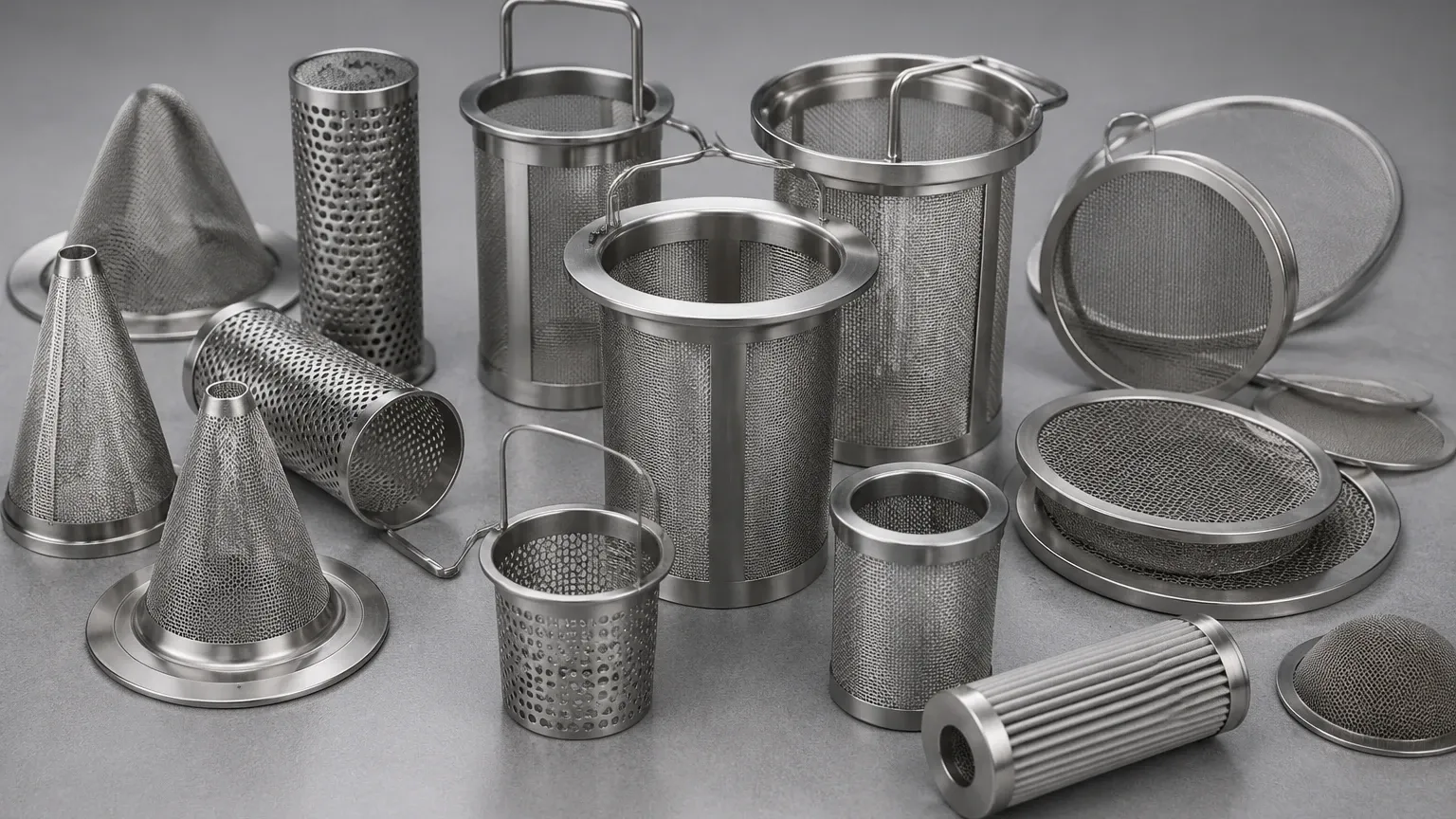
When high flow rates and high dirt-holding capacities are required, engineers typically specify Strainers & Baskets. These units feature a vertical cylinder that houses a removable basket-shaped screen. Because the basket is larger than a Y-strainer screen, it offers a greater surface area, which translates to a lower initial pressure drop and longer intervals between cleanings.
Simplex Basket Strainers
Simplex strainers consist of a single chamber. They are used in processes where the flow can be temporarily shut down to remove and clean the basket. They are common in batch processing or in systems where a bypass line is installed to maintain flow during maintenance.
Duplex (Twin) Basket Strainers
For 24/7 operations where flow cannot be interrupted, duplex strainers are the industry standard. These units consist of two separate strainer chambers connected by a diverter valve. When one basket becomes clogged, the operator shifts the valve to direct flow into the clean chamber. The dirty basket can then be serviced safely while the process continues. This is critical in applications such as chemical processing, cooling water systems, and continuous lubrication lines.
T-Strainers and Temporary Strainers
Beyond the standard Y and basket designs, there are several different types of strainers engineered for specific niche requirements.
T-Strainers (Inline Strainers)
T-strainers feature a "T" shaped body with the straining element perpendicular to the flow. They are often used in larger pipe sizes (6 inches and above) because they are typically lighter and more cost-effective than basket strainers of the same size. T-strainers provide a straight-through flow path, which can result in lower pressure drops in certain high-velocity systems.
Temporary (Conical) Strainers
Temporary strainers, often called "witch’s hats" due to their conical shape, are designed for use during system startup. After a new pipeline is constructed, it often contains welding slag, scale, and other construction debris. A temporary strainer is sandwiched between two pipe flanges to capture this debris during the initial flushing. Once the system is clean, these strainers are usually removed.
Material Selection and Engineering Considerations
The performance of any strainer is heavily dependent on its material construction and the specifications of the internal element. As a specialist in stainless steel filtration, Kaifil emphasizes that the choice of alloy is critical for durability and chemical compatibility.
Stainless Steel 304 vs. 316
* Type 304: Suitable for most general industrial applications, providing excellent strength and basic corrosion resistance.
* Type 316: Contains molybdenum, which provides superior resistance to chlorides and pitting. This is the preferred choice for pharmaceutical, food and beverage, and marine environments.
The Straining Element: Mesh vs. Perforation
The internal element is typically constructed from perforated metal or wire mesh. For coarse straining, perforated plate is sufficient. However, for finer particle removal, a wire mesh lining is added to the perforated support. Engineers must balance the "open area ratio" (the ratio of the total area of the holes to the total area of the screen) to ensure adequate flow without compromising the structural integrity of the basket under high differential pressure.
Critical Selection Criteria for Engineers
When evaluating different types of strainers for a new project or replacement, several technical factors must be confirmed to ensure operational success:
1. Flow Rate and Viscosity: Higher viscosity fluids require larger straining areas to prevent excessive pressure drops. If the fluid is thick, a standard Y-strainer may clog almost instantly.
2. Maximum Allowable Pressure Drop (Delta P): Every strainer introduces a restriction. Engineers must calculate the "clean" pressure drop and determine the "dirty" pressure drop limit at which the system must be cleaned to avoid pump cavitation or pipe failure.
3. Particle Size and Load: What is the smallest particle that must be removed? Selecting a mesh that is too fine will lead to rapid clogging, while a mesh that is too coarse will fail to protect downstream equipment.
4. Operating Temperature and Pressure: The housing material and seal types (O-rings vs. gaskets) must be rated for the maximum system extremes.
5. Customization Requirements: Off-the-shelf strainers may not meet specific flange standards (ANSI, DIN, JIS) or unique space constraints. Custom-engineered baskets can also be designed with reinforced handles, magnetic inserts for capturing ferrous particles, or specialized coatings.
Common Risks and Mitigation
The most common failure point in strainer management is neglecting the differential pressure. If a basket is allowed to fill completely, the pressure can build up until the straining element collapses (bursts), sending all the accumulated debris and shards of the metal screen directly into the downstream equipment.
To mitigate this risk, many industrial systems utilize differential pressure gauges or sensors. These provide a clear visual or electronic signal when the pressure across the strainer reaches a pre-set limit, indicating that maintenance is required. Furthermore, ensuring that the strainer is installed with sufficient clearance for basket removal is a simple but often overlooked engineering detail that significantly impacts maintenance efficiency.
Conclusion
Understanding the different types of strainers is essential for maintaining the reliability of industrial fluid systems. From the compact and high-pressure Y-strainer to the high-capacity duplex basket strainer, each design serves a specific operational purpose. By focusing on material quality—particularly the use of high-grade stainless steel—and precise engineering of the straining elements, facilities can significantly reduce downtime and protect their capital equipment investments.
When selecting a filtration partner, it is vital to work with manufacturers who understand the nuances of custom fabrication. Whether the application requires a standard simplex unit or a highly specialized custom basket, technical expertise in filtration performance and material science remains the foundation of a successful installation.
