


Dish Strainers for Kitchen Sinks
In commercial and industrial food service environments, the management of solid waste within drainage systems is a critical operational requirement. While the term "dish strainers for kitchen sinks" often evokes images of domestic kitchenware, the technical reality for high-volume facilities involves sophisticated Strainers & Baskets engineered to withstand rigorous use, corrosive environments, and high flow rates. For engineers and facility managers, selecting the correct filtration component is not merely a matter of fit, but a strategic decision to protect plumbing infrastructure and ensure compliance with municipal wastewater regulations.
Industrial-grade sink strainers serve as the first line of defense in drainage systems. They are designed to capture food particles, debris, and other solids before they enter the grease trap or the main sewage line. This article examines the technical specifications, material considerations, and engineering variables involved in selecting and implementing high-performance strainers and baskets for commercial kitchen sinks and industrial food processing applications.
Technical Anatomy of Commercial Sink Strainers
The effectiveness of a strainer is determined by its geometry, aperture size, and structural integrity. In a B2B context, these components are often integrated into larger drainage assemblies or used as standalone inserts in heavy-duty prep sinks and pot-washing stations.
Perforated Plate vs. Wire Mesh
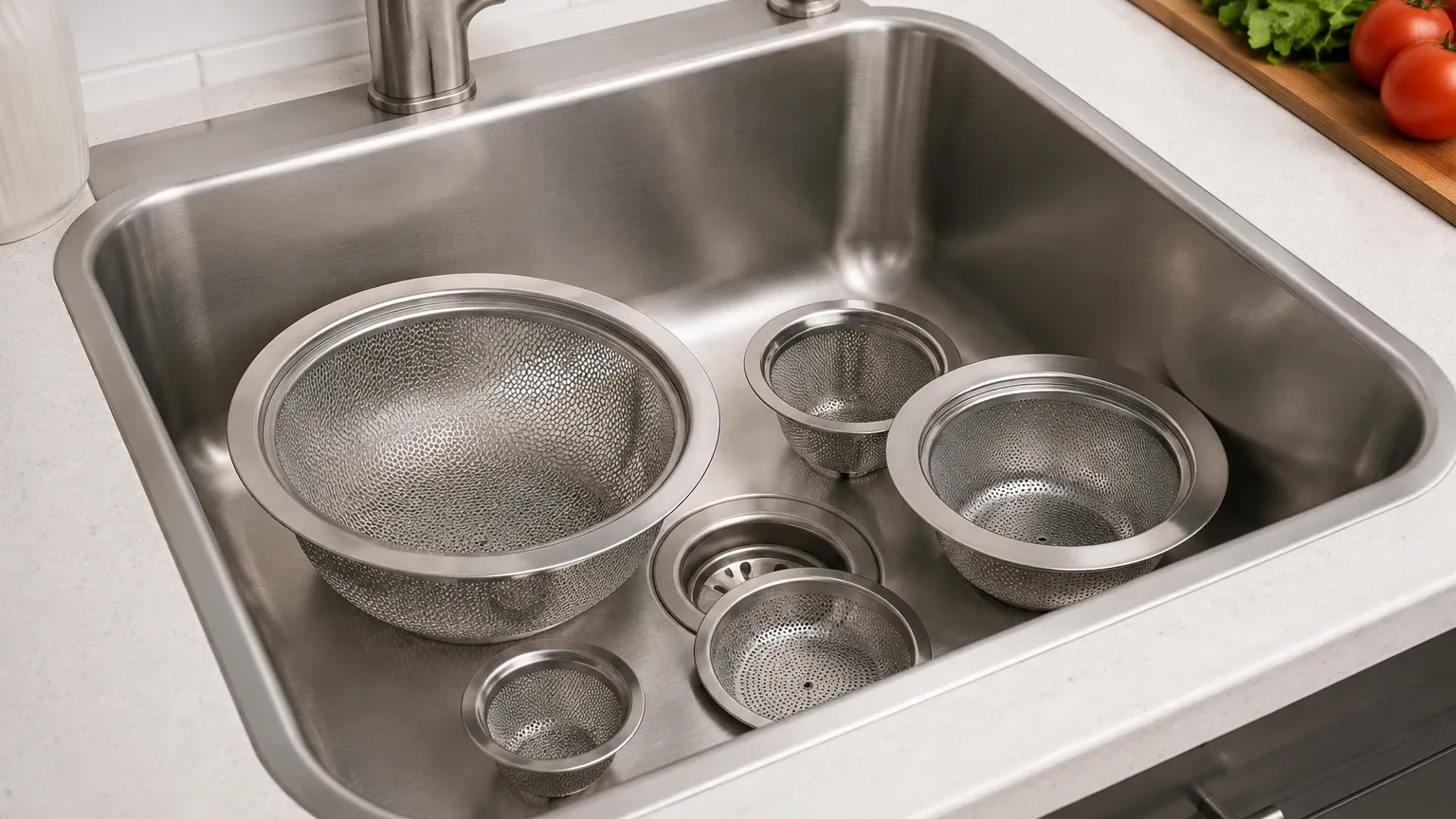
Most industrial dish strainers for kitchen sinks utilize either perforated metal sheets or woven wire mesh.
1. Perforated Plate: This design offers superior structural rigidity. It is typically used in applications where large volumes of heavy debris are expected. The hole patterns (staggered or straight) and the "open area" percentage are critical metrics. A higher open area reduces the risk of drainage backup but may compromise the mechanical strength of the basket if the bridge between holes is too narrow.
2. Woven Wire Mesh: For finer filtration—such as capturing small seeds or fine organic matter—wire mesh is preferred. Stainless steel wire mesh can be manufactured to very specific micron ratings. In many commercial kitchen scenarios, a hybrid design is used, where a wire mesh liner is supported by a perforated metal cage to provide both fine filtration and structural durability.
Flow Rate and Pressure Drop
Engineers must calculate the anticipated flow rate of the sink to ensure the strainer does not become a bottleneck. If the open area of the strainer is insufficient, water will pool in the sink, slowing down operations. Conversely, if the apertures are too large, the strainer fails its primary purpose of protecting the downstream pipes. The goal is to achieve a balance where the "clean" pressure drop is negligible, and the "dirty" pressure drop (as the basket fills) allows for a reasonable maintenance interval.
Material Selection: The Case for Stainless Steel
In the food and beverage industry, material selection is governed by hygiene standards and chemical resistance. Industrial dish strainers for kitchen sinks are almost exclusively manufactured from stainless steel, typically Grade 304 or Grade 316.
Grade 304 Stainless Steel
This is the standard for most commercial kitchen applications. It offers excellent resistance to corrosion from water and common food acids. It is durable, easy to sanitize, and cost-effective for standard drainage components.
Grade 316 Stainless Steel
In environments where high-salinity foods are processed or where aggressive chemical cleaners (such as those containing chlorides) are frequently used, Grade 316 is the preferred specification. The addition of molybdenum in 316 stainless steel provides enhanced resistance to pitting and crevice corrosion, which is essential for the long-term integrity of the strainer in harsh industrial environments.
Surface Finishes
Beyond the alloy choice, the surface finish of the strainer affects its performance. Electropolishing or passivating the stainless steel removes surface impurities and creates a more uniform chromium oxide layer. This not only enhances corrosion resistance but also creates a smoother surface that resists the adhesion of fats, oils, and greases (FOG), making the basket easier to clean during routine maintenance.
Engineering Considerations for Custom Strainers
Off-the-shelf solutions often fail to meet the specific requirements of custom-built industrial sinks or specialized food processing equipment. When specifying custom Strainers & Baskets, several engineering factors must be addressed:
Dimensional Tolerances
A precise fit is mandatory. If a strainer basket is too small for its housing, debris will bypass the filter through the gaps, leading to pipe blockages. If it is too large, it may become wedged, making removal for cleaning difficult and potentially damaging the sink flange. Custom manufacturing allows for tolerances that ensure a "drop-in" fit with minimal bypass.
Load-Bearing Capacity
In industrial pot sinks, a strainer basket may be subjected to the weight of heavy utensils or high-pressure water streams. The handle and the base of the basket must be engineered to withstand these mechanical stresses without deforming. Reinforced rims and heavy-duty handles are common features in B2B-grade products that distinguish them from consumer alternatives.
Filtration Efficiency (Micron Rating)
While a standard kitchen strainer might have 2mm or 3mm perforations, industrial applications may require much finer control. Determining the correct micron rating involves analyzing the typical waste profile of the facility. For example, a bakery might require a finer mesh to capture flour clumps and seeds, whereas a vegetable processing plant might prioritize larger perforations to handle high volumes of soil and peelings.
Operational Impacts: Maintenance and Replacement Cycles
The total cost of ownership (TCO) for drainage components is heavily influenced by their durability and the ease with which they can be maintained. In a high-volume facility, dish strainers for kitchen sinks may be emptied dozens of times per day.
Ease of Cleaning
Baskets designed with rounded internal corners and smooth welds prevent debris from becoming trapped in crevices. This is vital for maintaining sanitary conditions and preventing the growth of bacteria or mold within the drainage system. Engineers should look for designs that allow for rapid debris removal—often referred to as "knock-out" capability—where the contents can be easily dumped into a waste bin without the need for manual scraping.
Durability vs. Disposable Liners
While some facilities use disposable mesh liners, these create ongoing operational costs and environmental waste. A high-quality, permanent stainless steel basket is a more sustainable and cost-effective long-term solution. The replacement cycle for a well-engineered stainless steel strainer should be measured in years, provided it is not subjected to mechanical abuse or incompatible chemicals.
Common Risks in Substandard Strainer Selection
Choosing an inadequate strainer for a commercial application can lead to several systemic failures:
1. Downstream Clogging: If the strainer allows too much solid waste to pass, the facility's grease traps will fill prematurely, or worse, the main sewer lines will clog. This leads to expensive emergency plumbing calls and potential fines from local utilities.
2. Drainage Backups: A poorly designed strainer with a low open-area ratio will cause water to back up into the sink, creating a cross-contamination risk and slowing down the workflow of the kitchen staff.
3. Structural Failure: Thin-gauge metal or plastic strainers often crack or warp under the thermal stress of hot water and the physical weight of industrial kitchen use. A warped strainer allows bypass, defeating the purpose of the component.
4. Regulatory Non-Compliance: Many jurisdictions have specific requirements for the size of solids that can be discharged into the sewer system. Using a non-compliant strainer can result in legal and financial liabilities.
Procurement Guidance: What to Confirm Before Ordering
When purchasing or specifying Strainers & Baskets for industrial or commercial kitchen sinks, procurement teams and engineers should confirm the following data points with their manufacturer:
* Material Certification: Request confirmation of the stainless steel grade (304 or 316) to ensure it matches the environmental requirements of the site.
* Open Area Calculation: Ask for the percentage of open area to ensure the flow rate will meet the sink's discharge capacity.
* Handle and Attachment Strength: Ensure the handle is welded or riveted securely enough to manage the weight of a full basket of wet debris.
* Compatibility with Existing Hardware: Verify the flange diameter, depth, and taper to ensure a perfect fit with the existing sink drain assembly.
* Customization Options: If standard sizes do not fit, inquire about the manufacturer's ability to produce custom dimensions or specialized mesh/perforation combinations.
Conclusion
In the context of industrial filtration and commercial kitchen management, dish strainers for kitchen sinks are essential engineering components that protect infrastructure and maintain operational hygiene. By focusing on high-quality materials like stainless steel and considering technical factors such as flow rates, micron ratings, and structural durability, facilities can significantly reduce maintenance costs and prevent drainage failures. Whether for a large-scale food processing plant or a high-traffic commercial kitchen, the selection of robust Strainers & Baskets is a fundamental step in efficient waste management and system protection.
