


Elastic Top Strainers
In the landscape of industrial fluid handling, the efficiency of a filtration system is often determined by the compatibility and reliability of its primary separation components. Elastic top strainers represent a specialized segment of filtration media designed for rapid deployment, secure fitment, and effective particulate removal across various liquid processing applications. Unlike rigid filtration units, these components utilize a flexible, elasticized opening to conform to the rims of drums, pails, or specialized housing units, providing a versatile solution for batch processing and point-of-use filtration.
For engineers and procurement professionals, selecting the appropriate strainer involves a deep dive into material science, mesh geometry, and mechanical durability. This guide examines the technical specifications of elastic top strainers and their role within the broader category of Strainers & Baskets, focusing on the engineering considerations necessary to optimize industrial filtration performance.
Understanding the Mechanics of Elastic Top Filtration
The fundamental design of an elastic top strainer centers on its interface. The elastic band integrated into the top perimeter serves two primary functions: it provides a friction-based seal against the mounting surface and allows for tool-free installation and removal. This is particularly critical in environments where frequent media changes are required to prevent cross-contamination or where the filtration process occurs in open-head containers.
From an engineering perspective, the "elasticity" must be balanced with chemical and thermal resistance. In industrial settings, the elastic component is often encased in a protective shroud of the same material as the filter body—typically polyester, nylon, or a specialized polymer—to ensure that the entire unit maintains integrity when exposed to aggressive solvents or high-temperature fluids. The tension provided by the elastic must be sufficient to support the weight of the filter cake as it builds up, preventing the strainer from slipping into the vessel under the weight of the retained solids.
Material Science and Chemical Compatibility
Selecting the right material for elastic top strainers is a critical step in ensuring long-term operational success. The choice of material impacts not only the filtration accuracy but also the strainer's ability to withstand the chemical environment of the application.
Synthetic Fiber Options
1. Nylon (Polyamide): Nylon is widely used for its excellent abrasion resistance and high mechanical strength. It is particularly effective in alkaline environments and is common in the filtration of paints, inks, and coatings. However, nylon has limited resistance to concentrated acids and can be prone to moisture absorption, which may affect dimensional stability in certain aqueous applications.
2. Polyester: Polyester offers superior resistance to most organic solvents and mineral acids. It maintains its physical properties at higher temperatures compared to standard nylon and has low moisture regain, making it an ideal choice for precise filtration in chemical processing and pharmaceutical applications.
3. Polypropylene: For applications involving highly aggressive acids or bases, polypropylene is often the material of choice due to its near-universal chemical inertness. It is, however, more sensitive to high temperatures and UV exposure.
Metal Mesh Integration
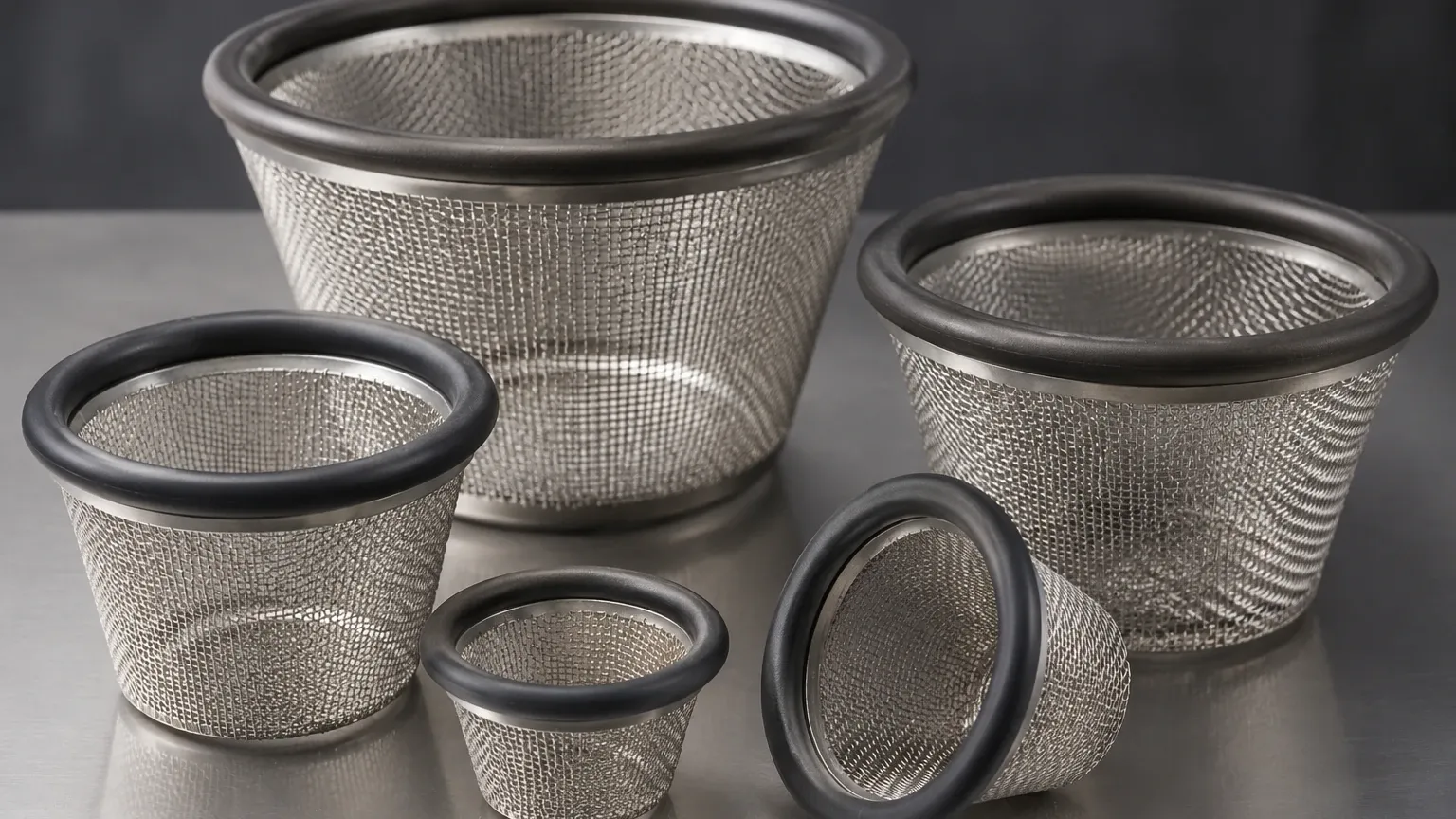
In more demanding industrial scenarios, elastic top strainers may incorporate stainless steel wire mesh components. While the top remains elastic for fitment, the filtration body can be reinforced with precision-woven stainless steel. This hybrid approach leverages the durability of Strainers & Baskets made from SS304 or SS316, providing the heat resistance and structural rigidity required for heavy-duty industrial sludge removal or high-viscosity fluid processing.
Engineering Considerations for Flow and Pressure
One of the most common challenges in industrial filtration is managing the relationship between filtration fineness (micron rating) and the resulting pressure drop (ΔP). When specifying elastic top strainers, engineers must calculate the effective filtration area (EFA) to ensure that the system can maintain the required flow rate without exceeding the mechanical limits of the strainer material.
Micron Ratings and Particle Retention
Elastic top strainers are typically available in micron ratings ranging from 1 micron to over 1500 microns.
* Nominal vs. Absolute: It is essential to distinguish between nominal and absolute ratings. Most elastic top strainers provide nominal filtration, meaning they are designed to retain a high percentage of particles at the specified size but may allow some passage of irregular or deformable solids. For critical applications requiring 99.9% retention, absolute-rated rigid baskets or high-performance filter bags are usually preferred.
* Mesh Geometry: The weave pattern—whether plain, twill, or dutch weave—determines the pore distribution and the mechanical strength of the mesh. A consistent pore size is vital for preventing "bypass," where particles larger than the target micron rating pass through distorted apertures under pressure.
Pressure Drop (ΔP) Management
As solids accumulate on the surface of the strainer, the available flow area decreases, leading to an increase in differential pressure. If the ΔP becomes too high, the elastic top may fail, or the mesh itself may undergo permanent deformation. Engineers should design systems with a maximum allowable ΔP in mind, typically recommending a strainer change-out when the pressure drop reaches 10-15 PSI, depending on the structural integrity of the specific strainer model.
Integration with Industrial Strainers & Baskets
Elastic top strainers often serve as a secondary or lining component within larger Strainers & Baskets systems. In many heavy-duty applications, a rigid stainless steel basket provides the structural support, while the elastic top strainer acts as a disposable or easy-to-clean liner that captures the finer particulates.
This "nested" configuration offers several advantages:
* Extended Equipment Life: The rigid basket is protected from direct contact with abrasive particles, reducing wear and tear.
* Simplified Cleaning: Instead of cleaning a heavy, complex metal basket, operators can simply remove and replace the elastic liner, significantly reducing downtime.
* Multi-Stage Filtration: By using a coarse metal basket with a fine elastic liner, a single filtration housing can achieve two-stage separation, capturing large debris in the basket and fine sediment in the liner.
When using elastic strainers in this manner, it is crucial to ensure that the dimensions of the elastic top are compatible with the flange or rim of the primary basket to prevent fluid bypass around the edges of the liner.
Performance Evaluation and Selection Criteria
To select the most cost-effective and high-performing filtration solution, purchasing teams and engineers should evaluate several key performance indicators (KPIs):
1. Solids Loading Capacity: How much particulate matter can the strainer hold before the flow rate drops below acceptable levels? This is determined by the depth of the strainer and the porosity of the material.
2. Tensile Strength of Seams: The seams are often the weakest point of a flexible strainer. High-quality elastic top strainers utilize ultrasonic welding or reinforced stitching to ensure that the seams do not burst under the weight of the collected material.
3. Thermal Stability: Will the elastic maintain its tension at the operating temperature? Standard elastics may degrade or lose elasticity at temperatures exceeding 80°C (176°F), requiring specialized high-temp elastomers.
4. Regulatory Compliance: For food and beverage or pharmaceutical applications, the materials used (including the elastic and the thread) must comply with FDA or EU food contact regulations.
Maintenance, Cleaning, and Replacement Cycles
The total cost of ownership (TCO) for filtration components is heavily influenced by their lifespan and the ease of maintenance. While many elastic top strainers are designed for single-use to ensure maximum hygiene and prevent cross-batch contamination, certain high-grade synthetic and stainless steel mesh versions can be cleaned and reused.
Cleaning Protocols
For reusable strainers, cleaning methods must be compatible with the material. Synthetic fibers may be sensitive to high-pressure washing, which can distort the mesh pores. Back-flushing or gentle chemical soaking is often recommended. For stainless steel components within the Strainers & Baskets category, ultrasonic cleaning or steam sterilization (SIP) provides a deeper level of decontamination without compromising the structural integrity of the metal.
Monitoring for Failure
Regular inspection of the elastic band is mandatory. Over time, exposure to chemicals and mechanical stretching can lead to "stress relaxation," where the elastic no longer provides a secure seal. If a strainer slips during operation, it can lead to catastrophic pump failure or downstream contamination, making proactive replacement cycles a cornerstone of industrial maintenance programs.
Customization and OEM Solutions
Every industrial process has unique requirements that standard off-the-shelf components may not meet. Customization of elastic top strainers allows for optimized performance in specific environments. Engineering teams often work with manufacturers to specify:
* Custom Dimensions: Tailoring the diameter and depth to fit non-standard vessels or custom-built filtration housings.
* Reinforced Bottoms: Adding extra layers of mesh or cross-stitching at the base of the strainer to handle high-density solids.
* Specialized Elastic Compounds: Utilizing Viton or EPDM-based elastics for superior chemical resistance in harsh environments.
* Dual-Media Designs: Combining different micron ratings or materials within a single strainer to target specific particle size distributions.
By focusing on these technical details, manufacturers like Kaifil provide reliable, precision-engineered solutions that go beyond simple separation. Whether you are managing a high-volume chemical line or a sensitive pharmaceutical batch, the correct implementation of Strainers & Baskets and their associated elastic top components ensures process stability, product purity, and equipment protection.
Conclusion
Elastic top strainers are a vital, albeit often overlooked, component of modern industrial filtration. Their ability to provide a quick, secure, and effective filtration interface makes them indispensable in fast-paced production environments. By understanding the material properties, flow dynamics, and mechanical requirements discussed in this guide, engineers can make informed decisions that enhance filtration efficiency and reduce operational costs. When integrated correctly into a comprehensive filtration strategy involving high-quality metal baskets and housings, these strainers provide a robust defense against contamination and process variability.
