


Filters and Strainers
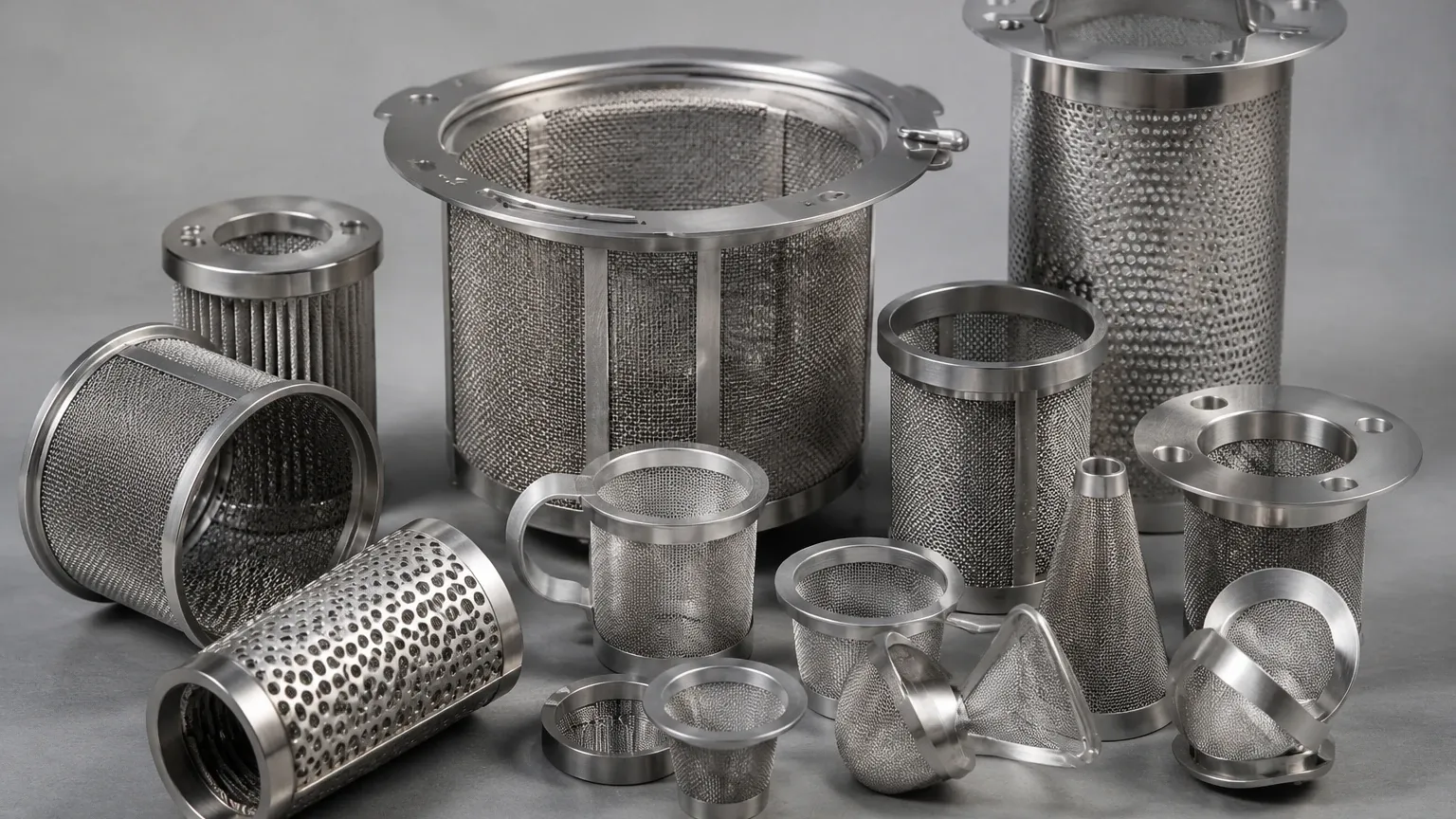
In industrial fluid handling systems, the terms "filters" and "strainers" are often used interchangeably, yet they serve distinct roles in process engineering. Selecting the appropriate component is critical for protecting downstream equipment, ensuring product purity, and maintaining system efficiency. As a specialized manufacturer of stainless steel filtration solutions, Kaifil provides high-performance Strainers & Baskets designed to meet the rigorous demands of chemical processing, food and beverage production, and hydraulic applications. Understanding the technical nuances between filters and strainers is the first step in optimizing any industrial piping system.
Understanding the Functional Differences Between Filters and Strainers
The primary distinction between filters and strainers lies in the size of the particles they are designed to remove and the impact they have on the fluid system. While both are used to separate solids from liquids or gases, their engineering profiles differ significantly.
Particle Size and Micron Ratings
Strainers are generally used to remove larger, coarse particles that are visible to the naked eye. They are typically rated by mesh size or hole diameter (in millimeters or inches). Their primary function is protection—preventing debris like scale, weld beads, or pebbles from damaging pumps, valves, and meters.
Filters, conversely, are designed to remove much finer contaminants, often measured in microns (μm). A filter is typically used for purification or clarification, ensuring that the fluid meets a specific cleanliness standard. While a strainer might remove particles larger than 40 microns, a filter is often tasked with capturing sub-micron particles.
Pressure Drop and Flow Resistance
Because strainers handle larger particles and often utilize a more open mesh or perforated metal structure, they generally exhibit a lower initial pressure drop compared to filters. Filters, with their denser media, create more resistance to flow. In industrial design, the "clean pressure drop" is a vital metric; if the resistance is too high, it can lead to cavitation in pumps or insufficient flow to critical process stages.
Service Life and Reusability
Strainers are almost always designed to be cleaned and reused. The filters and strainers used in heavy-duty industrial settings must be robust enough to withstand high-pressure cleaning or chemical baths. Filters may be either disposable (cartridges) or cleanable (stainless steel mesh), depending on the application. In many systems, a strainer is installed upstream of a filter to extend the filter's service life by removing the bulk of the larger contaminants first.
Key Types of Strainers & Baskets in Industrial Applications
Industrial strainers are categorized by their housing configuration and the specific way they handle flow. Selecting the right geometry is essential for ease of maintenance and system uptime.
Y-Strainers
Named for their shape, Y-strainers are the most common choice for pressurized lines, whether liquid or gas. They are compact and can be installed in either horizontal or vertical positions. However, they have a limited debris-holding capacity compared to basket-style designs, making them ideal for systems with low concentrations of solids.
Basket Strainers (Simplex and Duplex)
Basket strainers feature a larger, vertical chamber that houses a removable basket. This design offers a significantly higher dirt-holding capacity and a lower pressure drop than Y-strainers.
- Simplex Strainers: Used in systems where the flow can be intermittently shut down for cleaning.
- Duplex Strainers: These consist of two separate strainer baskets connected by a diverting valve. When one basket becomes clogged, the flow is switched to the other, allowing for continuous operation without system downtime. This is a requirement for critical cooling systems and continuous chemical processes.
T-Strainers
T-strainers (or Bathtub strainers) are used in large-diameter piping where space is a constraint. They offer a straight-through flow path and are typically easier to service in high-volume applications. Kaifil specializes in custom-engineered Strainers & Baskets that can be tailored to these specific housing configurations, ensuring a precise fit for existing infrastructure.
Material Selection and Engineering Considerations
In industrial filtration, the material of construction is as important as the filtration rating. For most demanding environments, stainless steel is the gold standard due to its mechanical strength and chemical resistance.
Stainless Steel 304 vs. 316
- Type 304: Offers excellent durability and cost-effectiveness for general industrial applications, including water treatment and food processing.
- Type 316: Contains molybdenum, which provides superior resistance to chlorides and pitting. This is the preferred material for marine environments, pharmaceutical production, and aggressive chemical processing.
Structural Integrity under Pressure
Industrial filters and strainers must withstand significant differential pressures, especially as they become loaded with contaminants. Engineering considerations include the "collapse pressure" of the mesh or perforated basket. Kaifil utilizes advanced welding and reinforcement techniques to ensure that baskets do not deform or bypass under high-load conditions. This includes the use of internal support cores and heavy-duty outer shrouds for high-viscosity or high-velocity applications.
Gaskets and Seals
The choice of sealing material (EPDM, Viton, PTFE, or Buna-N) is dictated by the chemical compatibility of the fluid and the operating temperature. A failure in the seal can lead to bypass, where unfiltered fluid escapes around the element, defeating the purpose of the installation.
Performance Metrics: Flow Rate, Pressure Drop, and Filtration Accuracy
When specifying filters and strainers, engineers must balance three competing factors: filtration efficiency, flow rate, and pressure drop.
The Open Area Ratio (OAR)
The Open Area Ratio is the relationship between the internal cross-sectional area of the inlet pipe and the total open area of the holes in the strainer basket. A common industrial standard is an OAR of 6:1 or 8:1. A higher ratio means the strainer can collect more debris before the pressure drop becomes unacceptable, thereby reducing the frequency of maintenance.
Micron vs. Mesh Conversion
Understanding the relationship between mesh count and micron rating is vital for accurate selection.
- Mesh Count: The number of openings per linear inch.
- Micron Rating: The actual size of the opening (1 micron = 1/1,000,000 of a meter).
As the mesh count increases, the wire diameter usually decreases, and the filtration becomes finer. However, finer mesh is also more delicate, which is why Kaifil often combines a fine inner mesh with a rugged perforated metal outer layer for structural support.
Viscosity Considerations
Fluid viscosity significantly impacts pressure drop. Thick fluids, such as heavy oils or resins, require much larger surface areas and coarser mesh to maintain flow. Engineers must calculate the "viscosity correction factor" when sizing strainers to ensure the system does not reach its maximum differential pressure too quickly.
Customization and OEM Solutions for Demanding Environments
Off-the-shelf filtration components often fail to meet the specific requirements of specialized industrial machinery. Customization is frequently necessary to accommodate non-standard flow rates, unique housing dimensions, or extreme temperature ranges.
Tailored Filtration Media
Depending on the application, the media might range from simple perforated plate to complex multi-layered sintered wire mesh. Sintered mesh provides the highest level of durability, as multiple layers of stainless steel are fused together to create a rigid, porous structure that can be backwashed repeatedly without losing its shape.
OEM Integration
For manufacturers of hydraulic power units, industrial pumps, and cooling towers, integrating custom filters and strainers directly into the equipment design is essential. Kaifil works closely with OEM engineering teams to develop filtration components that fit specific spatial constraints while meeting the required performance benchmarks for the equipment's warranty and operational lifespan.
Specialized Coatings and Treatments
In some chemical applications, even stainless steel requires additional protection. Treatments such as passivating, electropolishing, or specialized coatings can be applied to enhance corrosion resistance and reduce the adhesion of sticky or biological contaminants.
Maintenance, Cleaning, and Replacement Cycles
The total cost of ownership for filtration systems is heavily influenced by maintenance requirements. A well-designed system includes features that simplify the cleaning process.
Monitoring Differential Pressure
The most effective way to determine when a strainer or filter needs cleaning is by monitoring the differential pressure (ΔP) across the unit. Installing pressure gauges upstream and downstream allows operators to see exactly when the basket is reaching capacity. Typically, a strainer should be cleaned when the ΔP reaches 5-10 psi over the clean pressure drop.
Cleaning Procedures
- Manual Cleaning: Involves removing the basket and using a high-pressure water jet or air blast. For stubborn contaminants, ultrasonic cleaning or chemical soaking may be required.
- Automatic Self-Cleaning: Some advanced systems use a scraping mechanism or backwash flow to clear the mesh without stopping the process. While more expensive initially, these systems significantly reduce labor costs and downtime.
Replacement Indicators
While stainless steel Strainers & Baskets are designed for long-term use, they are not permanent. Signs that a component needs replacement include:
- Permanent Deformation: Resulting from excessive pressure spikes.
- Broken Wires or Welds: Which allow bypass and compromise filtration integrity.
- Irreversible Blinding: Where particles become so deeply embedded in the mesh that they cannot be removed by standard cleaning methods.
Final Considerations for Technical Procurement
When purchasing industrial filtration components, the focus should remain on technical compatibility rather than just initial cost. Engineers and purchasing teams should confirm the following before finalizing a specification:
1. Operating Temperature and Pressure: Ensure the housing and the element can handle the maximum system peaks.
2. Chemical Compatibility: Verify that both the metal and the seals are resistant to the process fluid.
3. Debris Characteristics: Understand the nature of the solids—are they hard, soft, fibrous, or abrasive?
4. Maintenance Access: Ensure there is enough clearance to remove the basket or cartridge easily.
By selecting high-quality, precision-engineered filters and strainers, industrial facilities can protect their capital equipment, minimize unplanned downtime, and ensure the consistent quality of their output. Kaifil remains a dedicated partner in this process, providing the manufacturing expertise and engineering support necessary to solve the most complex filtration challenges.
