


Jelly Strainers
In the industrial food and beverage sector, the transition from raw ingredients to a refined, clear, and high-quality final product depends heavily on the precision of filtration components. Jelly strainers, within a commercial manufacturing context, are not merely simple sieves but engineered filtration tools designed to handle high-viscosity liquids, suspended solids, and the rigorous demands of continuous production lines. For engineers and procurement specialists, selecting the right industrial strainer involves understanding the intersection of material science, fluid dynamics, and sanitary compliance.
Industrial jelly strainers are primarily utilized to remove seeds, skins, pulp, and incidental particulates from fruit extracts, pectin solutions, and syrups. Because these fluids often exhibit non-Newtonian flow characteristics or high viscosity, the design of the filtration media must balance fine particulate retention with the need to maintain adequate flow rates and minimize pressure drops across the system.
Understanding the Role of Jelly Strainers in Industrial Food Processing
In large-scale production, the term "jelly strainer" refers to specialized Strainers & Baskets configured for the clarification of viscous food products. Unlike standard water filters, these components must manage fluids that are often processed at elevated temperatures to reduce viscosity. The filtration process is critical not only for the aesthetic clarity of the jelly or preserve but also for the protection of downstream equipment, such as filling nozzles and heat exchangers, which can be easily clogged by stray seeds or fibrous material.
From a technical perspective, these strainers serve as a mechanical barrier. The efficiency of this barrier is determined by the mesh opening size, the open area percentage of the media, and the structural integrity of the basket. In industrial environments, these strainers are typically integrated into duplex or simplex strainer housings, allowing for the removal of solids without interrupting the entire production flow.
Material Selection and Food Safety Compliance
Material selection is the most critical factor when specifying jelly strainers for B2B applications. Because fruit-based products are often acidic (low pH), the filtration media and the supporting structure must be resistant to chemical corrosion and pitting.
Stainless Steel Grades
Most industrial applications require the use of stainless steel, specifically AISI 304 or 316L grades.
* Stainless Steel 304: Suitable for many general food applications where the acidity levels are moderate and cleaning agents are not overly aggressive.
* Stainless Steel 316L: The preferred choice for high-acid environments and pharmaceutical-grade processes. The addition of molybdenum provides superior resistance to chlorides and organic acids found in many fruits. The "L" denotes low carbon content, which is essential for preventing carbide precipitation during welding, ensuring the long-term integrity of the strainer's structural joints.
Sanitary Standards
Industrial jelly strainers must adhere to strict sanitary standards, such as those set by the FDA or 3-A Sanitary Standards. This requires the surfaces to be polished to a specific Ra (Roughness Average) value—typically 0.8 μm or smoother—to prevent bacterial growth and ensure that the component can be effectively cleaned using Clean-In-Place (CIP) protocols. Welds must be ground smooth, and there should be no "dead zones" where product can stagnate and spoil.
Engineering Considerations for Strainers & Baskets in High-Viscosity Applications
When integrating Strainers & Baskets into a jelly production line, engineers must account for the mechanical stresses caused by viscous drag. As a thick liquid passes through a fine mesh, it exerts significant force on the wire cloth. Without proper engineering, this can lead to mesh deformation or "bursting."
Structural Reinforcement
To prevent failure, industrial jelly strainers often utilize a multi-layered construction. A fine inner mesh (the filtration layer) is supported by a heavier perforated metal basket (the support layer). This combination allows for high-precision filtration while providing the mechanical strength necessary to withstand high differential pressures. For extremely demanding applications, external reinforcing rings or longitudinal ribs may be added to the basket frame.
Open Area Ratio
The "open area" refers to the total area of the holes in the mesh or perforated plate compared to the total surface area. A higher open area results in a lower initial pressure drop and longer run times between cleaning cycles. However, increasing the open area often involves using thinner wires, which can compromise durability. Engineering a jelly strainer requires a calculated balance between these two factors, often customized to the specific flow rate requirements of the facility.
Optimizing Filtration Performance: Mesh Size and Flow Dynamics
The performance of jelly strainers is measured by their ability to achieve the desired clarity without becoming a bottleneck in the production process. This involves a deep dive into mesh geometry and micron ratings.
Selecting the Correct Micron Rating
In the context of jelly production, the goal is usually to remove particles ranging from 100 to 500 microns (e.g., raspberry seeds or citrus pulp). If the mesh is too coarse, the final product will contain visible impurities. If the mesh is too fine, the strainer will clog (blind) almost immediately, leading to frequent downtime. Engineers must analyze the particle size distribution of the raw extract to select the optimal micron rating.
Managing Mesh Blinding
Blinding occurs when particles that are slightly larger than the mesh openings become wedged in the wires, or when viscous films bridge the openings. In jelly production, pectin can form a gel layer on the surface of the mesh. To combat this, some industrial strainers utilize a wedge wire design. The V-shaped profile of wedge wire provides a single point of contact for particles, making them easier to dislodge during backwashing or manual cleaning compared to traditional square-weave wire mesh.
Maintenance, Cleaning, and Operational Longevity
In a B2B environment, the total cost of ownership (TCO) of a filtration component is heavily influenced by its maintenance requirements and service life. A jelly strainer that is difficult to clean will increase labor costs and risk batch contamination.
CIP and COP Protocols
Most modern food processing facilities utilize Clean-In-Place (CIP) systems. Jelly strainers must be designed to withstand the high temperatures (often exceeding 80°C) and the caustic or acidic chemicals used in these cycles. For more intensive cleaning, Clean-Out-of-Place (COP) methods are used, where the baskets are removed and placed in ultrasonic baths. The durability of the stainless steel mesh is paramount here; it must withstand repeated handling and high-pressure hosing without losing its dimensional accuracy.
Monitoring Differential Pressure
To optimize the replacement or cleaning cycle, engineers should install differential pressure gauges across the strainer housing. A significant increase in pressure indicates that the basket is reaching its solids-holding capacity. Implementing automated alerts based on these pressure readings can prevent mesh failure and ensure consistent product quality.
Customization Options for Specific Production Requirements
No two food processing lines are identical. Factors such as floor space, existing piping configurations, and specific product characteristics necessitate customized filtration solutions.
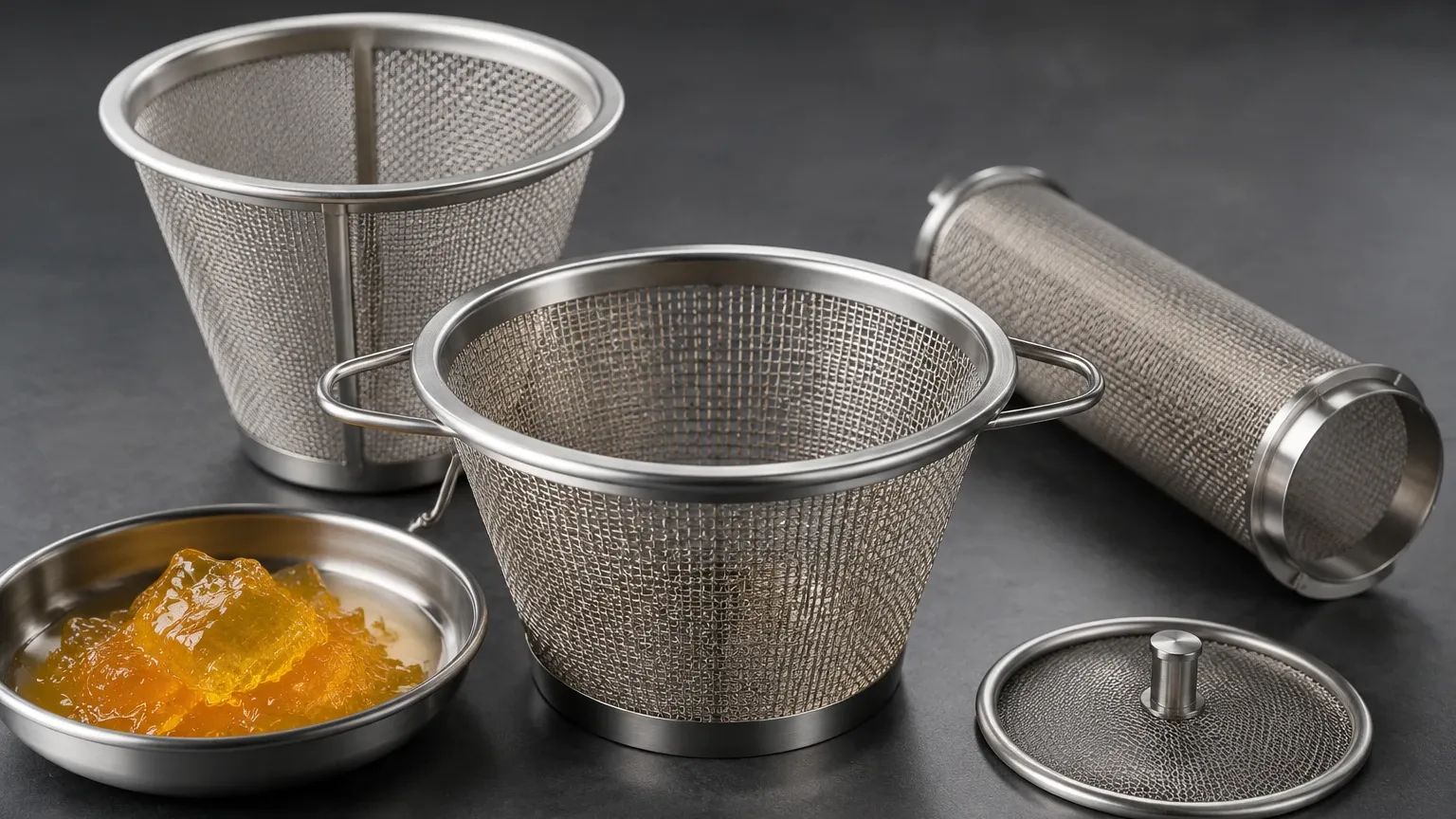
* Conical vs. Basket Designs: Conical (or "witch's hat") strainers are often used for start-up applications or lower-solids loads, whereas basket strainers offer a larger surface area and higher solids-holding capacity, making them better suited for continuous jelly production.
* Handle Configurations: For rapid changeovers, baskets can be fitted with various handle styles (e.g., slant handles, overhead bails) to facilitate quick removal from the housing.
* Magnetic Inserts: In some cases, rare-earth magnets are integrated into the strainer basket to capture any fine metallic fragments that may have entered the process stream from upstream machinery, providing an extra layer of product safety.
Conclusion: Selecting a Partner for Industrial Filtration
Choosing the right jelly strainer is a technical decision that impacts the efficiency, safety, and quality of food production. It requires a manufacturer that understands the nuances of stainless steel fabrication and the specific challenges of the food and beverage industry. By focusing on high-quality materials, robust structural design, and precise filtration ratings, manufacturers can ensure that their Strainers & Baskets provide reliable service in even the most demanding environments.
When evaluating suppliers, engineers should confirm the manufacturer's ability to provide material certifications (MTRs), compliance documentation, and custom engineering support. A well-designed filtration system reduces waste, protects expensive downstream equipment, and ultimately ensures that the final consumer receives a product that meets the highest standards of clarity and purity.
