


Kitchen Sieves and Strainers
In the context of commercial food production, pharmaceutical processing, and industrial-scale catering, the tools often referred to as kitchen sieves and strainers undergo a significant transformation in engineering complexity. While a domestic sieve is designed for occasional use and light loads, industrial-grade components must withstand continuous operation, aggressive cleaning cycles, and strict regulatory scrutiny. For engineers and procurement specialists, selecting the right filtration media involves understanding the intersection of material science, fluid dynamics, and hygienic design.
Industrial Strainers & Baskets serve as the frontline of quality control in liquid and dry material processing. Whether integrated into a high-volume commercial kitchen or a large-scale food manufacturing line, these components are critical for ensuring product consistency, protecting downstream equipment, and maintaining consumer safety. This guide examines the technical specifications and engineering considerations required when specifying high-performance sieving and straining solutions.
The Role of Precision Strainers & Baskets in Food Processing
In a commercial or industrial setting, the function of kitchen sieves and strainers extends far beyond simple separation. These tools are integral to various stages of production, including raw material preparation, intermediate processing, and final packaging. The primary objective is to remove oversized particles, contaminants, or unwanted debris from a product stream.
In liquid applications, such as the production of sauces, beverages, or oils, strainers are used to ensure a smooth texture and to prevent pump damage caused by solids. In dry applications, such as flour milling or spice processing, sieves are employed for particle size distribution and scalping. The reliability of these components directly impacts the throughput of the entire production line. A failure in a sieve mesh or a structural weakness in a strainer basket can lead to batch contamination, resulting in significant financial losses and potential safety risks.
Engineering Considerations for Industrial Kitchen Sieves and Strainers
When transitioning from consumer-grade products to industrial solutions, several engineering parameters must be evaluated to ensure the component is fit for purpose. These considerations go beyond basic dimensions and focus on the technical performance of the filtration media.
Material Selection
Stainless steel is the industry standard for industrial sieving and straining due to its corrosion resistance and durability. The two most common grades are:
* Type 304 Stainless Steel: Suitable for most food-grade applications where exposure to highly corrosive chemicals or salts is limited. It offers excellent formability and weldability.
* Type 316 Stainless Steel: Contains molybdenum, providing superior resistance to chlorides and organic acids. This is the preferred choice for pharmaceutical applications, high-salt food processing, and environments where aggressive Clean-in-Place (CIP) chemicals are used.
Mesh Count and Micron Rating
The precision of kitchen sieves and strainers is defined by the mesh count (the number of openings per linear inch) or the micron rating (the size of the smallest particle the mesh will retain). Engineers must balance the need for fine filtration with the requirement for high flow rates. A finer mesh provides better filtration but increases pressure drop and is more prone to blinding (clogging).
Open Area Calculations
The percentage of open area determines the efficiency of the strainer. A higher open area allows for greater flow capacity and longer intervals between cleanings. However, increasing the open area often requires using thinner wires, which may compromise the structural integrity of the sieve under high-pressure conditions.
Comparing Wire Mesh vs. Perforated Metal in Sieve Design
The choice between woven wire mesh and perforated metal is a critical decision in the design of industrial strainers and baskets. Each material offers distinct advantages depending on the application requirements.
Woven Wire Mesh
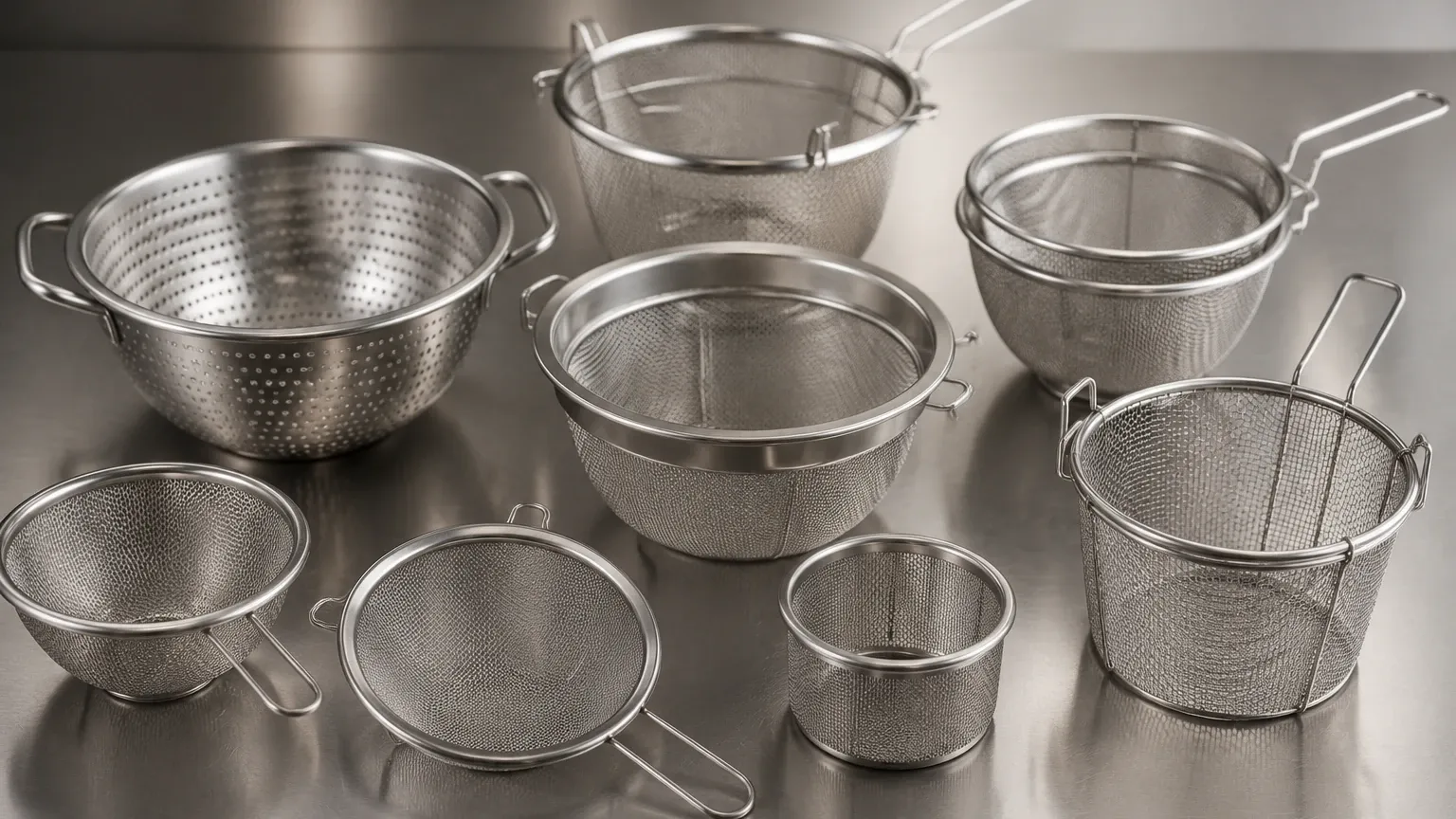
Woven wire mesh is the primary choice for fine sieving and straining. It is available in various weave types, such as plain weave, twilled weave, and Dutch weave. Plain weave is the most common for standard kitchen sieves and strainers, providing a square opening that is easy to clean. For applications requiring extreme precision or high-pressure resistance, Dutch weaves offer a more complex structure with smaller pore sizes and greater mechanical strength.
Perforated Metal
Perforated metal is typically used as a support structure for fine mesh or as a standalone strainer for coarse filtration. It is manufactured by punching holes into a metal sheet. Perforated strainers are exceptionally robust and can handle high differential pressures. They are ideal for removing large debris, such as vegetable peels or bone fragments, in the early stages of food processing. In many industrial designs, a fine wire mesh is sintered or mechanically fastened to a perforated metal basket to combine precision with structural rigidity.
Hygiene Standards and Compliance for Commercial Filtration
In the food, beverage, and pharmaceutical industries, the "cleanability" of a component is as important as its filtration performance. Industrial kitchen sieves and strainers must comply with stringent hygiene standards to prevent bacterial growth and cross-contamination.
Sanitary Design Principles
Components must be designed with smooth surfaces and minimal crevices. Internal corners should be radiused to prevent material buildup. In high-spec applications, welds must be ground smooth and polished to match the surrounding surface finish. This ensures that the equipment can be effectively sanitized during CIP or Sterilization-in-Place (SIP) processes.
Surface Finishes
The surface roughness (Ra) of the stainless steel is a key metric. For many food-grade applications, a 2B mill finish is sufficient, but for pharmaceutical or high-purity food processes, electropolishing may be required. Electropolishing removes microscopic peaks and valleys from the metal surface, creating a mirror-like finish that is highly resistant to adhesion and extremely easy to clean.
Regulatory Compliance
Materials used in the construction of sieves and strainers must be FDA-compliant. This ensures that the metal, welding fillers, and any gaskets or seals do not leach harmful substances into the product. Furthermore, adherence to 3-A Sanitary Standards or EHEDG guidelines provides assurance that the equipment meets the highest levels of hygienic design.
Customization and OEM Solutions for Equipment Manufacturers
Standard off-the-shelf sieves rarely meet the specific needs of complex industrial machinery. Customization is often necessary to integrate the filtration component seamlessly into an existing system. For Original Equipment Manufacturers (OEMs), partnering with a specialized manufacturer like Kaifil allows for the development of bespoke filtration solutions.
Tailored Geometry
Industrial strainers and baskets can be manufactured in a wide range of shapes, including cylindrical, conical, or flat-panel designs. Custom flanges, handles, and reinforcement rings can be added to ensure a perfect fit within the housing. This precision prevents "bypass," where unfiltered product escapes around the edges of the sieve.
Multi-Stage Filtration
For complex processing lines, custom baskets can be designed with multiple layers of different mesh sizes. This allows for graduated filtration within a single unit, capturing large debris in an outer layer while the inner layer performs fine straining. This approach extends the service life of the fine mesh and reduces maintenance frequency.
Prototyping and Engineering Support
Developing a new filtration component often requires iterative testing. Working with a manufacturer that provides engineering support—from material selection to CAD design—helps technical teams optimize performance before moving to full-scale production. This collaborative approach ensures that the final product meets both the functional and budgetary requirements of the project.
Maintenance and Longevity of Stainless Steel Strainers
The total cost of ownership for industrial kitchen sieves and strainers is heavily influenced by their durability and ease of maintenance. While stainless steel is inherently long-lasting, proper care is essential to maintain its performance and hygiene.
Cleaning Procedures
Regular cleaning is vital to prevent blinding and bio-burden accumulation. In many industrial settings, ultrasonic cleaning is used to remove fine particles trapped deep within the wire mesh. For heavier residues, chemical cleaning or high-pressure water jets may be employed. It is crucial to ensure that the cleaning agents used are compatible with the specific grade of stainless steel to avoid pitting or stress corrosion cracking.
Inspection and Replacement Cycles
Over time, even the most robust sieves will show signs of wear. Mesh can become frayed, and welds may fatigue under constant vibration or pressure pulses. Regular inspection protocols should be established to check for integrity breaches. A damaged sieve not only fails to filter effectively but can also introduce metal fragments into the product stream. Establishing a proactive replacement cycle based on operational hours or throughput volume is a best practice for maintaining process safety.
Repair vs. Replacement
In some cases, large or complex strainer baskets can be refurbished. Replacing a damaged mesh layer while retaining the structural perforated basket can be a cost-effective alternative to full replacement. However, this must be done with precision welding to ensure the component remains sanitary and structurally sound.
Conclusion: Selecting the Right Partner for Filtration Solutions
Specifying kitchen sieves and strainers for industrial applications requires a deep understanding of the operating environment and the physical properties of the media being processed. By focusing on high-quality materials, precision engineering, and hygienic design, facilities can achieve superior filtration results while minimizing downtime.
For engineers and purchasing teams, the key to success lies in choosing a manufacturer that understands these technical nuances. A commitment to quality and the ability to provide customized, durable components are essential for maintaining the integrity of industrial food and chemical processing lines. Whether you require a standard replacement or a completely custom-engineered solution, selecting the right filtration partner ensures that your operations remain efficient, compliant, and cost-effective.
