


Kitchen Strainers Nyt
In the realm of consumer product evaluation, publications such as the New York Times (NYT) Wirecutter provide comprehensive benchmarks for household tools. When searching for "kitchen strainers nyt," users typically encounter a rigorous analysis of ergonomics, drainage efficiency, and mesh durability for home use. However, for professionals in the food and beverage, pharmaceutical, and chemical processing industries, the requirements for Strainers & Baskets extend far beyond domestic utility. Industrial-grade filtration requires a deep understanding of material science, fluid dynamics, and structural integrity to ensure process continuity and product purity.
While a consumer-grade strainer may focus on how easily it rinses quinoa or fits in a dishwasher, an industrial strainer must withstand high-pressure differentials, corrosive cleaning agents, and continuous mechanical stress. This article bridges the gap between the high standards of consumer reviews and the technical specifications required for industrial applications, providing engineers and procurement teams with the data needed to select high-performance filtration components.
Understanding the Engineering Behind Professional Strainers
Industrial strainers are not merely larger versions of household tools; they are precision-engineered components designed for specific flow rates and particle retention levels. In a commercial or industrial setting, the term "strainer" often refers to a basket-style filter used to remove larger solids from a liquid stream, protecting downstream equipment like pumps, valves, and heat exchangers.
Mesh Count and Micron Ratings
In consumer reviews, "fine mesh" is a qualitative term. In B2B procurement, we define performance through mesh count (the number of openings per linear inch) and micron ratings (the size of the particles the mesh can trap). For example, a 100-mesh screen has 100 openings per inch, which corresponds to approximately 149 microns. Choosing the correct mesh is a balance between filtration efficiency and flow resistance. If the mesh is too fine, the pressure drop across the strainer will increase rapidly, leading to frequent cleaning cycles or potential pump cavitation. If it is too coarse, contaminants may pass through and damage sensitive equipment.
Open Area Ratio
A critical engineering metric often overlooked in consumer guides is the "Open Area Ratio." This is the ratio of the total area of the holes in the mesh to the total area of the screen. A higher open area allows for higher flow rates and lower pressure drops. Industrial Strainers & Baskets are typically designed with an open area that is several times the cross-sectional area of the inlet pipe to ensure that even as the basket begins to fill with debris, the process flow remains within acceptable parameters.
Evaluation Criteria: Beyond Consumer Reviews
When the NYT evaluates a kitchen strainer, they prioritize handle comfort and base stability. In an industrial context, evaluation criteria shift toward mechanical durability and regulatory compliance.
Structural Integrity and Burst Pressure
Industrial baskets are often subjected to high-velocity fluid streams and significant pressure differentials. Unlike a household strainer that rests in a sink, an industrial basket must be structurally reinforced. This is often achieved through a two-layer design: a fine inner mesh for filtration and a heavy-duty perforated metal outer layer for structural support. This construction prevents the mesh from collapsing or "ballooning" under pressure.
Connection Types and Sealing
In the food and pharmaceutical industries, bypass—where fluid escapes around the edges of the filter—is unacceptable. Professional strainers utilize precision-machined flanges, O-ring seals, or sanitary Tri-Clamp connections to ensure a 100% seal. This level of precision ensures that every drop of fluid passes through the filtration media, maintaining the integrity of the batch.
Material Selection: Why 304 and 316 Stainless Steel Prevail
While consumer strainers might use various grades of stainless steel or even plastic, industrial environments demand high-grade alloys. The choice between Grade 304 and Grade 316 stainless steel is fundamental to the longevity of the component.
* Grade 304 Stainless Steel: This is the standard for most food-grade applications. It offers excellent corrosion resistance and is easy to sanitize. It is suitable for water, dairy, and most non-acidic food processing.
* Grade 316 Stainless Steel: For applications involving high salt concentrations, acidic chemicals, or pharmaceutical ingredients, 316 stainless steel is the preferred choice. The addition of molybdenum provides superior resistance to pitting and crevice corrosion, particularly in chloride-rich environments.
Kaifil specializes in manufacturing these components using high-purity alloys, ensuring that the Strainers & Baskets meet the strict hygiene standards required by FDA and 3A regulations. Material traceability is also a key B2B requirement; industrial suppliers provide material test reports (MTRs) to prove the chemical composition of the steel, a level of documentation never found in consumer-grade products.
Common Risks in Industrial Filtration and Straining
Failure to select the correct industrial strainer can lead to significant operational risks. Understanding these risks is essential for any engineering team.
1. Corrosion and Material Degradation
In chemical processing, using the wrong alloy can lead to rapid corrosion. This not only destroys the strainer but can also introduce metallic contaminants into the product stream. Engineers must evaluate the chemical compatibility of the fluid with the filter material across the entire operating temperature range.
2. Excessive Pressure Drop
As a strainer captures debris, the available open area decreases, and the pressure drop (Delta P) increases. If a system is not designed with sufficient surface area, the pressure drop can spike, leading to system shutdowns or mechanical failure of the filter element. Monitoring pressure gauges upstream and downstream of the strainer is a standard industrial practice to determine when cleaning is required.
3. Cleaning and Sanitation Failures
In the food and beverage industry, "dead legs" or crevices in a strainer design can harbor bacteria. Professional Strainers & Baskets are designed with smooth welds and radiused corners to facilitate Clean-In-Place (CIP) or Sterilization-In-Place (SIP) procedures. A failure in the design phase can lead to batch contamination and costly product recalls.
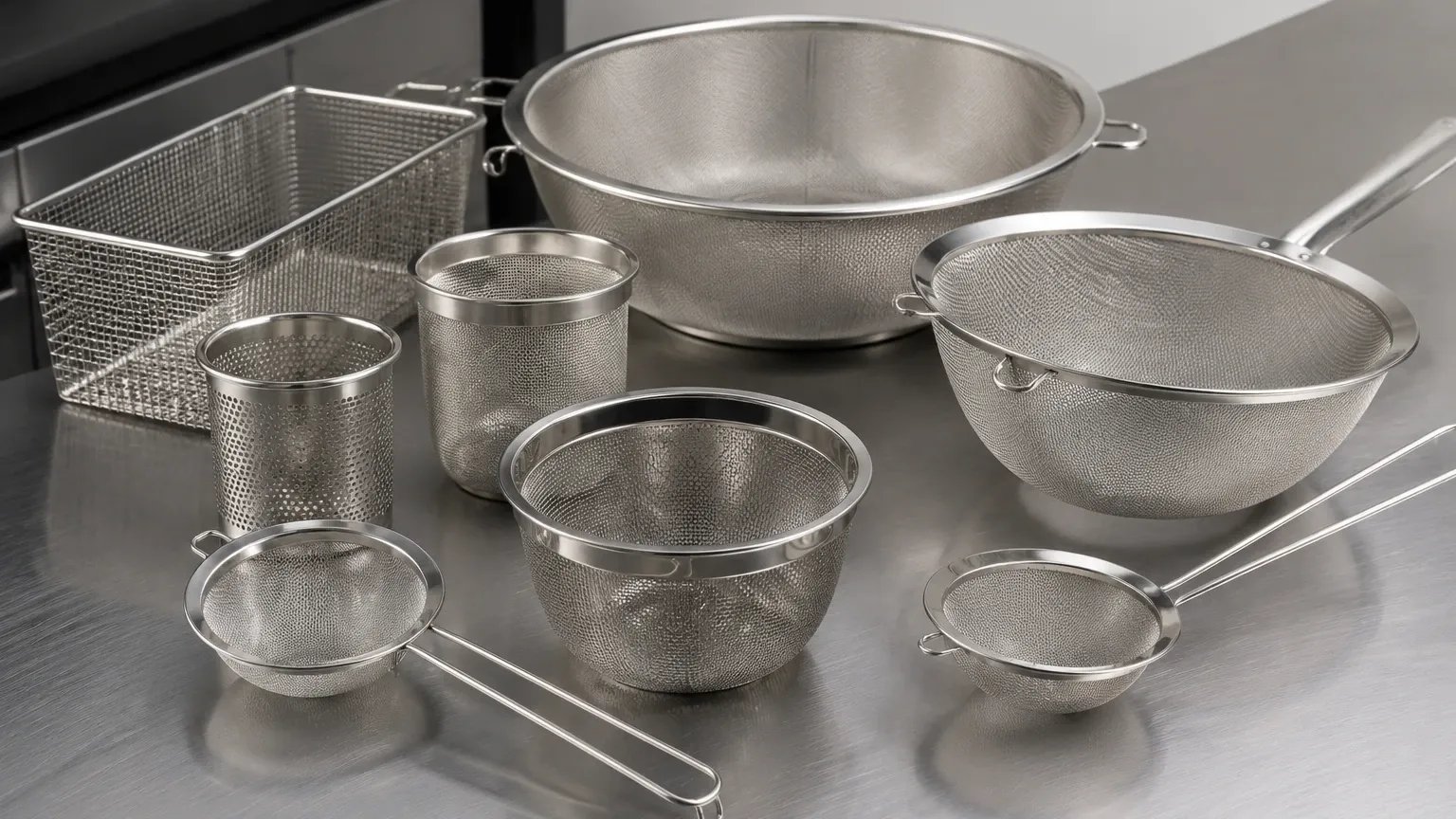
Customization Options for Commercial Applications
One of the primary differences between consumer products and B2B solutions is the ability to customize. Industrial processes are rarely "one size fits all."
Custom Geometry and Fitting
Industrial strainers can be manufactured to fit existing piping layouts. This includes custom heights, diameters, and handle configurations. For example, some baskets require heavy-duty lifting bails to allow for removal by overhead cranes, while others may feature slanted bottoms to facilitate complete drainage.
Multi-Stage Filtration
In some applications, a single mesh layer is insufficient. Custom baskets can be designed with multiple stages of filtration—starting with a coarse mesh to remove large debris and finishing with a fine micron mesh for final polishing. This graduated approach extends the life of the finer mesh and reduces the frequency of maintenance.
Magnetic Inserts
For processes involving metal wear or raw material processing, magnetic inserts can be added to the strainer basket. These magnets capture fine ferrous particles that might otherwise pass through the mesh, providing an extra layer of protection for downstream equipment.
Maintenance and Longevity of Industrial Strainers
To achieve the lowest total cost of ownership, industrial strainers must be maintained according to a strict schedule. Unlike a kitchen strainer that is replaced when the mesh breaks, industrial baskets are designed for years of service.
* Cleaning Protocols: Depending on the application, cleaning may involve ultrasonic baths, high-pressure washing, or chemical soaking. The durability of stainless steel allows for these aggressive cleaning methods without compromising the mesh integrity.
* Inspection for Fatigue: Regular inspection should look for signs of wire fatigue, particularly at the weld points where the mesh meets the support frame. Early detection of wear prevents catastrophic failure during a production run.
* Replacement Cycles: While the housing of a strainer may last decades, the internal Strainers & Baskets are considered wear parts. Keeping spare baskets on hand is a critical part of risk management, ensuring that production can resume immediately if a basket is damaged.
Conclusion: Selecting the Right Partner for Filtration
While "kitchen strainers nyt" reviews provide excellent guidance for the home cook, industrial filtration requires a partner with technical expertise and manufacturing precision. Engineers and purchasing managers must look beyond the surface level and evaluate filtration components based on their ability to perform under pressure, resist corrosion, and meet regulatory standards.
Kaifil provides the engineering support and manufacturing capabilities necessary to produce high-performance stainless steel filtration solutions. By focusing on material quality, precise mesh selection, and robust construction, we help our global customers optimize their processes and protect their equipment. Whether you are designing a new food processing line or upgrading a chemical filtration system, selecting the right Strainers & Baskets is a critical step toward operational excellence.
