


Large Strainers
In industrial fluid handling, the efficiency of a system often depends on the initial stages of debris removal. Large strainers serve as the primary line of defense, protecting expensive downstream equipment such as pumps, valves, and heat exchangers from damage caused by particulate matter. Unlike standard inline filters designed for fine polishing, large-scale strainers are engineered to handle high flow rates and significant solids loading without causing excessive pressure drops.
For engineers and procurement teams, selecting the right Strainers & Baskets involves more than just matching pipe sizes. It requires a deep understanding of fluid dynamics, material compatibility, and the structural requirements of large-scale industrial environments. This guide examines the technical specifications, design considerations, and performance metrics essential for integrating large strainers into heavy-duty applications.
Understanding the Role of Large Strainers in Industrial Systems
Large strainers are typically categorized by their ability to process high volumes of liquid or gas while capturing relatively coarse particles. While a cartridge filter might focus on sub-micron levels, a large strainer is designed for macroscopic debris—ranging from scale and rust to stones and manufacturing byproducts.
In sectors like municipal water treatment, chemical processing, and large-scale cooling systems, the failure of a strainer can lead to catastrophic pump cavitation or the clogging of heat exchanger tubes. Because these systems operate at high velocities, the structural integrity of the strainer element is paramount. Large strainers must withstand the mechanical stress of turbulent flow and the differential pressure that builds up as the basket fills with debris.
Engineering Specifications for Large-Scale Filtration
When specifying large strainers, several engineering parameters must be evaluated to ensure the component meets the operational demands of the facility.
Flow Rate and Velocity
Large-scale systems often move thousands of gallons per minute. The strainer must be sized so that the internal velocity does not exceed the structural limits of the mesh or the housing. High velocity can lead to "media migration" or the bypass of particles if the mesh is not properly supported. Engineers typically look for a low initial pressure drop (clean ΔP) to ensure the system remains energy-efficient.
Pressure Ratings and Standards
Large strainers are often integrated into piping systems that must adhere to strict pressure standards, such as ANSI, DIN, or JIS. The housing and the internal basket must be rated for the maximum operating pressure of the system, including potential surges. For high-pressure applications, heavy-duty reinforced baskets are necessary to prevent the collapse of the filtration media.
Open Area Ratio (OAR)
The Open Area Ratio is the relationship between the total area of the strainer openings and the cross-sectional area of the inlet pipe. For large strainers, a common industry standard is an OAR of at least 6:1. A higher ratio ensures that the strainer can accumulate a significant amount of debris before the pressure drop becomes critical, thereby extending the time between cleaning cycles.
Material Selection and Corrosion Resistance
The longevity of large strainers is heavily dependent on the materials used in their construction. Industrial environments often involve corrosive fluids, extreme temperatures, or abrasive slurries.
* Stainless Steel 304: The most common choice for general industrial applications, offering good corrosion resistance and mechanical strength for water and mild chemical service.
* Stainless Steel 316/316L: Preferred for marine environments, pharmaceutical production, and chemical processing where chloride exposure or high acidity is a concern. The addition of molybdenum provides superior pitting resistance.
* Specialty Alloys: In highly aggressive environments, such as those found in the petrochemical industry, duplex stainless steels or high-nickel alloys may be required to prevent stress corrosion cracking.
Beyond the housing, the selection of the mesh or perforated metal for the basket is critical. In large strainers, it is common to use a dual-layer approach: a heavy-duty perforated metal outer shell for structural support and a fine wire mesh inner lining for precise filtration accuracy.
Design Features of Strainers & Baskets
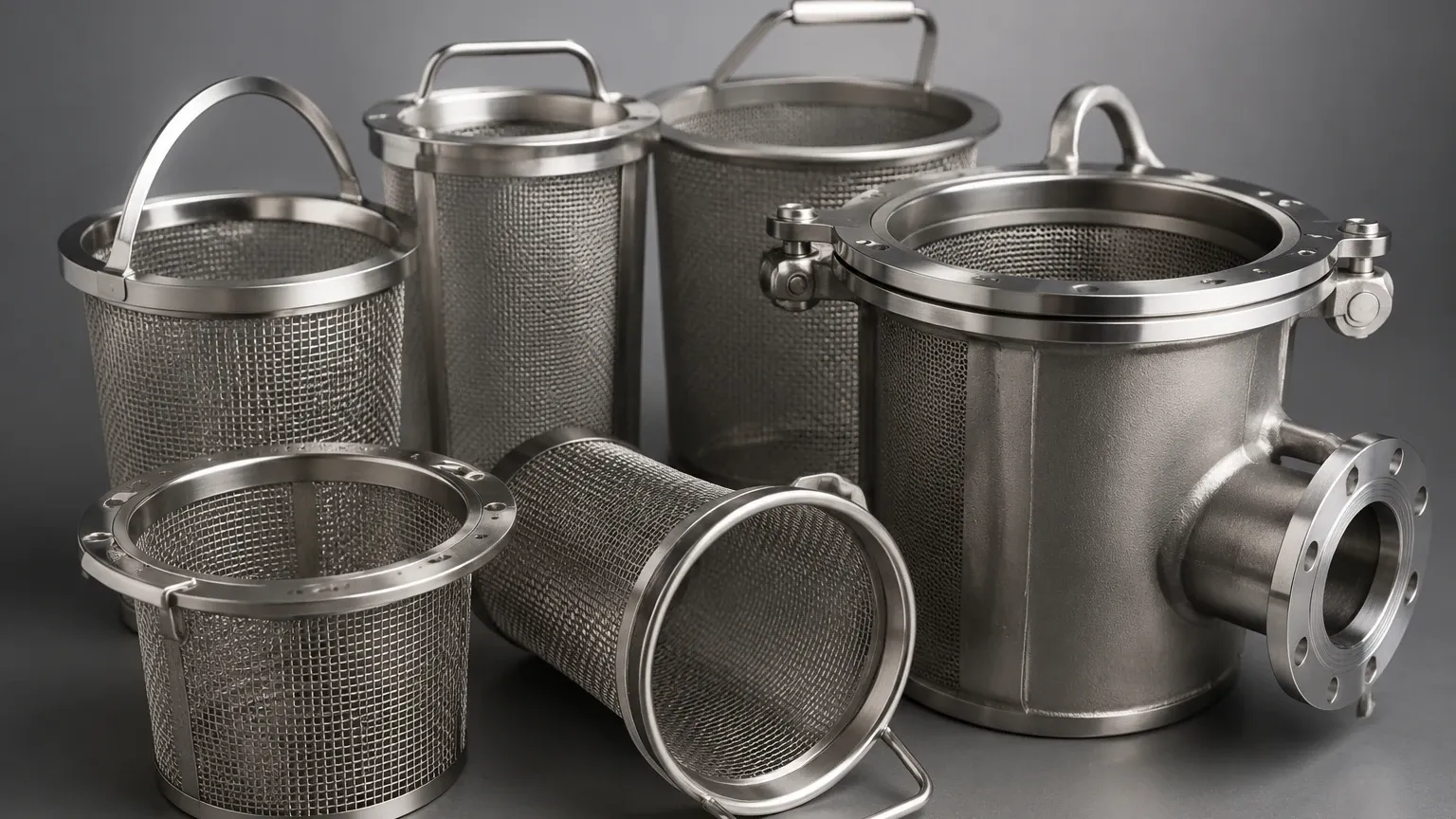
The design of the basket itself is a major factor in the ease of maintenance and the overall efficiency of the filtration process. Customization in this area allows for optimization based on the specific type of debris being targeted.
Basket Geometry
For large strainers, the basket must be designed to maximize surface area within a compact housing. Slant-top baskets or multi-basket configurations are often used in very large housings to increase the holding capacity without significantly increasing the footprint of the equipment.
Handle and Lifting Mechanisms
Because large strainers can hold a significant volume of debris, the weight of a full basket can be substantial. Engineering designs often include heavy-duty handles, lifting eyes, or even mechanical assist points to allow maintenance teams to safely remove and clean the elements.
Reinforcement and Support
Large-diameter baskets are susceptible to deformation under high differential pressure. Structural ribs, reinforced rings, and heavy-gauge perforated backings are essential features that prevent the basket from buckling or tearing during a pressure surge.
Evaluating Performance: Pressure Drop and Dirt Holding Capacity
Performance evaluation for large strainers centers on the balance between filtration fineness and maintenance frequency. If a strainer is too fine, it will clog rapidly, leading to frequent downtime. If it is too coarse, it will fail to protect downstream equipment.
Dirt Holding Capacity
This metric refers to the volume of solids the strainer can retain before reaching the maximum allowable pressure drop. In large-scale operations, maximizing dirt holding capacity is vital for reducing labor costs associated with manual cleaning. Large strainers with pleated or multi-layered designs can offer significantly more surface area than standard cylindrical baskets.
Differential Pressure Monitoring
In many industrial setups, large strainers are equipped with differential pressure gauges or sensors. These tools provide real-time data on the state of the strainer, allowing operators to perform maintenance based on actual conditions rather than arbitrary schedules. This data-driven approach prevents unnecessary system shutdowns and ensures the strainer is never pushed to the point of structural failure.
Customization Options for Specific Industrial Applications
Standard off-the-shelf solutions often fall short in specialized industrial processes. Custom manufacturing allows for the adjustment of every variable to fit a specific application.
* Custom Dimensions: Tailoring the height, diameter, and connection types (flanged, threaded, or socket weld) to fit existing piping layouts.
* Specialized Linings: Adding magnetic inserts to capture fine ferrous particles that might otherwise pass through a standard mesh.
* Variable Micron Ratings: Utilizing different wire mesh weaves—such as plain, twill, or dutch weave—to achieve the exact level of filtration required for the process fluid.
Through OEM capabilities, manufacturers like Kaifil can develop large strainers that meet unique engineering challenges, ensuring that the final product integrates seamlessly into the client's infrastructure while meeting all safety and performance benchmarks.
Maintenance and Operational Longevity
The total cost of ownership for large strainers is determined not just by the purchase price, but by the durability and ease of maintenance over the product's life. Stainless steel construction is inherently durable, but proper maintenance protocols are necessary to prevent issues like biofouling or scale buildup.
Cleaning Procedures
Most large strainers are designed for manual cleaning, where the basket is removed, hosed down, and reinstalled. In applications with high solids loading, "blow-down" valves may be included in the housing design, allowing for the removal of some accumulated sludge without stopping the flow. For continuous processes, duplex strainer systems—where one side is cleaned while the other remains in operation—are often the preferred solution.
Inspection Protocols
Regular inspection of the mesh and the basket seals is critical. Over time, the constant vibration and flow can cause fatigue in the wire mesh. Identifying small tears or weakened areas early prevents the bypass of debris that could damage expensive downstream components.
Critical Checklist for Procurement and Engineering Teams
Before finalizing the specifications for large strainers, engineering teams should confirm the following details to ensure the solution is fit for purpose:
1. Fluid Characteristics: Confirm the viscosity, temperature, and chemical composition of the fluid to ensure material compatibility.
2. Particle Profile: Identify the size, shape, and concentration of the debris. Is the debris hard and abrasive, or soft and fibrous?
3. Flow Dynamics: Determine the minimum, normal, and maximum flow rates, as well as the maximum allowable pressure drop for the system.
4. Installation Constraints: Assess the available space for the strainer housing and the clearance required for basket removal.
5. Compliance Requirements: Verify if the application requires adherence to specific industry standards (e.g., FDA for food and beverage, or ASME for pressure vessels).
By addressing these factors during the design and selection phase, organizations can implement large strainers that provide reliable, long-term protection for their industrial processes. High-quality Strainers & Baskets are an investment in system uptime and equipment longevity, reducing the risk of unplanned maintenance and costly repairs in demanding industrial environments.
