


Loose Leaf Tea Strainers
In the industrial food and beverage sector, the extraction and filtration of botanical products require a level of precision that transcends standard consumer-grade equipment. For commercial tea processors, beverage manufacturers, and OEM equipment builders, loose leaf tea strainers are critical components that determine the clarity, flavor profile, and consistency of the final product. Unlike domestic infusers, industrial-grade filtration solutions must withstand rigorous cleaning cycles, maintain structural integrity under pressure, and meet stringent food safety regulations.
Selecting the appropriate filtration hardware involves understanding the intersection of fluid dynamics, material science, and the specific morphological characteristics of tea leaves. Whether the application involves large-scale batch brewing for ready-to-drink (RTD) beverages or precision components for high-end commercial brewing machinery, the choice of Strainers & Baskets impacts both operational efficiency and product quality.
Technical Engineering of Tea Filtration
The primary function of loose leaf tea strainers is to allow for maximum solvent (water) contact with the solute (tea leaves) while ensuring that no particulate matter—ranging from whole leaves to fine tea dust—migrates into the final liquid. Achieving this balance requires a deep dive into mesh specifications.
Micron Ratings and Mesh Geometry
Industrial tea filtration typically utilizes stainless steel wire mesh. The choice of weave—plain, twilled, or Dutch weave—dictates the filtration accuracy and the flow rate. For whole-leaf teas, a larger aperture is permissible, often ranging from 200 to 500 microns. However, for broken orange pekoe (BOP) or fannings used in high-speed extraction, the mesh must be significantly finer, often reaching 50 microns or less to prevent sediment.
Engineers must also consider the "open area" percentage. A higher open area reduces pressure drop and allows for faster flow, which is essential in high-volume production environments. However, increasing the open area often requires thinner wires, which can compromise the durability of the strainer under the mechanical stress of cleaning or high-pressure agitation.
Material Selection for Food-Grade Compliance
In B2B applications, material durability and chemical resistance are non-negotiable. Stainless steel is the industry standard for loose leaf tea strainers due to its non-reactive nature and ability to withstand high temperatures without leaching contaminants.
1. Stainless Steel 304: This is the most common grade used in food processing. It offers excellent corrosion resistance and is cost-effective for most aqueous extraction environments.
2. Stainless Steel 316/316L: For applications involving flavored teas (which may contain acidic dried fruits or oils) or environments where aggressive chemical cleaners are used, SS316 is preferred. The addition of molybdenum enhances resistance to pitting and crevice corrosion, ensuring a longer service life in demanding industrial settings.
Beyond the alloy, the surface finish of the metal is a critical engineering consideration. Electropolishing is often employed to remove microscopic burrs and create a "mirror" finish. This process not only improves the aesthetic quality but also reduces the ability of tea tannins and proteins to adhere to the mesh, thereby simplifying the cleaning process and preventing bacterial growth.
Structural Variations in Industrial Strainers & Baskets
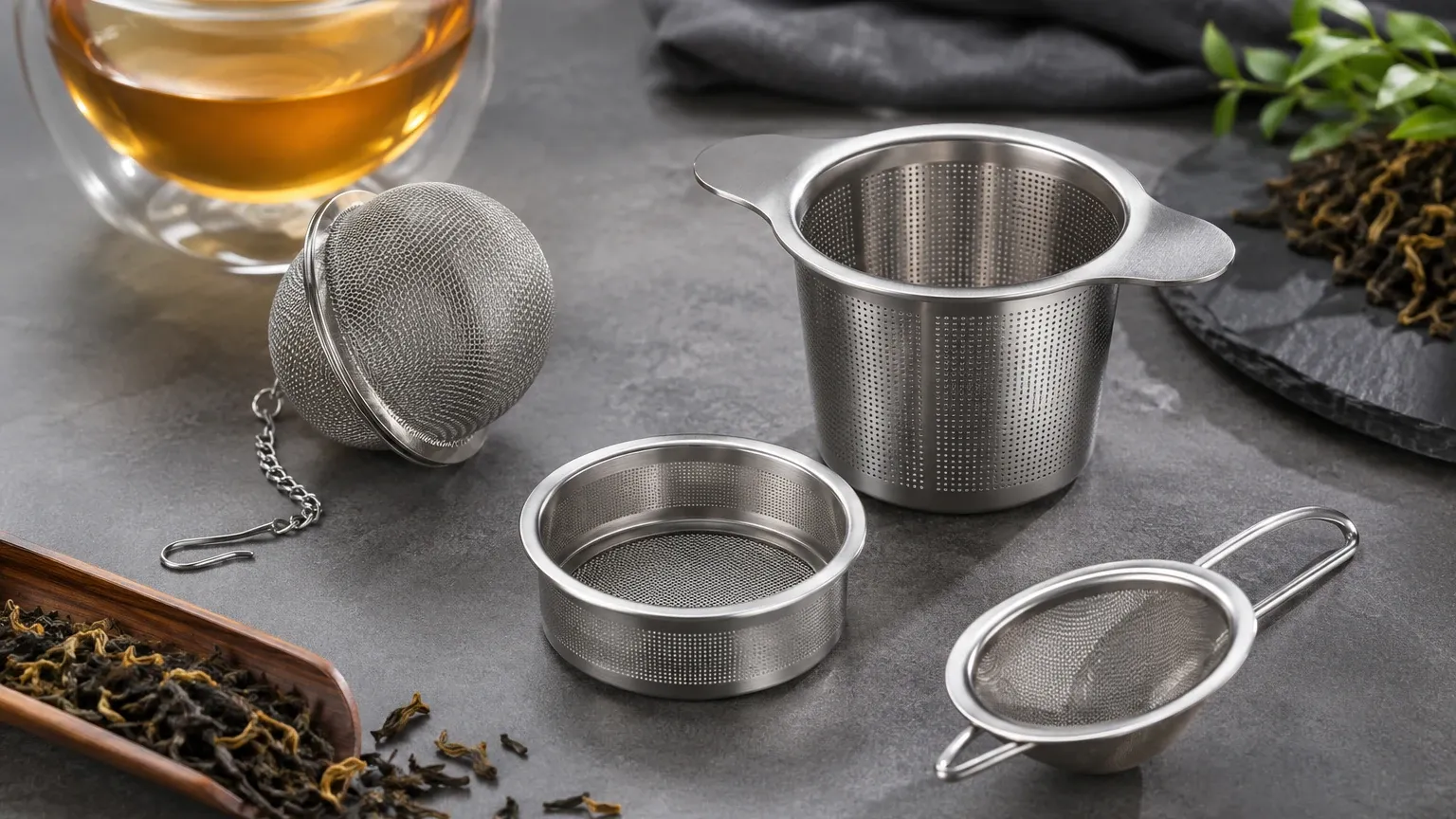
The physical architecture of the filtration component must align with the brewing vessel's design and the intended flow path. Industrial Strainers & Baskets are engineered in several configurations to optimize extraction:
* Cylindrical Filter Cartridges: These are often used in inline filtration systems where the tea extract is pumped through a housing. They provide a large surface area in a compact footprint and can be designed for outside-in or inside-out flow.
* Conical Strainers: Often used as "temporary" or start-up strainers, conical designs are effective for capturing larger particulates in gravity-fed systems. Their shape allows for easy removal and manual cleaning.
* Custom Basket Strainers: For batch brewing, large baskets with reinforced frames and lifting handles are used. These are designed to hold significant weights of saturated tea leaves, requiring robust structural support to prevent the mesh from sagging or tearing during the removal process.
Filtration Accuracy and Clogging Resistance
One of the most significant challenges in high-volume tea processing is "blinding" or clogging. Tea leaves, once saturated, become heavy and can form a dense mat against the filter surface. This layer of organic material acts as a secondary filter, which might increase filtration accuracy but drastically reduces the flow rate.
To combat this, industrial loose leaf tea strainers may incorporate a pleated design. Pleating increases the available surface area by 3 to 5 times compared to a flat or simple cylindrical screen. This distributed surface area allows for longer run times before the pressure differential necessitates a cleaning cycle. Additionally, the use of perforated metal as a support structure (backup tube) for the fine wire mesh ensures that the strainer can withstand the back-pressure during automated cleaning or back-flushing processes.
Operational Efficiency and Maintenance
From a B2B procurement perspective, the total cost of ownership (TCO) is a more vital metric than the initial purchase price. High-quality stainless steel strainers offer a lower TCO compared to disposable or lower-grade alternatives due to their longevity and cleanability.
Clean-in-Place (CIP) Compatibility
Modern beverage production lines often utilize CIP systems. Loose leaf tea strainers must be designed to withstand the thermal shocks and chemical concentrations associated with these systems. Welded joints, rather than soldered or epoxied ones, are essential to prevent structural failure and ensure there are no "dead zones" where organic material can accumulate and spoil.
Replacement Cycles
While stainless steel filters are durable, they are not infinite. Mechanical wear from abrasive particulates or fatigue from pressure fluctuations will eventually necessitate replacement. Engineers should look for strainers with reinforced edges and high-quality TIG (Tungsten Inert Gas) or plasma welding to maximize the intervals between replacements. Regular inspection of the mesh for "wire shifting" or micro-tears is essential to maintain consistent product quality.
Customization for OEM and Industrial Applications
Every industrial brewing process has unique requirements. A standard off-the-shelf solution rarely suffices for specialized extraction equipment. Customization options for loose leaf tea strainers typically include:
* Flange and Fitting Integration: Customizing the interface (e.g., Tri-clamp, NPT, or custom flanges) to ensure a leak-proof fit within existing machinery.
* Reinforcement Ribs: Adding structural bands to large-diameter baskets to handle the weight of bulk tea leaves.
* Multi-Layer Mesh Sintering: For the most demanding applications, sintering multiple layers of wire mesh together creates a filter medium that combines the fine filtration of thin wire with the mechanical strength of thick wire.
When partnering with a manufacturer, it is crucial to provide detailed application data, including the expected flow rate, operating temperature, pressure limits, and the specific type of tea being processed. This allows for the engineering of a solution that balances filtration fineness with mechanical durability.
Conclusion: Selecting the Right Partner
Choosing the right loose leaf tea strainers for industrial use is a technical decision that impacts the entire production chain. By focusing on material integrity, mesh precision, and structural design, B2B buyers can ensure their filtration systems deliver consistent results. High-performance Strainers & Baskets are an investment in product quality and operational reliability, reducing downtime and ensuring that the final beverage meets the high standards of the modern market.
For engineers and purchasing managers, the focus should remain on verified material certifications, precise manufacturing tolerances, and the ability of the supplier to provide customized engineering support. In the competitive landscape of beverage production, the smallest details in filtration hardware can lead to the most significant gains in efficiency and flavor consistency.
