


Mesh Sink Strainers
In industrial and commercial fluid management, the effectiveness of a system often depends on the smallest components. Mesh sink strainers, while seemingly simple, serve as the primary line of defense for drainage and processing systems. These components are engineered to capture solid debris before it enters downstream piping, pumps, or treatment facilities. For engineers and facility managers, selecting the correct mesh strainer is not merely a matter of size; it involves a deep understanding of material science, hydraulic flow, and mechanical durability.
Industrial-grade mesh sink strainers are distinct from residential versions. They must withstand corrosive chemicals, high-temperature effluents, and constant mechanical stress. This guide examines the technical specifications, engineering considerations, and selection criteria essential for integrating high-performance strainers into professional environments.
The Role of Mesh Sink Strainers in Industrial Fluid Systems
The primary function of a mesh sink strainer is the mechanical separation of solids from liquids. In sectors such as food processing, pharmaceuticals, and chemical manufacturing, the presence of oversized particles can lead to catastrophic system failures. A well-designed strainer protects the integrity of the entire infrastructure.
Protecting Downstream Assets
Downstream equipment, such as centrifugal pumps, heat exchangers, and sensitive valves, is highly susceptible to damage from particulate matter. Even small fragments of metal, plastic, or organic waste can cause impeller erosion, clogging of heat exchanger plates, or seal failure. By utilizing precision-engineered Strainers & Baskets, operators can significantly extend the Mean Time Between Failures (MTBF) for their most expensive equipment.
Regulatory and Environmental Compliance
In many industries, capturing solids at the source is a regulatory requirement. Mesh sink strainers help facilities comply with local wastewater discharge limits by preventing large organic loads or non-biodegradable materials from entering the municipal sewer system. This proactive approach reduces the burden on secondary treatment systems and helps avoid costly environmental fines.
Material Engineering: Selecting Stainless Steel for Durability
Material selection is the most critical factor in determining the service life of a mesh sink strainer. Industrial environments expose these components to a variety of stressors, including oxidation, galvanic corrosion, and abrasive wear. Stainless steel remains the industry standard due to its versatile properties.
Type 304 Stainless Steel
Grade 304 is the most common material for general-purpose industrial strainers. It provides excellent corrosion resistance to most oxidizing acids and is highly durable. It is suitable for food and beverage applications where frequent sanitization is required. However, in environments with high chloride concentrations, 304 may be susceptible to pitting.
Type 316 Stainless Steel
For more demanding applications, such as chemical processing or marine environments, Type 316 stainless steel is preferred. The addition of molybdenum enhances its resistance to chloride-induced pitting and crevice corrosion. When mesh sink strainers are used in pharmaceutical labs or facilities handling aggressive cleaning agents, 316 stainless steel ensures long-term structural integrity.
Specialized Coatings and Finishes
In certain B2B contexts, standard stainless steel may require additional treatments. Electropolishing can be applied to improve surface smoothness, which reduces the adhesion of biological films and makes the mesh easier to clean. For extremely abrasive environments, specialized surface hardening may be considered to prevent the wire mesh from thinning over time.
Technical Specifications: Mesh Count and Filtration Accuracy
When specifying mesh sink strainers, engineers must balance filtration efficiency with flow capacity. This balance is defined by the mesh count and the wire diameter.
Understanding Mesh Count
Mesh count refers to the number of openings per linear inch. A higher mesh count indicates smaller openings and finer filtration. For example, a 20-mesh strainer has 20 openings per inch, while an 80-mesh strainer has 80. Choosing the correct mesh involves identifying the smallest particle size that must be removed to protect downstream equipment without causing excessive flow restriction.
Open Area Percentage
The "Open Area" is the ratio of the total area of the holes to the total area of the mesh. This is a vital metric for hydraulic calculations. A higher open area percentage results in a lower pressure drop across the strainer. However, increasing the open area often requires using thinner wires, which can compromise the mechanical strength of the mesh. Engineers must calculate the required flow rate (GPM or L/min) and ensure the strainer’s open area can accommodate it without creating a significant bottleneck.
Wire Diameter and Weave Types
The diameter of the wire used in the mesh affects both the durability and the filtration precision. For industrial sink strainers, a plain weave is most common, providing a stable and consistent aperture. In high-pressure applications, a twill weave or a Dutch weave may be used to provide greater mechanical strength while maintaining fine filtration levels.
Design and Structural Variations in Strainers & Baskets
The physical geometry of a strainer dictates how it interacts with the sink or vessel and how easily it can be serviced. While the term "sink strainer" implies a specific location, the design principles apply to a wide range of industrial baskets.
Flat vs. Recessed Designs
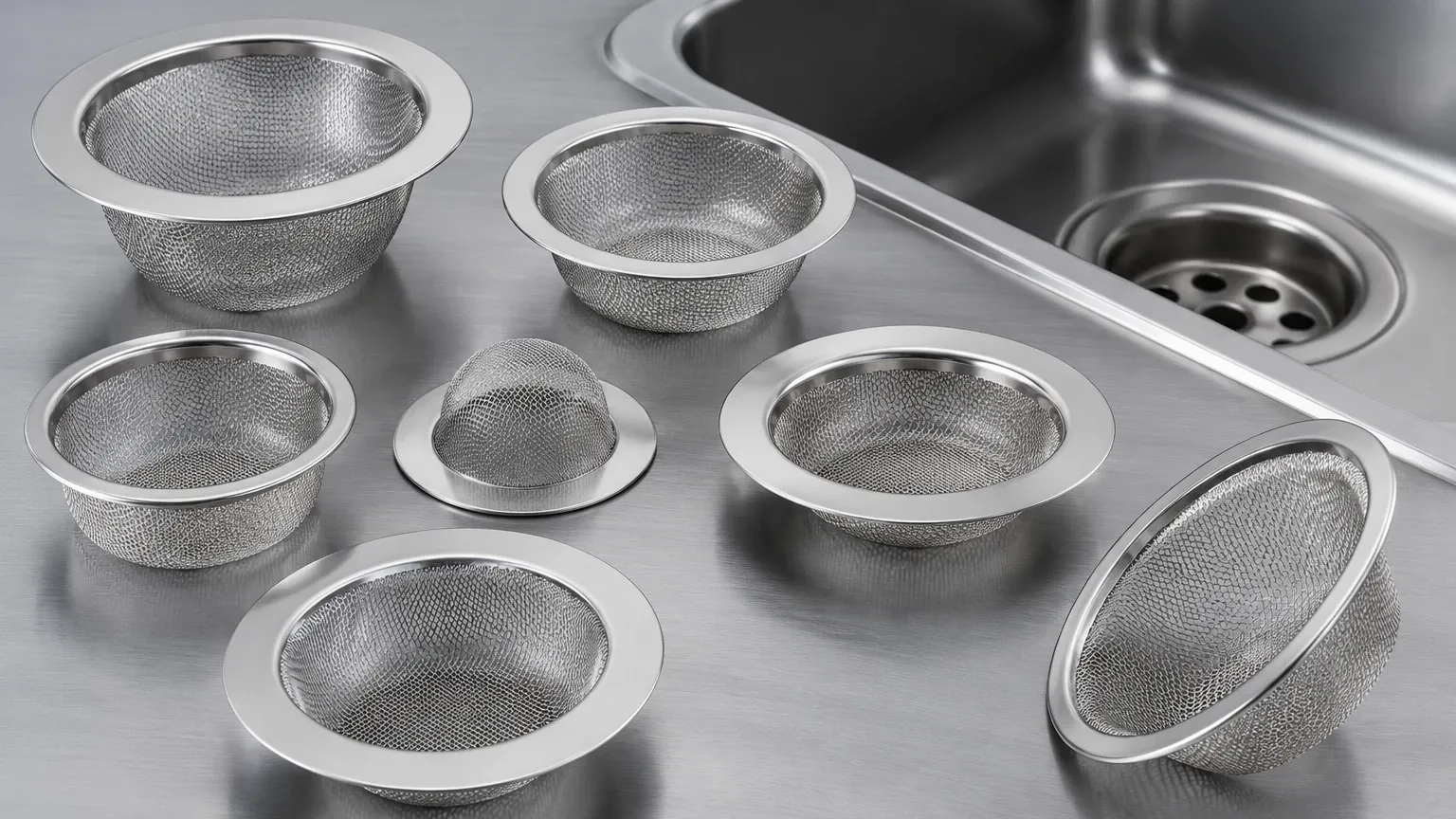
Flat mesh strainers are often used in shallow basins where space is limited. However, they have a smaller surface area and can clog quickly. Recessed or "basket" designs provide a significantly larger collection volume. This allows for longer intervals between cleanings, which is essential in high-volume production environments.
Reinforcement and Support
In larger industrial applications, the fine mesh itself may not be strong enough to support the weight of the captured debris or the force of the fluid flow. In these cases, the mesh is often bonded to a perforated metal backing or a heavy-duty wire frame. This composite structure ensures that the mesh does not deform or burst under load.
Handle and Removal Mechanisms
Ease of maintenance is a key consideration for B2B procurement. Strainers should feature ergonomic handles or lift-out tabs that allow operators to remove them quickly, even when wearing heavy protective gloves. Secure locking mechanisms may also be necessary to prevent the strainer from becoming dislodged by turbulent flow.
Key Performance Indicators (KPIs) for Industrial Selection
When evaluating mesh sink strainers for a project, technical professionals should focus on several key performance indicators to ensure the product meets the application's demands.
1. Pressure Drop (Delta P): The difference in pressure between the inlet and outlet of the strainer. A high pressure drop indicates that the strainer is either too fine for the application or is becoming clogged. System design should account for the pressure drop of a clean strainer and the maximum allowable drop before cleaning is required.
2. Dirt Holding Capacity: This refers to the volume of debris a strainer can hold before it significantly impacts flow. In industrial settings, maximizing this capacity reduces labor costs associated with manual cleaning.
3. Mechanical Fatigue Resistance: In systems with pulsating flows or frequent thermal cycling, the mesh and its welds must be able to withstand repeated stress without cracking.
4. Chemical Compatibility: Beyond the base metal, any seals, gaskets, or adhesives used in the construction of the strainer must be compatible with the process fluid.
Customization and OEM Requirements
Standard off-the-shelf strainers often fail to meet the specific requirements of complex industrial systems. This is where custom manufacturing becomes essential. Customization allows for the optimization of every variable, from the exact micron rating to the unique flange dimensions required for integration into proprietary machinery.
Bespoke Dimensions and Tolerances
In many OEM applications, a mesh sink strainer must fit into a precision-machined housing. Custom manufacturers can produce strainers with tight tolerances that ensure a bypass-free fit. This is critical in pharmaceutical and high-purity chemical applications where even a small amount of bypass can contaminate the final product.
Specialized Material Combinations
Some applications may require a combination of materials, such as a stainless steel mesh with a PTFE-coated rim for chemical inertness, or a magnetic insert to capture ferrous particles. Working with a specialized manufacturer like Kaifil allows engineers to develop these multi-functional filtration components.
Maintenance Protocols and Service Life Optimization
The total cost of ownership (TCO) of a mesh sink strainer is heavily influenced by its maintenance requirements and its ultimate lifespan. A high-quality strainer that is properly maintained will always be more cost-effective than a cheaper alternative that requires frequent replacement.
Cleaning Procedures
Industrial mesh strainers should be cleaned according to a set schedule based on the debris load. Cleaning methods vary from simple manual rinsing to ultrasonic cleaning for fine meshes that have become blinded by microscopic particles. It is important to avoid using abrasive tools that could damage the wire mesh or compromise the protective oxide layer of the stainless steel.
Inspection for Wear and Damage
Regular inspections should look for signs of "blinding" (permanent clogging of the mesh), pitting corrosion, or broken wires. If a mesh becomes compromised, it can release metal fragments into the system, causing the very damage it was intended to prevent. In high-stakes environments, a secondary "safety" strainer may be installed further downstream.
Replacement Cycles
While stainless steel strainers are highly durable, they are not permanent. Establishing a clear replacement cycle based on empirical data—such as the frequency of mesh failure or the gradual increase in baseline pressure drop—ensures that the system remains protected. Procurement teams should maintain a stock of critical spares to prevent downtime during unexpected failures.
Conclusion: Making Informed Purchasing Decisions
Selecting the right mesh sink strainers for an industrial application requires a technical approach that looks beyond the initial purchase price. By focusing on material grade, mesh specifications, and structural design, engineers can ensure that their filtration solutions provide reliable protection and efficient flow.
For those managing complex projects, partnering with a manufacturer that understands the nuances of industrial filtration is vital. Whether the requirement is for standard Strainers & Baskets or a fully customized OEM solution, the focus must always remain on precision, durability, and performance. By confirming the specific chemical, thermal, and mechanical demands of the application before purchase, technical teams can secure a filtration component that contributes to the long-term success and efficiency of their operations.
