


Mesh Strainers
In industrial fluid handling systems, the integrity of downstream equipment—such as pumps, valves, and instrumentation—depends heavily on the efficiency of primary filtration. Mesh strainers serve as a critical mechanical barrier, designed to remove oversized particulate matter from process streams. Unlike fine membrane filters used for sub-micron sterilization, industrial mesh strainers are typically utilized for coarse to fine filtration where high flow rates and low pressure drops are operational requirements.
Selecting the appropriate mesh strainer involves more than simply matching a pipe size. It requires an engineering-led evaluation of material compatibility, structural integrity under pressure, and the specific rheology of the fluid being processed. For engineers and procurement teams, understanding the technical nuances of wire mesh construction and its integration into larger Strainers & Baskets is essential for optimizing system uptime and reducing maintenance overhead.
Engineering Fundamentals of Industrial Mesh
The performance of mesh strainers is dictated by the geometry and material of the wire cloth used in their construction. In B2B industrial applications, stainless steel—specifically Grades 304 and 316L—is the standard due to its mechanical strength and resistance to oxidation.
Weave Types and Their Impact
The method by which wires are interlaced determines the strainer’s aperture precision and mechanical durability:
* Plain Weave: The most common configuration where each warp wire crosses alternately over and under each shute wire. It provides the highest open area and lowest pressure drop, suitable for general-purpose straining.
* Twill Weave: Each warp wire passes over and under two shute wires. This allows for the use of heavier wires in a given mesh count, increasing the strainer’s resistance to high-pressure surges.
* Dutch Weave: Utilizes different wire diameters for the warp and shute. This creates a dense, tortuous path for the fluid, offering superior strength and finer filtration ratings (down to 5–10 microns) compared to standard square mesh.
Aperture and Open Area
Engineers must calculate the "Percentage of Open Area" to predict flow efficiency. A higher open area reduces the velocity of the fluid as it passes through the mesh, which in turn minimizes the risk of particle "breakthrough" and reduces the initial pressure drop (Delta P). However, a very high open area often implies thinner wires, which may compromise the structural lifespan of the component in high-vibration environments.
Integrating Mesh into Strainers & Baskets
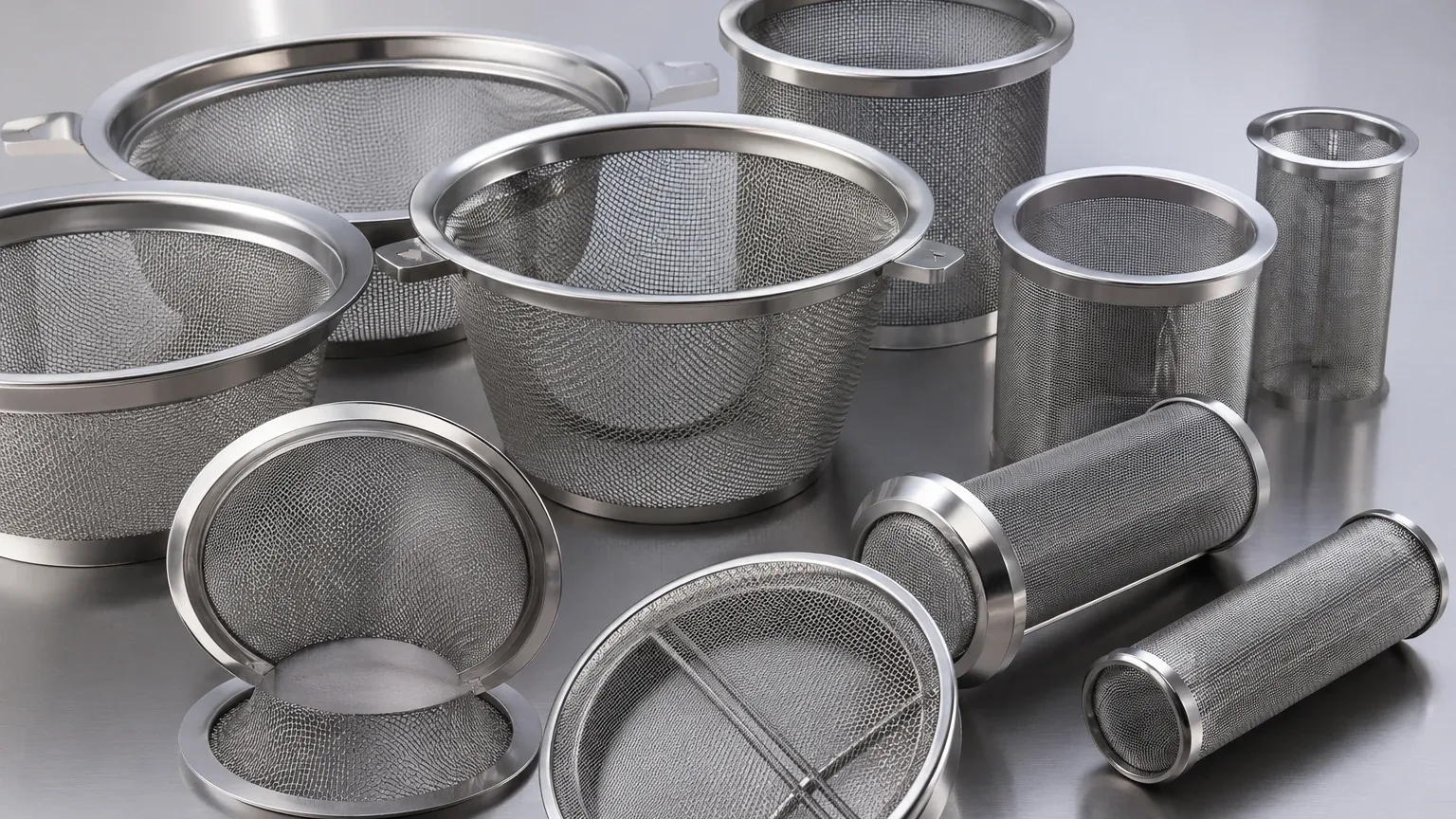
While the mesh provides the filtration logic, the housing or basket provides the structural framework. In heavy-duty industrial environments, a fine mesh layer is rarely used in isolation. Instead, it is typically supported by a perforated metal backup or a heavier wire frame.
Structural Support Systems
Fine mesh strainers are susceptible to deformation if the differential pressure exceeds the material’s yield strength. To prevent mesh collapse, manufacturers like Kaifil engineer composite designs where the fine mesh is sintered or resistance-welded to a perforated stainless steel basket. This configuration allows the strainer to handle the mechanical loads of the fluid column while the mesh performs the precision separation.
Customization of Basket Geometry
Industrial systems often require non-standard geometries to fit existing housings or to accommodate specific flow patterns (e.g., slant-top baskets or multi-layer pleated inserts). Customization options include:
* Flange and Handle Designs: Specialized lift handles or slanted flanges to ensure a bypass-free seal within the strainer housing.
* Reinforced Bottoms: For applications involving heavy sludge or metallic debris, reinforced solid bottoms prevent the basket from sagging or tearing during extraction.
* Pleated Mesh Inserts: To increase the effective filtration surface area without increasing the footprint of the strainer, pleating the mesh can provide 2x to 4x the dirt-holding capacity of a standard cylindrical basket.
Key Performance Criteria for Selection
When specifying mesh strainers for a project, engineers should evaluate several technical variables to ensure the component meets the intended service life.
Micron Rating vs. Mesh Count
It is vital to distinguish between mesh count (the number of openings per linear inch) and the micron rating (the actual size of the opening). Because wire diameter varies, two "100 mesh" strainers can have significantly different micron ratings. Engineers should always request the absolute or nominal micron rating to ensure compatibility with downstream tolerances.
Differential Pressure (Delta P) Management
The pressure drop across a clean strainer is a function of fluid viscosity, flow rate, and the strainer’s open area. A well-designed system typically targets an initial clean pressure drop of less than 2 PSI. As the mesh strainers accumulate debris, the Delta P increases. If the system is not equipped with a bypass or a high-pressure alarm, the mesh may eventually blind, leading to pump cavitation or structural failure of the basket.
Chemical and Thermal Compatibility
While stainless steel is highly versatile, certain industrial processes involve aggressive chlorides or high-temperature acids that can cause pitting or stress corrosion cracking. In pharmaceutical and food processing, the mesh must also meet sanitary standards, ensuring that the wire intersections are polished or bonded in a way that prevents bacterial growth in "dead zones."
Common Risks and Operational Challenges
Failure to properly specify or maintain mesh strainers can lead to significant operational risks. Understanding these challenges allows for better preventative engineering.
Mesh Blinding and Plugging
Blinding occurs when particles that are roughly the same size as the mesh openings become wedged in the apertures. This is particularly common with fibrous materials or deformable solids. Selecting a Dutch weave or a pleated design can mitigate this by providing a more complex path or a larger surface area to distribute the load.
Media Migration and Fatigue
In systems with high-frequency pressure pulsations (such as those near reciprocating pumps), the individual wires in the mesh can undergo fatigue. Over time, this can lead to wire breakage and "media migration," where fragments of the stainless steel mesh enter the process stream. Utilizing sintered mesh, where the wire intersections are thermally bonded, significantly reduces this risk.
Bypass Leakage
A strainer is only as effective as its seal. If the basket does not fit precisely within the housing, or if the gasket material is incompatible with the process fluid, contaminated fluid will take the path of least resistance and bypass the mesh entirely. Precision machining of the strainer flange is critical for high-purity applications.
Maintenance and Total Cost of Ownership (TCO)
From a B2B procurement perspective, the initial purchase price of a mesh strainer is often a small fraction of its total lifetime cost. Reusable stainless steel components offer significant TCO advantages over disposable cartridges, provided they are maintained correctly.
Cleaning Protocols
Stainless steel mesh can be cleaned using several methods depending on the contaminant:
1. Backwashing: Reversing the flow to dislodge surface-level debris.
2. Ultrasonic Cleaning: Using high-frequency sound waves in a solvent bath to remove deeply embedded particles from fine Dutch weaves.
3. Chemical Cleaning: Using mild acids or bases to dissolve organic buildup, followed by thorough passivation to restore the oxide layer of the stainless steel.
Replacement Cycles
Even with regular cleaning, mesh strainers eventually reach a point of mechanical fatigue or permanent plugging. Establishing a replacement cycle based on the number of cleaning hits or a maximum allowable Delta P (after cleaning) is essential for maintaining process safety.
Engineering Confirmation: Next Steps for Procurement
Before finalizing a purchase order for industrial mesh strainers, engineering teams should confirm the following technical details with the manufacturer:
* Fluid Profile: Confirm the viscosity, temperature, and chemical composition (including pH and chloride levels).
* Contaminant Load: Determine the expected particle size distribution and the nature of the solids (hard, soft, or fibrous).
* Flow Rate Requirements: Specify the minimum and maximum flow rates to ensure the strainer body and mesh can handle the velocity without excessive turbulence.
* Certification Needs: For food, beverage, or pharmaceutical sectors, confirm if the materials meet FDA or 3A sanitary standards.
By focusing on these factual engineering parameters, organizations can ensure they select a filtration solution that provides reliable protection and long-term durability. For specialized configurations and high-performance requirements, exploring custom-fabricated Strainers & Baskets ensures that the filtration component is perfectly aligned with the unique demands of the industrial application.
