


Mueller Strainers
In industrial fluid handling systems, the protection of downstream equipment is a critical engineering priority. Components such as pumps, flow meters, control valves, and heat exchangers are susceptible to damage from entrained solids, scale, and debris. Mueller strainers have long been recognized in the industry as a standard for robust pipeline protection. These mechanical components are designed to remove foreign particles from flowing liquids or gases through a perforated or wire mesh straining element. For engineers and procurement teams, selecting the correct configuration of Strainers & Baskets is not merely a matter of fitting a pipe size, but a complex calculation involving flow dynamics, material compatibility, and maintenance cycles.
Industrial filtration requires a deep understanding of the medium being processed. Whether the application involves steam, water, oil, or corrosive chemicals, the strainer serves as the first line of defense. This guide examines the technical specifications, selection criteria, and engineering considerations essential for integrating high-performance straining solutions into industrial infrastructures.
Technical Classifications of Industrial Strainers
When discussing mueller strainers and similar industrial-grade components, the classification is typically based on the geometry of the housing and the orientation of the flow. Each design offers specific advantages depending on the pressure requirements and the volume of debris expected in the system.
Y-Strainers
The Y-strainer is perhaps the most common configuration used in high-pressure liquid and gas pipelines. Named for its "Y" shape, this design allows the straining element to be positioned at an angle to the main flow path. This configuration is ideal for applications where the amount of solids to be removed is relatively small, or where frequent cleaning is not required. Because of their compact footprint, Y-strainers are frequently used in steam lines and pressurized gas systems. They can be installed in either horizontal or vertical (downward flow) positions, providing significant installation flexibility.
Basket Strainers (Simplex)
Basket strainers, or T-strainers, feature a vertical cylinder that houses a large-capacity basket. These are designed for horizontal pipelines where a higher volume of debris is anticipated. The primary advantage of the basket design is the larger surface area of the straining element compared to a Y-strainer. This results in a lower initial pressure drop and longer intervals between cleaning cycles. In many industrial processes, such as cooling water intake or chemical batching, the high dirt-holding capacity of basket strainers is essential for maintaining operational efficiency.
Duplex Strainers
For operations that cannot be shut down for maintenance, duplex strainers are the standard solution. A duplex system consists of two separate strainer chambers connected by a diversion valve. When one basket becomes clogged, the flow is diverted to the clean chamber, allowing the operator to remove and clean the first basket without interrupting the process. This is a critical requirement in lubrication systems, continuous chemical processing, and fuel oil filtration where downtime results in significant financial loss.
Material Selection and Corrosion Resistance
The longevity of mueller strainers depends heavily on the materials used for both the housing and the internal baskets. In B2B industrial environments, material selection is dictated by the chemical properties of the fluid, the operating temperature, and the external environment.
1. Stainless Steel (304/316/316L): Stainless steel is the preferred material for food and beverage, pharmaceutical, and chemical applications. Type 316 stainless steel, containing molybdenum, offers superior resistance to chloride-induced pitting and crevice corrosion. For high-purity applications, 316L (low carbon) is used to prevent sensitization during welding processes.
2. Carbon Steel: Suitable for oil and gas applications where corrosion is less of a concern or can be managed through chemical inhibitors. Carbon steel offers high structural strength and cost-effectiveness for non-corrosive media.
3. Specialty Alloys: In highly aggressive environments, such as seawater filtration or concentrated acid processing, alloys like Monel, Hastelloy, or Duplex Stainless Steel may be required to prevent premature failure of the strainer housing or the internal mesh.
At Kaifil, the focus remains on high-performance stainless steel solutions, ensuring that the Strainers & Baskets provided meet the stringent hygiene and durability standards required by modern industrial processing plants.
Engineering the Straining Element: Mesh vs. Perforation
The performance of mueller strainers is defined by the internal element. Engineers must distinguish between "straining" and "filtering," though the terms are often used interchangeably. Straining typically refers to the removal of larger particles (above 40 microns), while filtration handles finer particulates.
Perforated Sheets
Perforated metal is the most robust type of straining element. It is typically used for coarse straining where the particle size is relatively large (e.g., 1/16" to 1/4"). The strength of the perforated sheet allows it to withstand significant differential pressure without collapsing. However, the open area ratio (OAR) of perforated metal is generally lower than that of wire mesh.
Wire Mesh Linings
For finer particle removal, a wire mesh lining is added to the perforated basket. This allows for filtration down to very fine micron levels. When selecting mesh, engineers must consider the "Open Area Ratio," which is the relationship between the total area of the openings in the mesh and the area of the pipe inlet. A well-designed strainer should have an OAR of at least 4:1. A higher OAR ensures that the pressure drop across the unit remains low even as the basket begins to fill with debris.
Pressure Drop and Flow Dynamics
One of the most critical factors in strainer selection is the pressure drop ($ΔP$). Every component in a pipeline creates resistance to flow. If the pressure drop across a strainer is too high, it can lead to cavitation in pumps or insufficient flow to downstream processes.
Calculating Clean Pressure Drop
The clean pressure drop is the resistance measured when the strainer is first installed with a clean basket. This is influenced by the fluid's viscosity, specific gravity, and velocity. As debris accumulates, the effective open area decreases, and the pressure drop increases exponentially.
Terminal Pressure Drop
Engineers must define a "terminal pressure drop"—the point at which the strainer must be cleaned. Most industrial systems utilize differential pressure gauges (DP gauges) to monitor this. If the $ΔP$ exceeds the structural limits of the basket, the element may burst or collapse, allowing all captured debris to bypass into the downstream system. High-quality Strainers & Baskets are engineered with reinforced skeletons to withstand these pressure spikes.
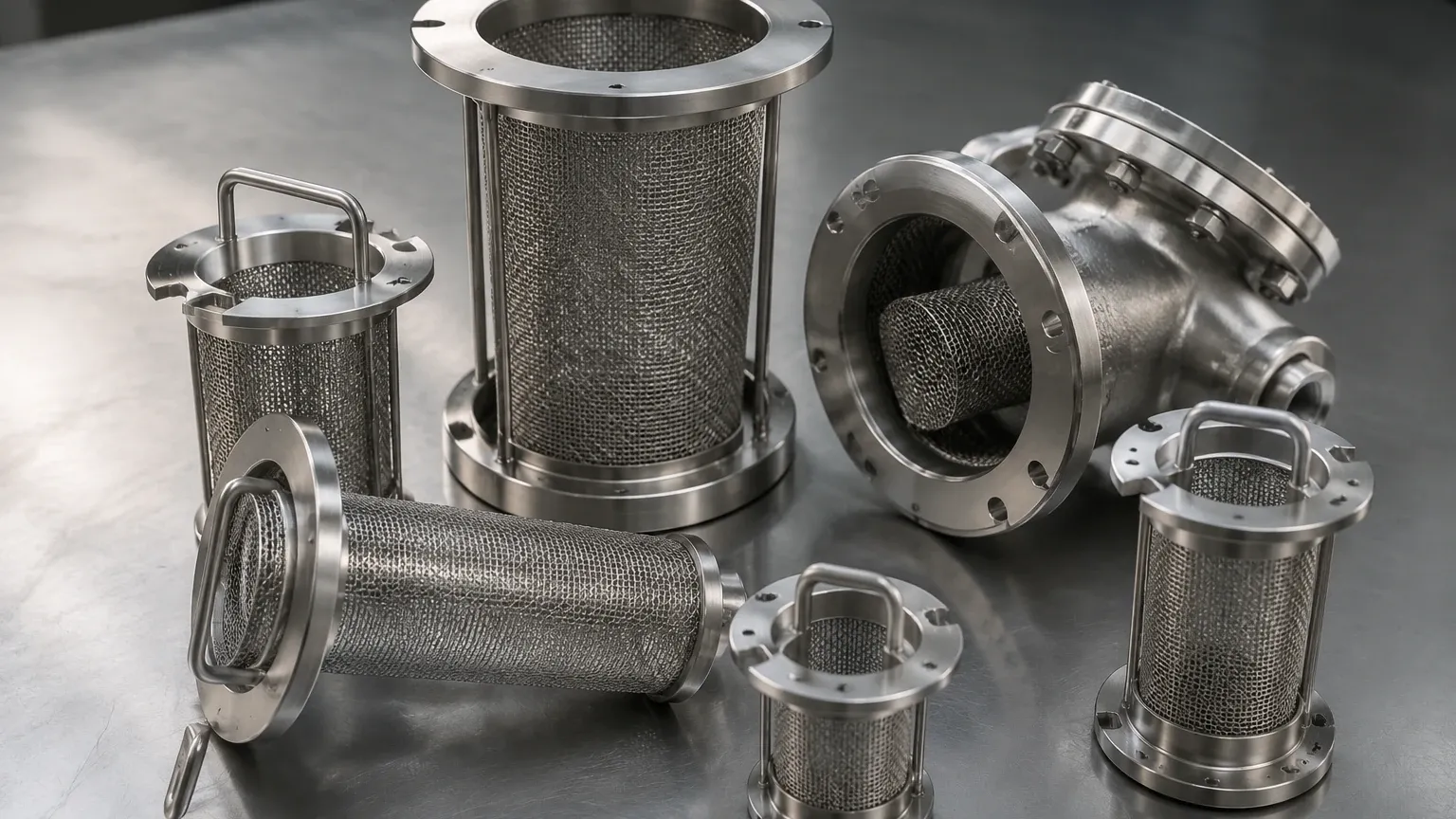
Customization and OEM Considerations
While standard mueller strainers meet many general requirements, complex industrial applications often demand customized solutions. OEM manufacturing allows for the integration of specific features that improve performance and ease of maintenance.
* Custom Flange Ratings: Matching the strainer housing to specific ANSI, DIN, or JIS flange standards to ensure leak-proof integration into existing piping.
* Magnetic Inserts: For applications involving hydraulic oils or machining coolants, magnetic rods can be placed inside the basket to capture fine ferrous particles that might otherwise pass through the mesh.
* Specialty Coatings: Epoxy or PTFE coatings can be applied to the interior of the strainer housing to enhance chemical resistance or reduce friction.
* Reinforced Baskets: For high-viscosity fluids or high-pressure systems, baskets can be reinforced with external cages or internal supports to prevent deformation under heavy loads.
Kaifil specializes in these customized configurations, working closely with engineering teams to develop filtration components that are tailored to specific flow rates and particulate profiles.
Maintenance and Operational Best Practices
The total cost of ownership (TCO) for mueller strainers is determined more by maintenance and downtime than by the initial purchase price. Implementing a rigorous maintenance schedule is essential for system reliability.
Cleaning Procedures
When cleaning a basket strainer, it is vital to ensure the system is depressurized and drained before opening the housing. For Y-strainers, a "blow-down" valve can be installed on the strainer cap, allowing the operator to flush out debris using the line pressure without opening the unit. However, this is only effective for loose, non-fibrous debris.
Gasket and Seal Integrity
Every time a strainer is opened for cleaning, the cover gasket should be inspected. Using high-quality O-rings or flat gaskets (made of Viton, EPDM, or PTFE) ensures that the unit remains leak-free upon reassembly. Repeatedly using a compromised gasket is a common cause of industrial leaks and safety hazards.
Spare Parts Management
For critical processes, maintaining an inventory of spare baskets and gaskets is mandatory. Having a clean basket ready for immediate swap-out minimizes the time the process remains offline. When ordering replacements, it is important to confirm the micron rating and material grade to ensure continued process consistency.
Conclusion: Selecting the Right Partner for Filtration
Choosing the right straining solution requires a balance between technical performance and economic viability. Whether you are replacing existing mueller strainers or designing a new process line, the focus should remain on the quality of the internal components and the precision of the manufacturing process. Stainless steel filtration solutions offer the durability and hygiene required for the most demanding B2B sectors, from chemical processing to pharmaceutical manufacturing.
By understanding the nuances of mesh selection, pressure drop calculations, and material science, engineers can optimize their systems for maximum uptime. For those seeking high-performance, customized filtration components, exploring the range of Strainers & Baskets provides a pathway to reliable and efficient industrial operations. Kaifil remains committed to providing the engineering expertise and manufacturing precision necessary to support global industrial filtration needs, ensuring that every component delivers the exact performance required for its specific application.
