


Natural Gas Strainers
In the midstream and downstream segments of the oil and gas industry, the integrity of natural gas pipelines is paramount to operational safety and equipment longevity. Natural gas strainers serve as a critical mechanical defense mechanism, designed to remove solid contaminants from gas streams before they reach sensitive downstream components such as compressors, pressure regulators, flow meters, and turbines. Without effective filtration, particulates such as pipe scale, rust, weld slag, and sand can cause catastrophic equipment failure, leading to unplanned downtime and significant financial loss.
Selecting the appropriate natural gas strainers requires a deep understanding of fluid dynamics, material compatibility, and the specific contaminants present in the gas stream. This guide examines the technical specifications, engineering considerations, and operational maintenance required to optimize filtration performance in natural gas applications.
The Critical Role of Strainers in Natural Gas Infrastructure
Natural gas is rarely "clean" at the point of transport. As gas moves through hundreds of miles of carbon steel piping, it inevitably picks up debris. One of the most common challenges in gas filtration is the presence of "black powder"—a mixture of iron sulfides and iron oxides that forms due to internal corrosion of the pipeline. These fine particulates are highly abrasive and can erode valve seats or clog the intricate internals of gas meters.
Natural gas strainers are typically installed at city gate stations, compressor stations, and industrial burner inlets. Their primary function is to provide a physical barrier that captures solids while allowing the gas to pass through with minimal pressure resistance. By maintaining a clean gas stream, these components ensure that the custody transfer meters remain accurate and that high-speed rotating equipment, such as centrifugal compressors, is protected from particulate impingement.
Engineering Specifications and Design Standards
When specifying natural gas strainers, engineers must adhere to stringent industry standards to ensure the pressure vessel can withstand the operating environment. Most industrial gas strainers are designed and manufactured in accordance with ASME Section VIII, Division 1 for pressure vessels, and piping standards such as ASME B31.8 (Gas Transmission and Distribution Piping Systems).
Pressure Ratings and Flow Velocity
The design pressure of the strainer must exceed the maximum allowable operating pressure (MAOP) of the pipeline. Common ratings include ANSI/ASME 150#, 300#, and 600#, though high-pressure transmission lines may require 900# or 2500# ratings.
Flow velocity is another critical factor. If the gas velocity through the strainer is too high, it can cause "carryover," where particulates are forced through the mesh or the mesh itself suffers mechanical fatigue. Engineers typically target a specific velocity range to balance filtration efficiency with the physical size of the strainer housing.
Pressure Drop (ΔP) Calculations
The pressure drop across a strainer is the difference in pressure between the inlet and the outlet. In natural gas systems, maintaining a low differential pressure is vital for energy efficiency. A high initial pressure drop indicates that the strainer is either undersized or the mesh is too fine for the application. The total pressure drop is a combination of the housing loss and the clean media loss. As debris accumulates, the ΔP increases, necessitating a cleaning cycle.
Comparing Configurations: Strainers & Baskets
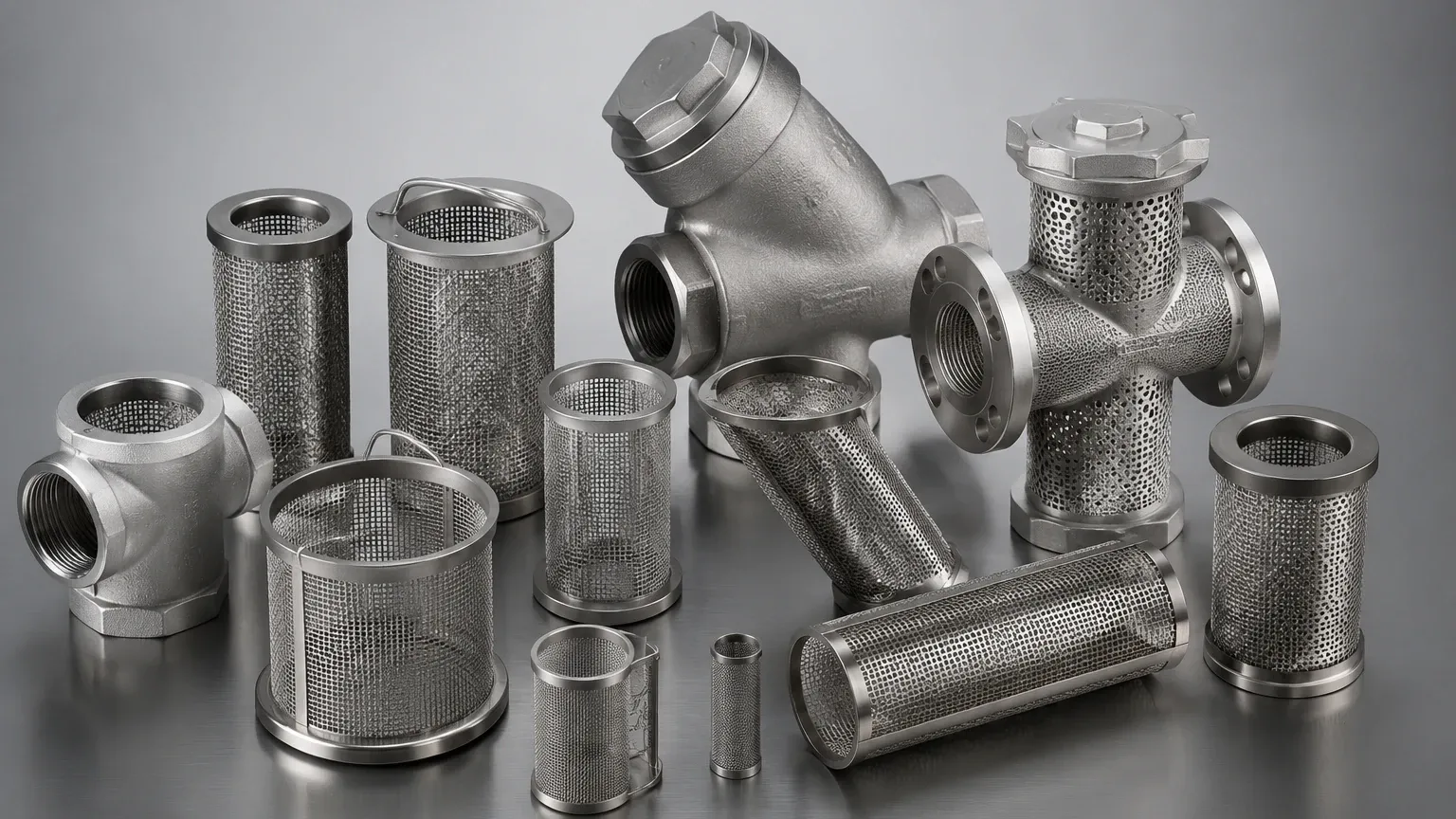
The choice between different strainer configurations often depends on the volume of debris expected and the allowable downtime for maintenance. While Y-strainers are common for small-diameter pipes with low debris loads, industrial gas applications frequently utilize Strainers & Baskets for their superior dirt-holding capacity.
Basket Strainers (Simplex and Duplex)
Basket strainers feature a vertical cylinder that houses a removable basket-shaped screen. Because the basket has a larger surface area than a Y-strainer screen, it can hold more contaminants before requiring service.
* Simplex Strainers: These are used in systems where the gas flow can be temporarily shut down to remove and clean the basket.
* Duplex Strainers: For continuous processes where shutdown is not an option, duplex strainers utilize two separate chambers connected by a diversion valve. When one side becomes clogged, the flow is switched to the clean chamber, allowing the operator to service the dirty basket without interrupting the gas supply.
Y-Strainers
Y-strainers are more compact and are often used in high-pressure gas lines where space is limited. However, they have a smaller storage capacity for debris and are generally reserved for applications where the gas is relatively clean, serving as a "safety net" rather than a primary filter.
Material Selection for Natural Gas Environments
Material compatibility is a primary concern in natural gas filtration, particularly when dealing with "sour gas" (gas containing hydrogen sulfide, H2S). H2S can lead to sulfide stress cracking (SSC) in certain metals, requiring materials that comply with NACE MR0175/ISO 15156 standards.
Stainless Steel Components
For the internal filtration elements, stainless steel is the industry standard due to its corrosion resistance and mechanical strength. Grades such as 304 and 316L are commonly used for the wire mesh and perforated supports. Stainless steel provides the necessary durability to withstand the high-velocity impact of particulates without deforming. In offshore or highly corrosive environments, specialized alloys like Duplex or Super Duplex stainless steel may be specified to ensure a longer service life.
Housing Materials
While the internal baskets are almost always stainless steel, the outer housing may be constructed from carbon steel (A106, A234, or A105) for standard applications, or stainless steel for high-purity or corrosive gas streams. The choice of housing material impacts the total cost of ownership and the expected lifespan of the installation.
Filtration Accuracy and Mesh Selection
The performance of natural gas strainers is defined by their filtration accuracy, typically measured in mesh size or microns. Selecting the right mesh is a balance between protecting downstream equipment and avoiding frequent clogging.
1. Perforated Plate: This serves as the primary structural support for the basket. It can also act as a coarse strainer for large debris (e.g., 1/8" or 1/16" holes).
2. Wire Mesh Lining: For finer filtration, a layer of stainless steel wire mesh is sintered or welded to the perforated plate. In natural gas applications, mesh sizes often range from 40 mesh (approx. 400 microns) for coarse protection to 200 mesh (approx. 74 microns) for finer requirements.
Engineers must confirm the particle size distribution of the contaminants in their specific gas stream. If the mesh is too coarse, fine dust will pass through and damage downstream seals. If it is too fine, the strainer will require cleaning too frequently, increasing labor costs.
Operational Risks and Maintenance Protocols
Failure to maintain natural gas strainers can lead to several operational risks. The most significant is the structural failure of the basket. If the differential pressure exceeds the basket's collapse rating, the screen can rupture, sending both the captured debris and pieces of the basket into the downstream equipment.
Differential Pressure Monitoring
Every industrial gas strainer should be equipped with a differential pressure (DP) gauge or transmitter. This allows operators to monitor the "health" of the strainer in real-time. Standard operating procedures typically dictate that the basket must be cleaned when the DP reaches a predetermined limit (e.g., 10-15 psi), depending on the system design.
Cleaning and Inspection
When cleaning natural gas strainers, it is essential to inspect the mesh for signs of erosion, pitting, or mechanical fatigue. Because natural gas is flammable, the housing must be properly depressurized and purged before opening. Using reusable stainless steel baskets is a cost-effective strategy, as they can be ultrasonically cleaned or pressure-washed and returned to service multiple times.
Customization for Specialized Gas Applications
Standard off-the-shelf strainers may not meet the requirements of every industrial site. Customization is often necessary to accommodate specific flow rates, connection types (flanged, butt-weld, or socket-weld), or space constraints.
OEM manufacturers like Kaifil specialize in developing custom stainless steel filtration solutions that address these unique challenges. This includes engineering baskets with reinforced supports for high-pressure surges or designing multi-layered sintered mesh elements for precise filtration in pharmaceutical or food-grade gas applications. Customization ensures that the strainer is not just a component, but a tailored solution for the specific chemistry and physics of the gas stream.
Technical Checklist for Purchasing Natural Gas Strainers
Before finalizing a procurement order for natural gas strainers, engineering and purchasing teams should confirm the following technical parameters:
* Gas Composition: Is the gas sweet or sour? Does it contain liquid aerosols (condensate)?
* Operating Pressure and Temperature: What are the minimum, normal, and maximum values?
* Flow Rate: What is the standard cubic feet per hour (SCFH) or day (SCFD)?
* Required Filtration Level: What is the micron rating required by the manufacturer of the downstream equipment (e.g., the turbine or meter)?
* Allowable Pressure Drop: What is the maximum ΔP the system can tolerate when the strainer is clean?
* Connection Standards: Does the site require RF (Raised Face) or RTJ (Ring Type Joint) flanges?
* Closure Type: Does the application require a quick-opening closure for frequent cleaning, or is a standard bolted cover sufficient?
By addressing these factors, engineers can ensure that their selection of natural gas strainers provides reliable, long-term protection for their infrastructure. Investing in high-quality stainless steel filtration components is a fundamental step in reducing the total cost of ownership and maintaining the safety of natural gas distribution and processing systems.
