


Nylon Strainers
In the diverse landscape of industrial filtration, selecting the appropriate material for media retention and particulate separation is a critical engineering decision. Nylon strainers, constructed from various grades of polyamide (PA), represent a versatile solution for applications requiring specific chemical resistance, flexibility, and cost-effective performance. While stainless steel remains the gold standard for high-pressure and extreme-temperature environments, nylon offers unique advantages in specialized industrial contexts, particularly where metal contamination must be avoided or where specific organic solvent resistance is required.
For engineers and procurement specialists, understanding the technical boundaries of nylon as a filtration medium is essential for optimizing system uptime and ensuring product purity. This guide examines the mechanical properties, application suitability, and engineering considerations of nylon filtration components, providing a framework for comparing them against permanent Strainers & Baskets used in heavy-duty industrial processes.
Understanding Nylon as a Filtration Material
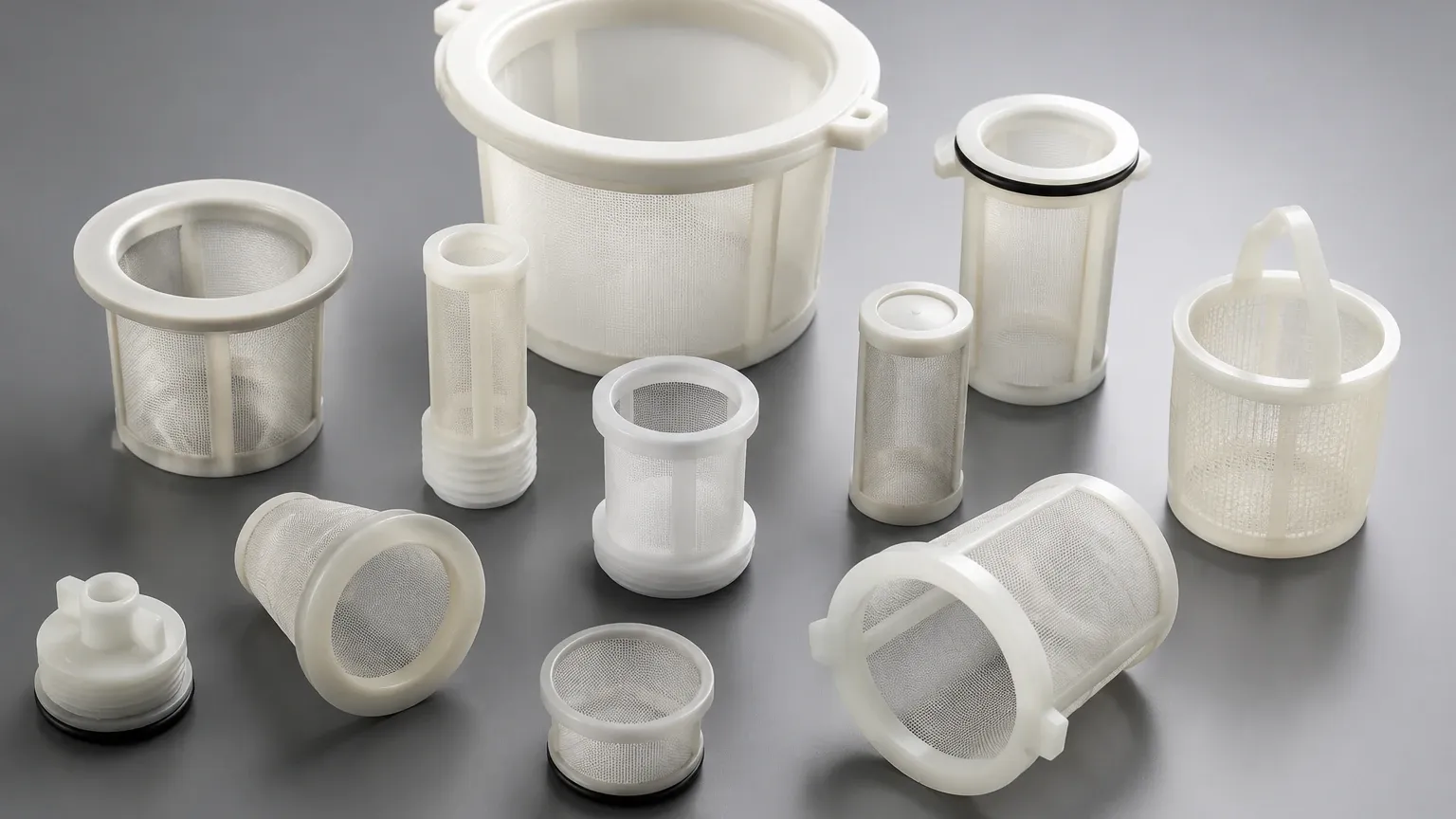
Nylon is a synthetic polymer belonging to the polyamide family. In filtration, it is most commonly utilized in the form of woven monofilament or multifilament mesh. The material is characterized by its high tensile strength, excellent abrasion resistance, and a relatively low coefficient of friction.
Chemical Compatibility
One of the primary reasons engineers specify nylon strainers is their specific chemical profile. Nylon exhibits excellent resistance to:
* Alkalis: It remains stable in high-pH environments where other polymers might degrade.
* Organic Solvents: It is highly resistant to hydrocarbons, ketones, and esters, making it suitable for fuel filtration and solvent recovery.
* Microbiological Growth: Nylon does not support the growth of bacteria or fungi, which is a critical requirement in food and beverage applications.
However, nylon has notable limitations. It is susceptible to degradation by strong acids and oxidizing agents (such as bleach). Furthermore, nylon is hygroscopic, meaning it absorbs water. This absorption can lead to dimensional changes in the mesh, potentially altering the filtration accuracy (micron rating) in high-moisture environments. For applications involving aggressive acids or requiring absolute dimensional stability under varying humidity, stainless steel alternatives are typically preferred.
Thermal Limits
Nylon strainers generally operate effectively within a temperature range of -40°C to 115°C (-40°F to 239°F). While this is sufficient for many ambient and mid-temperature industrial processes, it falls significantly short of the capabilities of metallic filtration media. If a process involves steam cleaning or high-temperature chemical reactions, the structural integrity of a nylon strainer may be compromised, leading to fiber migration or mesh deformation.
Technical Specifications and Mesh Configurations
Nylon strainers are defined by their mesh geometry and the diameter of the fibers used in the weave. The precision of the weave determines the filtration efficiency and the ability of the strainer to withstand differential pressure.
Monofilament vs. Multifilament
* Monofilament Nylon: These are woven from a single, continuous strand of nylon. This results in highly precise pore sizes and a smooth surface that is easy to clean. Monofilament strainers are ideal for critical applications where exact particle retention (micron rating) is mandatory.
* Multifilament Nylon: These consist of multiple small-diameter fibers twisted together to form a single thread. While multifilament mesh offers higher surface area and can be more flexible, it is generally less precise than monofilament and can be more difficult to clean thoroughly, as particles may become trapped within the fiber twists.
Micron Ratings and Open Area
The "micron rating" indicates the size of particles the strainer is designed to retain. Nylon mesh can be manufactured with extremely fine apertures, often ranging from 10 microns to 1000 microns or more.
Another critical engineering metric is the "percentage of open area." This refers to the ratio of the total area of the holes to the total area of the mesh. A higher open area results in a lower initial pressure drop ($ΔP$) and higher flow rates, but it may reduce the mechanical strength of the mesh. Engineers must balance the need for high flow capacity with the requirement for structural durability under load.
Comparing Nylon Strainers with Stainless Steel Solutions
When designing a filtration system, the choice between nylon and stainless steel Strainers & Baskets often comes down to the specific demands of the operating environment and the total cost of ownership.
Durability and Mechanical Strength
Stainless steel (typically Grade 304 or 316L) offers vastly superior mechanical strength compared to nylon. In high-pressure systems where the strainer may be subjected to hydraulic shock or high differential pressures due to heavy cake loading, nylon mesh may stretch or tear. Stainless steel baskets are rigid and can be reinforced with perforated metal backings to withstand extreme pressure differentials without bypassing.
Longevity and Reusability
Nylon strainers are often treated as semi-disposable or limited-use components, especially in fine filtration applications. While they can be cleaned, the polymer fibers eventually fatigue or become permanently blinded. In contrast, stainless steel strainers are designed for long-term service. They can be subjected to aggressive cleaning cycles, including ultrasonic cleaning, backwashing, and chemical sanitization, without losing their structural properties.
Cost Considerations
From a CAPEX (Capital Expenditure) perspective, nylon strainers are significantly less expensive than their stainless steel counterparts. This makes them attractive for pilot plants, batch processes with frequent material changes, or low-pressure water filtration. However, from an OPEX (Operating Expenditure) perspective, the frequent replacement and potential for failure in demanding environments may make stainless steel the more economical choice over the life of the equipment.
Industrial Applications for Nylon Filtration
Despite the dominance of metal in heavy industry, nylon strainers occupy several critical niches where their specific properties are advantageous.
Food and Beverage Processing
Nylon is widely used in the food industry due to its compliance with FDA regulations and its non-reactive nature. It is commonly found in honey filtration, milk processing, and beverage clarification. The smooth surface of monofilament nylon allows for easy rinsing, which is vital for maintaining hygiene standards.
Paint, Ink, and Coatings
In the production of paints and coatings, nylon strainers are used to remove agglomerates and contaminants that could affect the finish quality. Because nylon is resistant to the solvents found in many industrial coatings, it provides a reliable filtration barrier that does not leach contaminants into the product.
Water Treatment and Irrigation
For large-scale water intake or irrigation systems, nylon mesh strainers serve as effective primary filters to remove sand, algae, and debris. Their lightweight nature makes them easy to handle during manual cleaning cycles in the field.
Automotive and Hydraulic Fluids
Nylon is frequently used in automotive fuel strainers and certain low-pressure hydraulic suction lines. Its resistance to petroleum-based fluids and its ability to be molded into complex shapes allow for integrated filtration solutions within compact engine components.
Engineering Considerations for Selection
Before integrating a nylon strainer into a system, engineers should confirm several operational parameters to prevent premature failure.
1. Flow Velocity: High fluid velocity can cause "fiber migration" in lower-quality nylon mesh, where small fragments of the polymer break off and contaminate the downstream filtrate. It can also cause the mesh to vibrate, leading to mechanical fatigue.
2. Differential Pressure (ΔP) Limits: Every strainer has a maximum allowable pressure drop before it must be cleaned or replaced. For nylon, this limit is much lower than for metal. Exceeding the ΔP limit can cause the mesh to distend, enlarging the pore sizes and allowing oversized particles to pass through.
3. Housing Compatibility: Nylon strainers must be properly seated within their housings. Because nylon is more flexible than metal, ensuring a proper seal at the flange or O-ring interface is critical to prevent "bypass," where fluid flows around the filter rather than through it.
4. Cleaning Protocols: If the strainer is intended to be reused, the cleaning method must be compatible with nylon. High-pressure water jets or stiff brushes can damage fine mesh. Engineers should specify cleaning procedures that use compatible detergents and moderate pressure.
Maintenance and Service Life
The service life of a nylon strainer is dictated by the solids loading of the process fluid and the frequency of cleaning. In many B2B industrial settings, nylon strainers are fitted with differential pressure gauges. A common rule of thumb is to initiate a cleaning cycle when the pressure drop reaches 0.5 to 1.0 bar (7 to 15 psi), depending on the fragility of the mesh.
Signs that a nylon strainer requires replacement include:
* Permanent Blinding: When particles become embedded so deeply in the weave that they cannot be removed by standard cleaning.
* Fraying or Tearing: Visible damage to the weave pattern, often occurring at the seams or where the mesh meets the support frame.
* Discoloration or Brittleness: This often indicates chemical attack or UV degradation, suggesting that the material is no longer fit for purpose.
Conclusion
Nylon strainers provide a targeted solution for filtration tasks where chemical compatibility with organic solvents and alkalis is paramount, or where cost-effective, lightweight filtration is required. However, for high-performance industrial environments characterized by high temperatures, extreme pressures, and the need for long-term durability, stainless steel Strainers & Baskets offer a more robust and reliable alternative. By carefully evaluating the chemical, thermal, and mechanical requirements of a process, engineers can select the filtration media that ensures the highest level of product quality and system efficiency.
