


P Strainer
In industrial fluid handling, the protection of downstream equipment such as pumps, valves, and instrumentation is a primary engineering concern. The P strainer, a specialized configuration within the broader category of Strainers & Baskets, serves as a critical line of defense against particulate contamination. Designed for inline installation, these components are engineered to remove coarse solids from liquid or gas streams, ensuring process stability and extending the service life of high-value mechanical assets.
Unlike fine filtration systems that utilize disposable cartridges, P strainers typically employ permanent, cleanable stainless steel elements. This makes them a cost-effective and sustainable choice for heavy-duty industrial applications where high flow rates and significant solids loading are common. Understanding the technical nuances of P strainer design, material selection, and performance metrics is essential for engineers tasked with optimizing filtration systems.
Engineering Design and Operating Principles of P Strainers
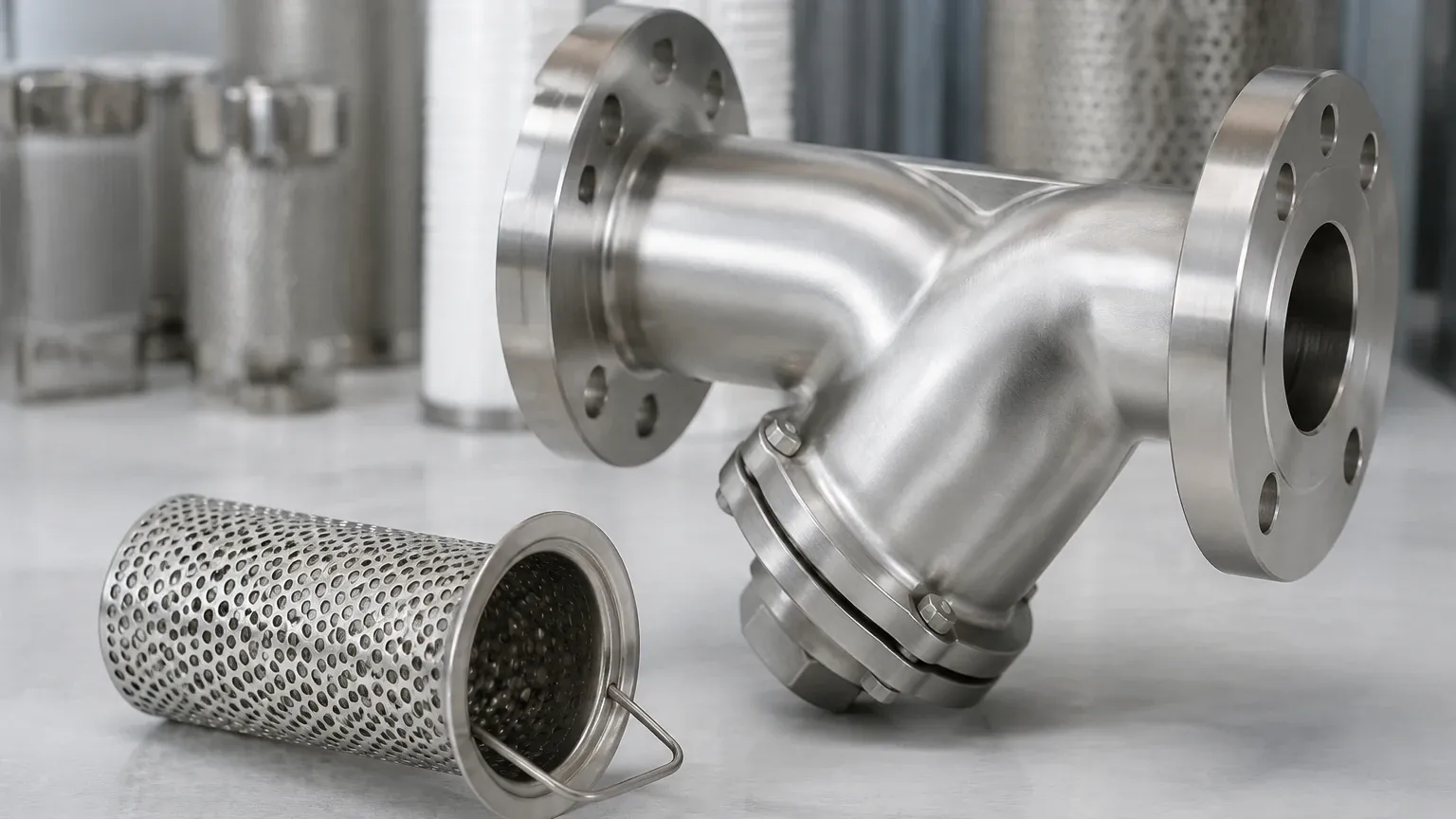
The P strainer is characterized by its specific housing geometry, which allows for an inline flow path while providing a localized collection chamber for debris. The "P" designation often refers to the offset or the specific orientation of the basket housing relative to the piping axis, which facilitates gravity-assisted particle settling and simplifies the removal of the internal basket.
Flow Dynamics and Pressure Drop
At the core of P strainer performance is the management of differential pressure ($ΔP$). As fluid enters the strainer body, it is directed through a perforated or mesh-lined basket. The velocity profile of the fluid changes as it passes through the straining medium. Engineers must balance the need for high filtration efficiency (smaller hole sizes) with the requirement for low initial pressure drop. A well-designed P strainer minimizes turbulence at the inlet and outlet ports, reducing energy consumption across the pumping system.
The Role of the Basket Element
The internal basket is the functional heart of the P strainer. These baskets are typically fabricated from perforated stainless steel sheets, which may be reinforced with a fine wire mesh liner for increased filtration accuracy. The structural integrity of the basket is paramount; it must withstand the mechanical stresses of high-pressure flow and the cumulative weight of captured debris without collapsing or deforming.
Material Selection and Compatibility for Industrial Applications
Material science plays a pivotal role in the longevity and reliability of Strainers & Baskets. Because P strainers are frequently exposed to corrosive chemicals, high temperatures, and abrasive slurries, selecting the appropriate alloy is a critical engineering decision.
Stainless Steel 304 vs. 316L
Most industrial P strainers are manufactured from 300-series stainless steel.
- Type 304: This is the standard grade for general-purpose applications. It offers excellent strength and good corrosion resistance in most atmospheric and water-treatment environments.
- Type 316L: For applications involving chemical processing, pharmaceuticals, or marine environments, 316L is preferred. The addition of molybdenum provides superior resistance to chloride-induced pitting and crevice corrosion. The "L" (low carbon) designation is crucial for components that require welding, as it prevents carbide precipitation and maintains corrosion resistance in the heat-affected zones.
Specialized Coatings and Exotic Alloys
In extreme environments—such as those involving highly acidic or alkaline process fluids—standard stainless steel may be insufficient. In these cases, P strainers can be fabricated from exotic alloys like Hastelloy, Monel, or Duplex stainless steel. Alternatively, internal surfaces can be coated with PTFE or other fluoropolymers to provide a chemical barrier while maintaining the structural strength of the metal housing.
Performance Metrics: Open Area Ratio and Filtration Accuracy
When evaluating a P strainer for a specific application, engineers rely on several quantitative metrics to ensure the component meets the process requirements. Two of the most important factors are the Open Area Ratio (OAR) and the micron rating.
Understanding Open Area Ratio (OAR)
The OAR is the ratio of the total area of the holes in the straining element to the cross-sectional area of the inlet pipe. A common industry standard is an OAR of 6:1 or higher for basket-style strainers. A higher OAR is advantageous because:
1. It reduces the initial pressure drop across the strainer.
2. It increases the "dirt-holding capacity," allowing for longer intervals between cleaning cycles.
3. It lowers the velocity of the fluid as it passes through the mesh, reducing the risk of particle "breakthrough" or impingement erosion.
Filtration Accuracy and Mesh Selection
The level of filtration required depends on the sensitivity of the downstream equipment. For pump protection, a coarse perforation (e.g., 1/8 inch or 3mm) may be sufficient. However, for protecting spray nozzles or heat exchangers, a fine wire mesh lining may be required. Kaifil specializes in custom-engineered baskets where a structural perforated metal layer supports a fine stainless steel mesh, allowing for filtration accuracies down to 20 microns while maintaining high mechanical strength.
Customization Options for Precision Filtration
Industrial processes are rarely "one size fits all," and the P strainer must often be customized to fit specific spatial or functional requirements. Customization in the manufacturing of Strainers & Baskets typically involves three main areas: connection types, housing modifications, and specialized internals.
Connection Types and Standards
Depending on the piping system, P strainers can be equipped with various connection styles:
- Flanged Connections: Used for high-pressure and large-diameter piping, following ASME B16.5 or DIN standards.
- Threaded (NPT/BSP): Common in smaller diameter systems (typically under 2 inches) where ease of installation is a priority.
- Socket Weld or Butt Weld: Preferred in applications where leak prevention is critical, such as in high-temperature steam or hazardous chemical lines.
Housing and Cover Modifications
For high-frequency maintenance environments, quick-opening covers (such as swing-bolt or clamp-style closures) can be integrated to replace standard bolted covers. This reduces downtime during basket cleaning. Additionally, housings can be fitted with differential pressure ports, allowing for the installation of gauges or sensors that alert operators when the basket is reaching capacity.
Installation and Maintenance Best Practices
The effectiveness of a P strainer is heavily dependent on proper installation and a rigorous maintenance schedule. Failure to adhere to these practices can lead to system bypass, equipment damage, or catastrophic pipe failure.
Orientation and Support
P strainers must be installed in the correct orientation to ensure that the collection chamber is positioned to capture debris effectively. In horizontal lines, the basket housing should typically point downward. It is also essential to ensure that the piping is properly supported to account for the weight of the strainer when it is full of fluid and captured solids.
Monitoring Differential Pressure
The most reliable way to determine when a P strainer requires cleaning is by monitoring the pressure drop across the unit. A significant increase in $ΔP$ indicates that the basket is becoming clogged. If left uncleaned, the pressure can build to a point where the basket ruptures or the pump cavitates due to insufficient suction head. Automated systems often use differential pressure switches to trigger an alarm or initiate a bypass sequence.
Cleaning Protocols
When cleaning the basket of a P strainer, it is vital to follow safety protocols, especially in systems handling high-temperature or hazardous fluids. Once the strainer is isolated and depressurized, the basket should be removed and cleaned using a soft brush or high-pressure water/air. Metal scrapers should be avoided as they can damage the wire mesh or enlarge the perforations, compromising filtration accuracy.
Selecting the Right Strainer for Your Process
Choosing the correct P strainer requires a comprehensive understanding of the process fluid and the operational environment. Engineers should confirm the following data points before finalizing a selection:
1. Fluid Properties: Viscosity, density, and chemical composition. High-viscosity fluids require larger strainers to maintain acceptable pressure drops.
2. Flow Rate: Both minimum and maximum expected flow rates must be considered to avoid excessive velocity through the strainer.
3. Contaminant Characteristics: The size, shape, and concentration of the solids being removed. Is the debris hard and abrasive, or soft and fibrous?
4. Operating Conditions: Maximum operating pressure and temperature. These dictate the wall thickness of the housing and the type of gasket material (e.g., EPDM, Viton, or PTFE) required.
5. Cleaning Frequency: If the process cannot be shut down for cleaning, a duplex strainer configuration or an automated self-cleaning system may be more appropriate than a simplex P strainer.
Conclusion
The P strainer is an indispensable component in modern industrial filtration. By providing a robust, cleanable solution for coarse particulate removal, it protects the integrity of the entire fluid system. Whether utilized in the chemical, food and beverage, or water treatment sectors, a well-specified P strainer—selected from a comprehensive range of Strainers & Baskets—offers a balance of performance, durability, and ease of maintenance. For engineers and purchasing teams, focusing on material compatibility, open area ratios, and customization options ensures that the filtration solution will meet the demanding requirements of their specific industrial application.
