


Replacement Strainer Baskets
In industrial fluid handling, the integrity of downstream equipment—such as pumps, valves, and heat exchangers—depends heavily on the performance of primary filtration components. Among these, strainers and baskets serve as the first line of defense against particulate contamination. While these components are designed for durability, the harsh conditions of chemical processing, water treatment, and food production eventually necessitate the procurement of replacement strainer baskets.
Selecting the correct replacement is not merely a matter of matching dimensions; it requires a technical understanding of fluid dynamics, material science, and the specific mechanical stresses of the application. This guide explores the engineering considerations, material selection criteria, and performance benchmarks essential for engineers and purchasing teams when sourcing high-quality replacements.
The Role of Strainers & Baskets in Industrial Systems
Industrial Strainers & Baskets are closed-circuit filtration components designed to remove relatively large solids from a flowing liquid or gas. Unlike fine membrane filters that may operate at the sub-micron level, strainer baskets typically handle coarser particles, ranging from several millimeters down to approximately 40 microns.
Their primary function is protection. By capturing debris such as scale, rust, or foreign objects, they prevent mechanical damage and clogging in more sensitive downstream components. When a basket becomes blinded by debris or suffers structural fatigue from high differential pressure, the efficiency of the entire system is compromised. Consequently, understanding when and how to specify replacement strainer baskets is critical for maintaining operational uptime.
Engineering Specifications for Replacement Strainer Baskets
When evaluating a replacement, engineers must look beyond the physical footprint of the existing basket. A direct "like-for-like" replacement may not always be the optimal choice if the process conditions have evolved or if the original component underperformed.
1. Filtration Media: Perforation vs. Mesh
Most industrial baskets utilize a two-stage construction: a perforated metal sheet for structural support and a fine wire mesh lining for precise filtration.
* Perforated Metal: This provides the mechanical strength. The hole size and the "staggered" or "straight" pattern determine the open area. A common mistake is selecting a replacement with insufficient open area, which leads to excessive pressure drops.
* Wire Mesh: For finer filtration requirements, stainless steel wire mesh is welded to the interior or exterior of the perforated basket. The mesh count (wires per inch) determines the micron rating. In high-viscosity applications, the mesh must be securely bonded to prevent "quilting" or tearing under pressure.
2. The Importance of Open Area Ratio
The open area ratio is the relationship between the total area of the holes in the basket and the total area of the basket's surface. For efficient operation, the open area of the replacement strainer baskets should ideally be at least four times the cross-sectional area of the inlet pipe. A higher ratio ensures a lower initial pressure drop and longer intervals between cleaning cycles.
3. Dimensional Accuracy and Seating
A replacement basket that does not seat perfectly within the strainer housing will allow "bypass." Bypass occurs when fluid flows around the basket rather than through the filtration media, rendering the strainer useless. Key dimensions to verify include:
* Flange Diameter and Thickness: Ensures the basket is held firmly by the housing cover.
* Overall Height: Prevents the basket from rattling or being crushed by the housing lid.
* Body Diameter: Must allow for easy removal while maintaining a tight enough tolerance to prevent bypass.
Material Selection and Chemical Compatibility
Material selection is perhaps the most critical factor in determining the lifespan of replacement strainer baskets. Industrial environments often involve corrosive fluids, high temperatures, and abrasive particles.
Stainless Steel 304 vs. 316L
* SS 304: Suitable for general-purpose applications, including water treatment and some food processing. It offers good corrosion resistance but can be susceptible to pitting in chloride-rich environments.
* SS 316L: The preferred choice for chemical processing and marine applications. The addition of molybdenum provides superior resistance to chlorides and organic acids. The "L" (Low Carbon) designation is vital for components that require extensive welding, as it prevents sensitisation and intergranular corrosion.
Specialty Alloys
In extreme cases involving highly acidic or high-temperature environments, standard stainless steels may fail. In these instances, custom manufacturers like Kaifil provide solutions in Monel, Hastelloy, or Duplex stainless steels to ensure the structural integrity of the filtration system is maintained.
Common Risks of Poorly Specified Replacements
Procuring replacement strainer baskets based solely on price often leads to hidden costs. Poorly manufactured baskets introduce several risks to the industrial process:
1. Structural Collapse: If the perforated metal is too thin or the welding is substandard, the basket may collapse under high differential pressure ($ΔP$). This can release the captured debris—and fragments of the basket itself—into the downstream system.
2. Premature Blinding: If the mesh is not suited for the particle morphology of the fluid, the basket will clog rapidly. This increases the frequency of manual cleaning, raising labor costs and process downtime.
3. Bypass and Contamination: As mentioned, improper seating leads to bypass. In industries like food and beverage or pharmaceuticals, even minor bypass can result in entire batches of product being discarded due to contamination.
4. Erosion: High-velocity fluids carrying abrasive particles can erode the wire mesh over time. A high-quality replacement should feature reinforced wear plates or heavier gauge wire in high-impact zones.
Customization and OEM Solutions
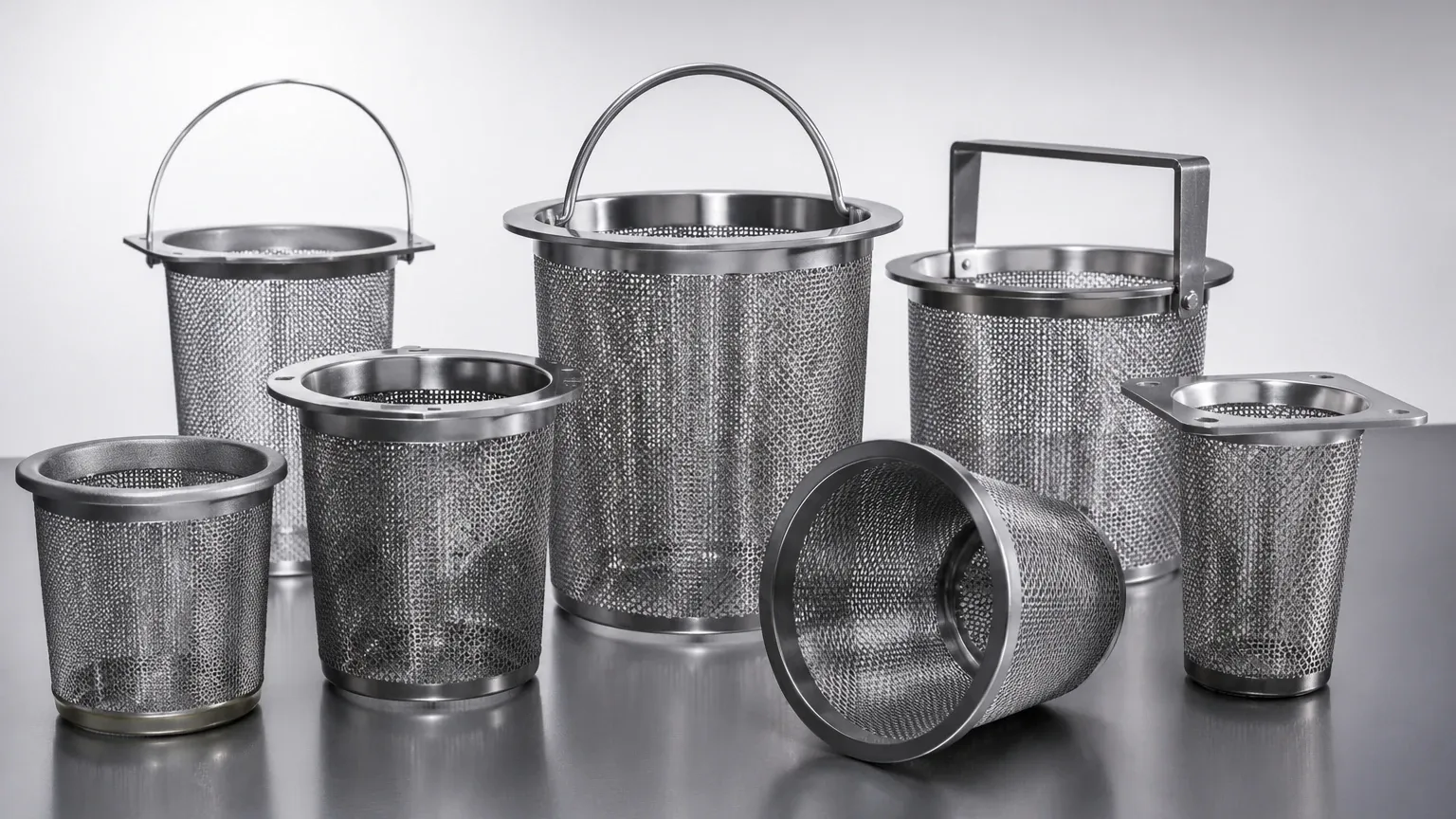
Standard off-the-shelf baskets often fail to meet the specific needs of specialized industrial equipment. This is where custom manufacturing becomes essential. Custom replacement strainer baskets allow for modifications that improve performance, such as:
* Reinforced Handles: Heavy-duty handles (lifting bails) for easier removal in large-scale systems.
* Magnetic Inserts: The addition of magnetic rods within the basket to capture fine ferrous particles that might otherwise pass through the mesh.
* Multi-Layer Construction: Using multiple layers of mesh to provide graduated filtration, which extends the life of the basket by capturing larger particles on the outer layers and finer particles on the inner layers.
* Custom Flange Designs: Ensuring a perfect seal in older or non-standard strainer housings where OEM parts are no longer available.
Total Cost of Ownership (TCO) Considerations
When purchasing replacement strainer baskets, the initial purchase price is only one component of the total cost. Engineers should evaluate the following to determine the true value of the component:
* Cleaning Efficiency: Is the basket design conducive to easy cleaning? Baskets with smooth interior surfaces and high-quality welds reduce the time required for maintenance.
* Durability: A basket that lasts two years is significantly more cost-effective than a cheaper version that requires replacement every six months.
* System Protection: The cost of a replacement basket is negligible compared to the cost of repairing a high-pressure pump damaged by debris bypass.
Checklist for Engineers Before Ordering
To ensure the procurement of the correct replacement strainer baskets, technical teams should confirm the following data points with their manufacturer:
1. Fluid Characteristics: What is the viscosity, temperature, and chemical composition of the fluid?
2. Contaminant Profile: What is the size, shape, and concentration of the particles being removed?
3. Flow Rate and Pressure: What is the maximum operating flow rate and the maximum allowable pressure drop ($ΔP$)?
4. Housing Compatibility: Provide the make and model of the strainer housing, or better yet, provide precise measurements of the existing basket.
5. Micron Rating: Specify whether the requirement is for nominal or absolute filtration.
Conclusion
Replacement strainer baskets are vital components that ensure the longevity and efficiency of industrial fluid systems. By focusing on material integrity, structural design, and precise dimensional accuracy, engineers can significantly reduce the risks of equipment failure and process downtime.
As a specialist in custom stainless steel filtration solutions, Kaifil provides the technical expertise and manufacturing precision required to produce high-performance Strainers & Baskets tailored to demanding industrial applications. Whether you are dealing with corrosive chemicals, high-temperature steam, or sensitive food products, selecting a replacement basket built to rigorous engineering standards is the most effective way to protect your infrastructure and optimize your filtration performance.
