


Strainer 10 Inch
In large-scale industrial fluid systems, the management of particulate matter is essential for the protection of high-value downstream equipment such as centrifugal pumps, heat exchangers, and flow control valves. The strainer 10 inch configuration is a standard yet critical component in high-flow piping systems, designed to remove coarse particles from liquids or gases. As industrial processes scale, the engineering requirements for these 10-inch components become increasingly complex, necessitating a deep understanding of fluid dynamics, material science, and mechanical structural integrity.
Kaifil specializes in the manufacture of high-performance Strainers & Baskets tailored for demanding industrial environments. For a 10-inch nominal pipe size (NPS), the selection of a strainer involves more than simply matching the flange diameter; it requires a comprehensive evaluation of the application’s flow rate, viscosity, pressure rating, and the specific nature of the contaminants being filtered.
Engineering Foundations of 10-Inch Strainers
A strainer 10 inch unit is typically used in main lines where flow rates can exceed several thousand gallons per minute (GPM). At this scale, the mechanical forces exerted on the internal basket are significant. Engineering a reliable strainer for a 10-inch line starts with the housing design and the internal support structure.
Flow Velocity and Turbulence
In a 10-inch pipe, fluid velocity must be carefully managed to prevent excessive turbulence and erosion of the strainer housing. Standard engineering practice suggests maintaining liquid velocities between 5 to 10 feet per second for suction lines and slightly higher for discharge lines. When a strainer is introduced, it creates a localized restriction. A well-designed 10-inch basket strainer provides a large internal volume to allow the fluid to decelerate, ensuring that the debris settles into the basket rather than being forced through the mesh by high-velocity impingement.
Pressure Drop (Delta P) Considerations
The pressure drop across a clean strainer 10 inch is a primary performance metric. For high-flow systems, keeping the initial pressure drop low (typically under 2 PSI) is vital for energy efficiency. As the basket collects debris, the open area decreases, and the pressure drop increases. Engineers must calculate the "Open Area Ratio" (OAR), which is the ratio of the total open area of the strainer basket to the cross-sectional area of the inlet pipe. For 10-inch systems, an OAR of 6:1 or higher is often recommended to extend the time between cleaning cycles.
Material Selection for Industrial Durability
Material compatibility is a non-negotiable factor in industrial filtration. Kaifil utilizes various grades of stainless steel to ensure that the strainer 10 inch components can withstand corrosive fluids and extreme temperatures.
Stainless Steel 304 and 316L
* Grade 304: Suitable for general-purpose applications, including water treatment and less corrosive chemical processing. It offers excellent strength and cost-effectiveness for 10-inch housings and baskets.
* Grade 316L: The "L" denotes low carbon content, which is essential for components that require extensive welding, as it prevents sensitized grain boundaries and subsequent intergranular corrosion. 316L is the standard for pharmaceutical, food and beverage, and marine applications where chloride resistance is paramount.
Gasket and Seal Compatibility
While the metal housing provides structural strength, the integrity of a 10-inch strainer also depends on the sealing elements. For a strainer 10 inch assembly, the cover gasket must be compatible with the process fluid. Common materials include EPDM for water, Viton (FKM) for hydrocarbons and high temperatures, and PTFE for aggressive chemical services. In high-pressure 10-inch systems, spiral-wound gaskets or O-rings are often employed to ensure a leak-proof seal under thermal cycling.
Design Variations in 10-Inch Filtration
The physical layout of a strainer 10 inch unit is determined by the installation space and the required maintenance frequency. There are three primary configurations used in 10-inch piping:
Basket Strainers (Simplex and Duplex)
Basket strainers are the most common choice for 10-inch lines due to their high dirt-holding capacity.
* Simplex Strainers: Used in systems where the flow can be intermittently stopped for basket cleaning. A 10-inch simplex strainer features a top-loading design, allowing the operator to lift the heavy basket out vertically.
* Duplex Strainers: For continuous processes where shutdown is not an option, a 10-inch duplex strainer consists of two separate housings connected by a diverter valve. This allows one side to be cleaned while the other remains in operation, ensuring uninterrupted flow.
Y-Strainers
Y-strainers are typically used for steam, gas, or liquid applications where the amount of debris is minimal. In a 10-inch size, Y-strainers are significantly heavier and require more structural support than smaller sizes. They are often preferred for high-pressure steam lines due to their compact, pressure-resistant cylindrical shape.
T-Type Strainers
T-type strainers offer a compact footprint and are often used in 10-inch lines where space is limited. They can be configured for straight-through flow or right-angle flow, providing flexibility in piping layout. However, they generally have a smaller OAR compared to dedicated basket strainers.
Filtration Media: Perforated Plates and Wire Mesh
The heart of the strainer 10 inch is the internal basket or screen. The choice of filtration media depends on the target particle size and the mechanical stress of the application.
Perforated Support Baskets
For 10-inch strainers, the primary basket is usually constructed from heavy-gauge perforated stainless steel. Common hole sizes range from 1/16 inch to 1/4 inch. This perforated plate provides the structural skeleton required to resist the differential pressure that occurs as the strainer clogs.
Fine Wire Mesh Liners
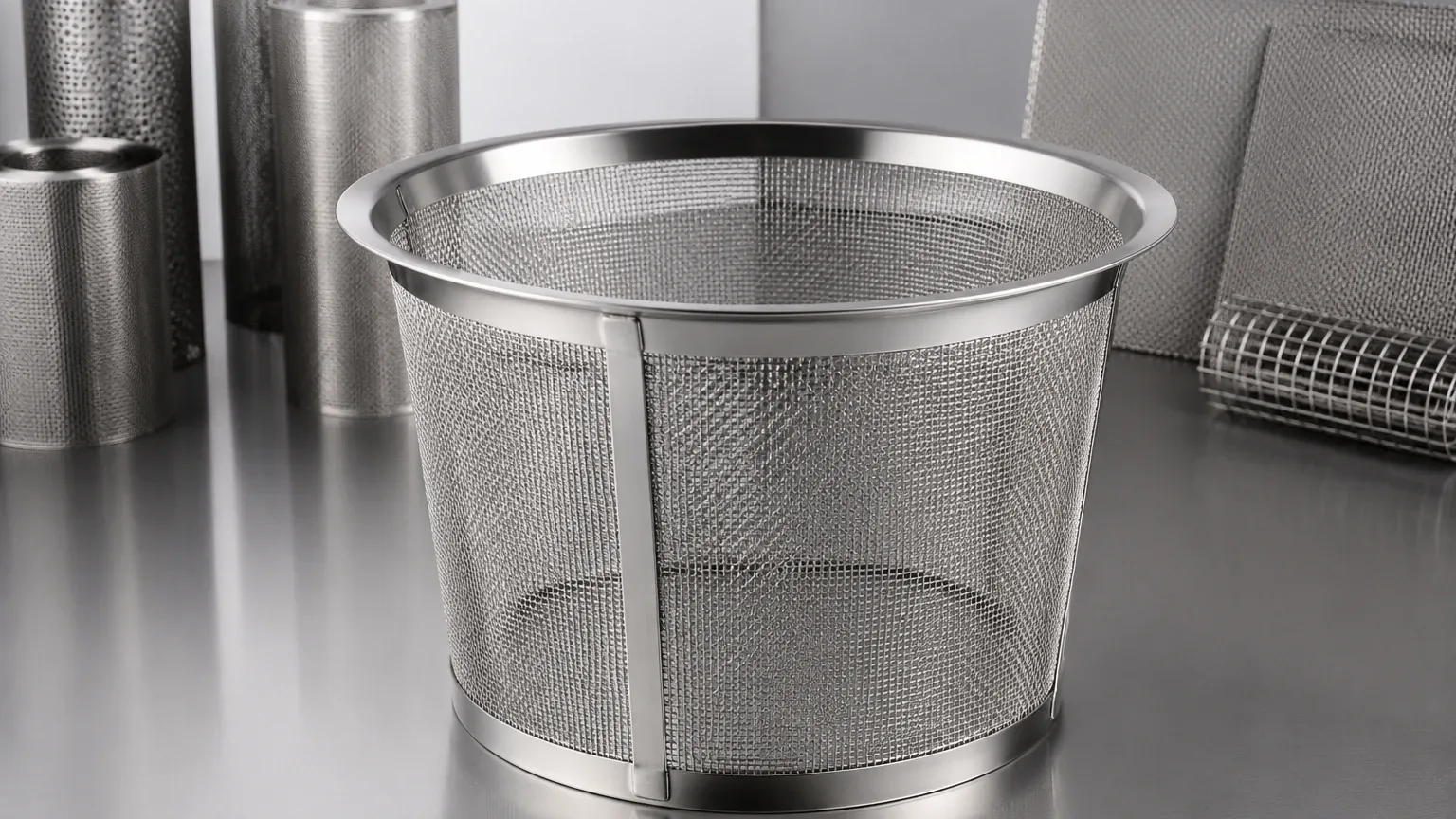
When finer filtration is required (down to 20 microns or 400 mesh), the perforated basket is lined with a precision-woven wire mesh. In a 10-inch strainer, the mesh must be securely sintered or spot-welded to the support basket to prevent bypass or mechanical failure. Kaifil’s expertise in wire mesh allows for the creation of multi-layered mesh structures that provide both fine filtration and high mechanical strength, which is critical when dealing with the high flow velocities of a 10-inch pipe.
Application-Specific Requirements
Different industries impose unique demands on a strainer 10 inch assembly. Understanding these nuances is essential during the procurement and engineering phase.
Chemical and Petrochemical Processing
In these sectors, chemical compatibility and pressure ratings are the top priorities. 10-inch strainers often require ANSI Class 150, 300, or even 600 flange ratings. The use of exotic alloys or high-grade 316L stainless steel is common to prevent pitting and stress corrosion cracking in the presence of aggressive solvents or acids.
Food and Beverage Industry
Hygienic design is the primary focus for food-grade 10-inch strainers. This includes polished internal surfaces (Ra < 0.8 µm) to prevent bacterial growth and the use of Tri-Clamp or specialized hygienic flanges. The strainer 10 inch must be designed without "dead legs" where fluid can stagnate and spoil.
Water Treatment and Desalination
Large-scale water intake systems utilize 10-inch strainers to protect membranes and pumps from sand, shells, and organic debris. In desalination plants, the high salt content requires the use of Duplex stainless steel or specialized coatings to prevent rapid corrosion of the 10-inch housing.
Maintenance and Operational Longevity
The total cost of ownership for a strainer 10 inch is heavily influenced by maintenance requirements. Because 10-inch baskets can be heavy when full of debris, ergonomic considerations are important.
Differential Pressure Monitoring
Every 10-inch strainer installation should include differential pressure (DP) gauges or transmitters. Monitoring the pressure drop across the strainer is the only reliable way to determine when the basket needs cleaning. For a 10-inch line, a typical cleaning threshold is reached when the DP increases by 10-15 PSI over the clean pressure drop.
Cleaning Protocols
Manual cleaning of a 10-inch basket involves depressurizing the housing, opening the cover, and removing the basket. In many industrial settings, quick-opening covers (such as swing-bolt or yoke types) are preferred for 10-inch strainers to reduce downtime. For automated systems, self-cleaning strainers use internal scrapers or backwash mechanisms to clear the screen without manual intervention.
Structural Fatigue and Replacement
Over years of service, the constant cycling of pressure and the impact of debris can lead to fatigue in the basket structure. Regular inspection of the welds and the mesh-to-perforation interface is necessary. Kaifil provides replacement Strainers & Baskets designed to fit existing housings, ensuring that the filtration system remains efficient throughout its operational life.
Customization and OEM Solutions from Kaifil
Standard off-the-shelf strainers often fail to meet the specific spatial or performance constraints of complex industrial projects. This is where Kaifil’s customization capabilities provide significant value. For a strainer 10 inch project, customization can include:
* Custom Flange Orientations: Adjusting the inlet and outlet positions to fit existing piping offsets.
* Specialized Coatings: Applying PTFE or epoxy coatings for enhanced chemical resistance.
* Reinforced Baskets: Designing bespoke internal supports for high-viscosity fluids or high-pressure-differential scenarios.
* Integrated Sensors: Pre-installing ports for temperature, pressure, or flow sensors directly into the 10-inch housing.
By working closely with engineering teams, Kaifil ensures that every strainer 10 inch is optimized for its specific role, balancing filtration efficiency with mechanical durability and ease of maintenance. Whether for a new plant construction or a retrofit of an existing system, selecting an engineered strainer solution is a critical step in maintaining the reliability of industrial fluid infrastructure.
