


Strainer 10
In industrial fluid handling and process engineering, the designation "10" often refers to two critical specifications in the selection of Strainers & Baskets: the nominal pipe size (10-inch or DN250) or the mesh count (10 mesh). Both parameters are foundational to the design of a filtration system, influencing flow dynamics, pressure drop, and the efficiency of particle retention. For engineers and procurement teams, understanding the technical nuances of these specifications is essential to ensure equipment longevity and process reliability.
At Kaifil, we specialize in the manufacturing of custom stainless steel filtration solutions that address these specific engineering requirements. Whether an application demands a large-scale 10-inch basket strainer for high-volume water treatment or a 10-mesh stainless steel insert for coarse particle removal in chemical processing, the structural integrity and material composition remain the primary drivers of performance.
Technical Specifications of 10-Inch Industrial Strainers
A 10-inch (DN250) strainer is typically categorized as a large-bore filtration component, utilized in systems where high flow rates are standard. These units are commonly found in cooling water loops, large-scale chemical intake lines, and municipal water treatment facilities. When specifying a strainer of this size, several engineering factors must be evaluated.
Flow Rate and Velocity
In a 10-inch piping system, the flow velocity is a critical calculation. For liquids, maintaining a velocity between 5 to 10 feet per second (fps) is generally recommended to minimize friction loss and prevent erosion of the strainer housing. A 10-inch strainer must be designed to accommodate these velocities without inducing excessive turbulence, which can lead to cavitation or mechanical vibration within the basket assembly.
Pressure Ratings and Flange Standards
Industrial strainers in this size category are usually manufactured to meet specific ASME or DIN standards. Common pressure ratings include Class 150, Class 300, or PN16/PN40. The thickness of the stainless steel housing and the integrity of the welded joints are paramount, especially in high-pressure hydraulic or steam applications. Kaifil utilizes advanced welding and precision machining to ensure that every 10-inch unit maintains its seal under peak operational loads.
Understanding 10 Mesh Filtration Performance
When the term "strainer 10" refers to the mesh count, it defines the coarseness of the filtration media. A 10 mesh screen indicates that there are 10 openings per linear inch. This is a common specification for primary filtration or "roughing" stages, where the goal is to protect downstream pumps and valves from large debris, scale, or foreign objects.
Geometry and Aperture Size
The aperture size of a 10 mesh screen depends on the wire diameter used during the weaving process. For example, using a standard 0.025-inch (0.635 mm) wire diameter results in an opening size of approximately 0.075 inches (1.905 mm). This equates to roughly 1900 to 2000 microns.
Open Area Percentage
The ratio of the open area to the total area of the mesh is a vital metric for calculating the Clean Pressure Drop (ΔP). A 10 mesh screen with 0.025-inch wire provides an open area of approximately 56.3%. A higher open area reduces the initial resistance to flow, which extends the interval between cleaning cycles. However, engineers must balance this against the structural strength of the mesh; thinner wires increase open area but may fail under the mechanical stress of high-viscosity fluids or rapid flow surges.
Material Selection for Corrosive and High-Temperature Environments
The longevity of strainers and baskets is directly tied to material science. In B2B industrial environments, standard carbon steel is often insufficient due to the risk of oxidation and contamination. Stainless steel is the industry standard for high-performance filtration.
1. Grade 304 Stainless Steel: Suitable for general-purpose applications, including food and beverage processing where moderate corrosion resistance is required.
2. Grade 316/316L Stainless Steel: The preferred choice for pharmaceutical, marine, and chemical industries. The addition of molybdenum provides superior resistance to chlorides and pitting, which is essential for 10-inch strainers handling brine or acidic solutions.
3. Specialty Alloys: For extreme environments involving high temperatures or highly aggressive chemicals, alloys such as Monel, Hastelloy, or Duplex stainless steel may be required to prevent stress corrosion cracking.
Kaifil’s manufacturing process focuses on the use of high-quality, certified materials to ensure that the filtration components can withstand the specific chemical and thermal profiles of the application.
Engineering Considerations for Basket Design
The "basket" is the functional heart of the strainer. For a 10-inch housing, the basket must be engineered to handle significant weight and pressure differentials.
Reinforcement and Support
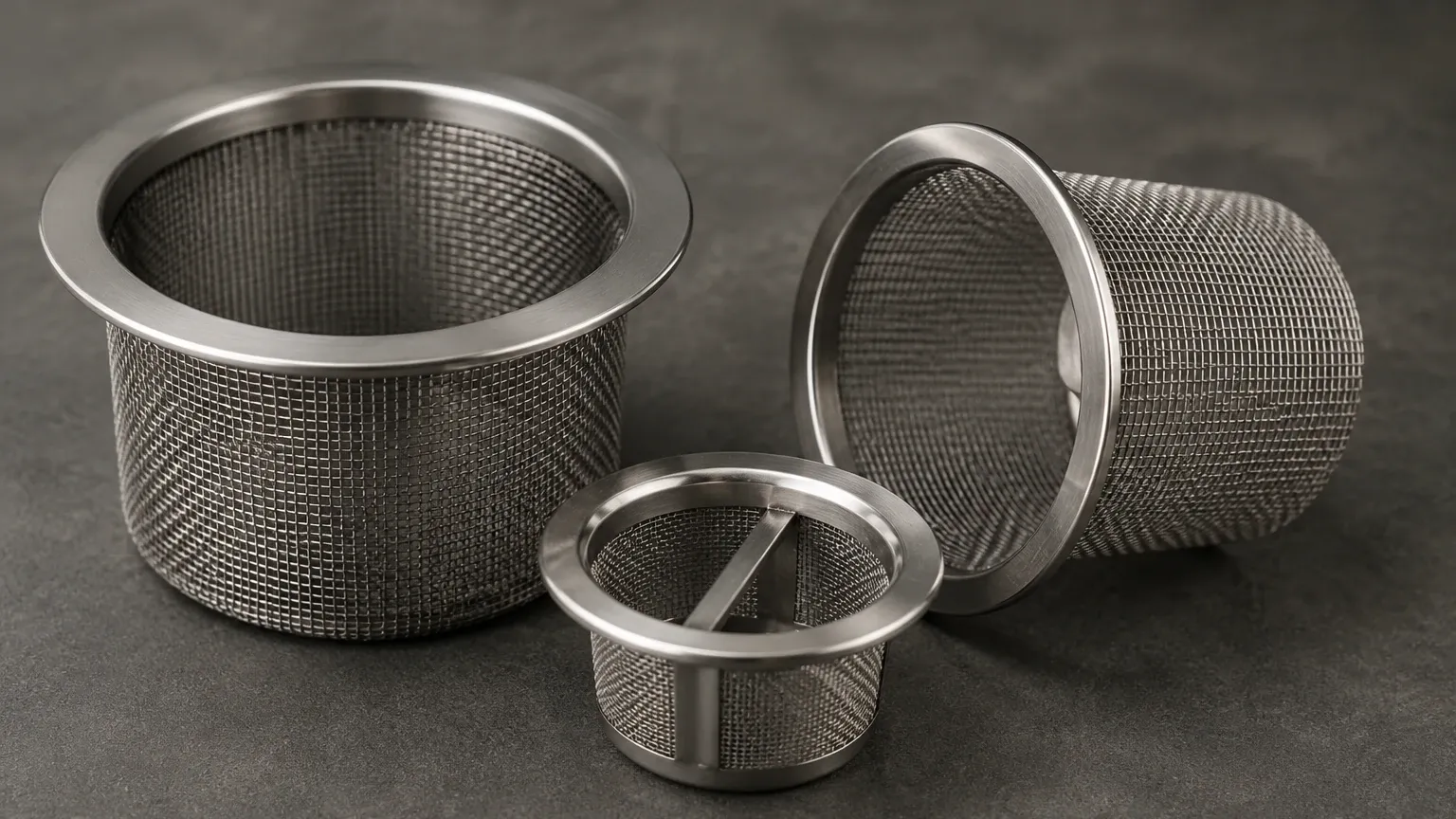
A 10 mesh wire cloth is relatively flexible. In large-diameter strainers, the mesh is typically supported by a perforated metal backup cylinder. This "heavy-duty" construction prevents the mesh from collapsing or distorting when it becomes loaded with solids. The perforation pattern (e.g., staggered vs. straight) and the hole size of the support cylinder are optimized to ensure maximum flow while providing rigid structural backing.
Handle and Seal Configurations
Ease of maintenance is a critical B2B consideration. Baskets for 10-inch strainers are heavy when full of debris. Incorporating ergonomic lifting handles and precision-machined seating surfaces ensures that the basket can be removed and replaced quickly during downtime. Furthermore, the choice of gasket or O-ring material (EPDM, Viton, or PTFE) must be compatible with the process fluid to prevent bypass leakage.
Customization and OEM Solutions
Off-the-shelf filtration products often fail to meet the exact spatial or performance requirements of complex industrial systems. This is where custom engineering becomes a value-add for purchasing teams and plant engineers.
Customization options for Strainers & Baskets include:
* Custom Dimensions: Adjusting the length or diameter of the basket to increase the Effective Filtration Area (EFA) within a constrained footprint.
* Multi-Stage Filtration: Combining a 10 mesh outer layer with a finer inner mesh (e.g., 100 mesh) to provide graduated filtration in a single unit.
* Magnetic Inserts: Adding magnetic rods to the basket to capture fine ferrous particles that might otherwise pass through a 10 mesh screen.
* Surface Treatments: Electropolishing or passivating the stainless steel to meet sanitary standards for pharmaceutical or food-grade applications.
Maintenance and Total Cost of Ownership (TCO)
While the initial purchase price of a strainer is important, the Total Cost of Ownership is driven by maintenance efficiency and durability. A poorly designed 10-inch strainer can lead to frequent clogging, excessive energy consumption due to high pressure drops, and potential downstream equipment failure.
Differential Pressure Monitoring
Engineers should always install differential pressure gauges across the strainer. For a 10 mesh basket, a common rule of thumb is to initiate a cleaning cycle when the pressure drop reaches 5-10 psi over the clean state. Allowing the ΔP to rise too high can result in "blow-through," where particles are forced through the mesh, or mechanical failure of the basket itself.
Cleaning Protocols
Stainless steel baskets are designed for reuse. Depending on the contaminant, cleaning may involve backflushing, ultrasonic cleaning, or chemical soaking. The robust construction of Kaifil’s stainless steel filters ensures they can withstand repeated cleaning cycles without losing filtration accuracy or structural integrity.
Selection Criteria: Questions for Engineers
Before finalizing the specification for a strainer 10 configuration, engineers should confirm the following data points:
* What is the maximum allowable pressure drop? This dictates the required Effective Filtration Area.
* What is the nature of the solids? Are they hard, abrasive particles or soft, deformable contaminants? This influences the choice between wire mesh and perforated metal.
* What are the cleaning intervals? If the system cannot be shut down, a duplex strainer (two 10-inch housings with a changeover valve) may be necessary.
* Are there regulatory requirements? Does the unit need to comply with FDA, 3A, or ASME Section VIII standards?
Conclusion
Whether referring to a 10-inch pipe size or a 10 mesh screen, the "strainer 10" specification plays a vital role in industrial fluid management. By focusing on high-grade stainless steel construction, precision engineering, and application-specific customization, Kaifil provides filtration solutions that protect critical infrastructure and optimize process efficiency.
Selecting the right strainer requires a deep understanding of flow dynamics, material compatibility, and mechanical design. For technical professionals looking to enhance their system's performance, investing in high-quality, custom-engineered Strainers & Baskets is a strategic decision that reduces long-term operational risks and ensures consistent product quality.
