


Strainer 200 Mesh
In industrial fluid handling and process engineering, the selection of filtration media is a critical decision that impacts equipment longevity, product purity, and operational efficiency. Among the various specifications available for fine-particle removal, the strainer 200 mesh configuration represents a significant threshold in fine filtration. This specification is widely utilized across the chemical, pharmaceutical, and food processing industries to protect sensitive downstream components from microscopic contaminants.
Understanding the technical nuances of a 200 mesh strainer involves more than just recognizing the hole size. Engineers must consider material compatibility, structural integrity under pressure, and the relationship between mesh count and flow dynamics. As a specialist in custom stainless steel filtration, Kaifil provides precision-engineered Strainers & Baskets designed to meet these rigorous industrial standards.
Technical Specifications of 200 Mesh Filtration
The term "mesh" refers to the number of openings per linear inch of the screen. A 200 mesh screen contains 200 wires in one inch, creating a grid that is exceptionally fine. To understand the performance of a strainer 200 mesh, it is necessary to convert this count into a micron rating.
Micron Rating and Aperture Size
For a standard stainless steel wire cloth, a 200 mesh count typically corresponds to an aperture (opening) size of approximately 74 microns (0.074 mm or 0.0029 inches). This level of filtration is capable of capturing fine sand, silt, and large bacteria or organic particulates.
Wire Diameter and Open Area
The effectiveness of a strainer is also dictated by the wire diameter used in the weave. A common wire diameter for 200 mesh is 0.0021 inches (0.053 mm). The relationship between the wire diameter and the mesh count determines the "percentage of open area." For a standard 200 mesh screen, the open area is generally around 33.6%. This percentage is a vital metric for engineers calculating the initial pressure drop across the filter element; a lower open area requires a larger total surface area to maintain the desired flow rate without excessive resistance.
Material Selection for Industrial Strainers
In industrial environments, the durability of a strainer 200 mesh is as important as its filtration accuracy. Because 200 mesh wire is relatively thin, it is susceptible to chemical corrosion and mechanical wear if the material is not correctly specified for the process fluid.
Stainless Steel 304 vs. 316L
Stainless steel is the industry standard for high-performance strainers due to its tensile strength and resistance to oxidation.
* SS304: Suitable for general-purpose applications, including water treatment and basic chemical handling where high-temperature or highly acidic conditions are not present.
* SS316L: Often required in pharmaceutical and marine applications. The addition of molybdenum provides superior resistance to chlorides and pitting corrosion. The "L" (low carbon) variant is preferred for welded components to prevent carbide precipitation, ensuring the structural integrity of the strainer basket housing.
Exotic Alloys
For specialized chemical processing involving highly aggressive media, such as concentrated acids or high-temperature caustic solutions, strainers may be fabricated from Hastelloy, Monel, or Inconel. These materials ensure that the fine 200 mesh weave does not degrade, which would otherwise lead to bypass or downstream contamination.
Structural Design: Mesh Support and Basket Configuration
A common engineering challenge with a strainer 200 mesh is its inherent fragility. A single layer of 200 mesh wire cloth cannot withstand high differential pressures (Delta P) on its own; it would likely deform or burst under the force of the fluid flow.
Perforated Metal Backing
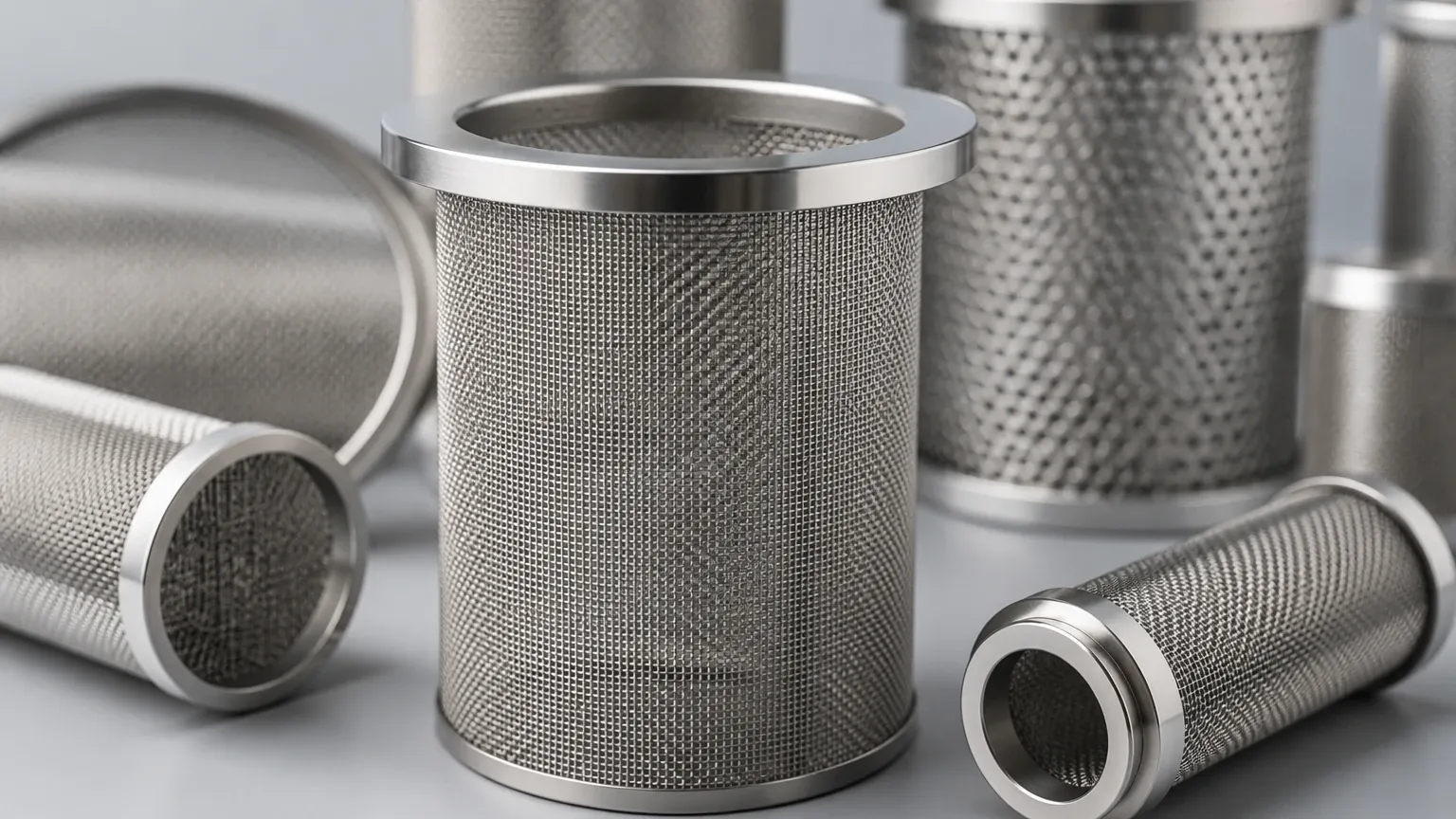
To resolve this, industrial Strainers & Baskets are typically constructed using a multi-layer approach. The 200 mesh fine screen is lined or wrapped around a heavier perforated metal basket. This perforated "backup" provides the mechanical strength to handle the pressure load, while the mesh layer performs the actual filtration. The hole size and pattern of the perforated support must be optimized to ensure it does not significantly restrict the flow already limited by the fine mesh.
Pleated vs. Cylindrical Designs
Depending on the required dirt-holding capacity and the available space within the strainer housing, the 200 mesh element can be designed as a simple cylinder or a pleated cartridge. Pleating the mesh significantly increases the effective filtration surface area. This design is particularly beneficial for 200 mesh applications because it offsets the lower open area of the fine weave, allowing for longer intervals between cleaning cycles and lower clean-state pressure drops.
Performance Factors: Pressure Drop and Flow Capacity
When integrating a strainer 200 mesh into a piping system, engineers must account for the fluid's viscosity and the expected flow velocity. Fine mesh strainers create more resistance than coarse strainers (such as 20 mesh or 40 mesh).
1. Viscosity Impacts: As fluid viscosity increases, the pressure drop across a 200 mesh screen rises exponentially. For high-viscosity fluids like heavy oils or resins, a 200 mesh strainer may require a significantly oversized housing to reduce velocity and maintain an acceptable pressure profile.
2. Clogging Factor: In systems with a high concentration of solids, a 200 mesh screen will clog rapidly. Engineers often employ a "staged" filtration approach, where a coarser strainer (e.g., 40 or 80 mesh) is placed upstream of the 200 mesh unit to remove larger debris, leaving the fine strainer to handle only the target 74-micron particulates.
3. Velocity Limits: To prevent premature wear and mesh displacement, fluid velocity through the mesh should generally be kept low. High-velocity impingement can cause "wire shifting," which alters the aperture size and compromises filtration consistency.
Industrial Applications for 74-Micron Filtration
The application of a strainer 200 mesh is found wherever fine-particulate protection is mandatory for the safety of downstream equipment or the quality of the final product.
Protection of Spray Nozzles
In coating, cooling, and fuel injection systems, spray nozzles have extremely small orifices that are easily obstructed by microscopic debris. A 200 mesh strainer is often the final line of defense, ensuring that particulates larger than 74 microns do not reach the nozzle, thereby preventing uneven spray patterns or total system shutdowns.
Pharmaceutical and Food Processing
In these sectors, purity is paramount. 200 mesh strainers are used to remove fine precipitates or contaminants from liquid ingredients. Because these industries require frequent cleaning, the strainers must be designed for easy disassembly and must meet stringent sanitary standards, often featuring polished surfaces to prevent bacterial growth.
Hydraulic and Lubrication Systems
Precision hydraulic valves and high-speed bearings are sensitive to fine metallic shavings and environmental dust. Utilizing a 200 mesh strainer in the return line or the reservoir fill point helps maintain the ISO cleanliness codes required for high-performance machinery.
Maintenance, Cleaning, and Replacement Protocols
The lifespan and reliability of a strainer 200 mesh depend heavily on proper maintenance. Unlike coarse strainers that can often be cleaned with a simple rinse, 200 mesh screens require more specialized attention due to the potential for particles to become wedged within the fine weave.
* Monitoring Differential Pressure: The most effective way to determine when a strainer needs cleaning is by monitoring the pressure gauges upstream and downstream of the unit. A pre-defined limit (e.g., 5-10 psi increase over the clean-state pressure) should trigger a maintenance cycle.
* Cleaning Methods: For 200 mesh stainless steel baskets, ultrasonic cleaning is often the most effective method for removing deeply embedded particles without damaging the delicate wires. Backwashing with high-pressure air or water can also be effective, provided the mesh is properly supported by a perforated basket to prevent collapse during the reverse flow.
* Inspection for Damage: During cleaning, the mesh should be inspected for "blinded" areas (permanently clogged sections) or breaks in the wire. Even a small tear in a 200 mesh screen allows all particles to bypass the filter, rendering the entire system vulnerable.
Customization and OEM Solutions
Every industrial process has unique requirements regarding flow rate, chemical exposure, and installation footprint. Standard off-the-shelf strainers often fail to meet the specific needs of complex engineering projects. Kaifil specializes in the design and manufacture of custom Strainers & Baskets, offering tailored 200 mesh solutions that integrate seamlessly into existing hardware.
From selecting the appropriate wire gauge and alloy to designing multi-stage filtration baskets with reinforced structural supports, Kaifil’s engineering team works to ensure that the filtration solution balances performance with durability. Whether the application requires a high-capacity basket strainer for a chemical plant or a precision-fit 200 mesh insert for a hydraulic system, custom manufacturing ensures that the specific 74-micron filtration target is met without compromising the system's overall hydraulic efficiency.
