


Strainer 4 Inch
In industrial fluid handling systems, the 4-inch nominal pipe size (NPS) represents a critical threshold where flow volumes and pressure dynamics require robust filtration solutions. A strainer 4 inch unit is a fundamental component designed to protect downstream equipment—such as pumps, meters, control valves, and heat exchangers—from damage caused by scale, weld beads, and other foreign particles.
Selecting the correct strainer for a 4-inch line involves more than matching the pipe diameter. Engineers must evaluate housing configuration, material compatibility, filtration surface area, and the specific rheological properties of the fluid being processed. As a professional manufacturer, Kaifil specializes in engineering Strainers & Baskets that meet the rigorous demands of chemical processing, food and beverage production, and hydraulic systems.
Engineering Fundamentals of the 4-Inch Strainer
A 4-inch strainer is typically integrated into piping systems where flow rates are substantial, often ranging from 200 to 600 gallons per minute (GPM) depending on the allowable pressure drop and fluid velocity. At this scale, the mechanical integrity of the strainer element becomes paramount. The force exerted by the fluid against the mesh or perforated basket increases significantly compared to smaller diameters, necessitating reinforced structures.
The primary function of the strainer is to remove solids from a flowing liquid or gas through a perforated or wire mesh straining element. For a 4-inch line, the design must ensure that the "open area ratio" (the ratio of the internal area of the strainer screen to the cross-sectional area of the inlet pipe) is sufficient to prevent excessive flow restriction. A standard industrial-grade strainer 4 inch should ideally offer an open area ratio of at least 6:1 to 8:1 to ensure long service intervals and minimal energy loss.
Material Selection and Chemical Compatibility
Material selection is the most critical factor in ensuring the longevity of a strainer 4 inch. Industrial environments often involve corrosive fluids, high temperatures, or strict hygienic requirements. Kaifil utilizes high-grade stainless steel to address these challenges.
Stainless Steel 304
This is the standard grade for general industrial applications. It provides excellent strength and good corrosion resistance for water treatment, cooling systems, and non-acidic chemical lines. It is a cost-effective choice for environments where the primary goal is mechanical protection rather than extreme chemical resistance.
Stainless Steel 316/316L
For more demanding applications, such as pharmaceutical manufacturing or chemical processing involving chlorides and acids, 316 stainless steel is the preferred material. The addition of molybdenum enhances resistance to pitting and crevice corrosion. The "L" (low carbon) variant is utilized in components requiring extensive welding to prevent carbide precipitation, ensuring the structural integrity of the strainer 4 inch housing and basket.
Specialized Coatings and Finishes
In the food and beverage industry, the internal and external surfaces of the strainer must meet specific roughness averages (Ra). Electropolishing or mechanical polishing can be applied to stainless steel strainers to eliminate microscopic pits where bacteria might reside, ensuring the component complies with sanitary standards.
Comparing Strainer Configurations for 4-Inch Lines
The physical configuration of a strainer 4 inch is dictated by the installation space, the expected debris load, and the required maintenance frequency. The three most common designs are Y-strainers, Basket strainers, and T-strainers.
Y-Strainers
Y-strainers are characterized by their compact, slanted cylinder design. They are typically used in applications where the amount of debris to be removed is relatively small. In a 4-inch line, a Y-strainer is often chosen for steam or high-pressure gas applications. Their primary advantage is that they can be installed in either horizontal or vertical orientations (with downward flow). However, they have a smaller dirt-holding capacity compared to basket designs.
Basket Strainers (Simplex and Duplex)
For liquid applications with higher debris loading, the basket strainer is the industry standard. The "basket" design allows for a much larger filtration surface area.
* Simplex Strainers: These are used in systems where the flow can be intermittently stopped to clean or replace the basket.
* Duplex Strainers: In critical 4-inch lines where the process cannot be shut down, a duplex system is required. This consists of two separate strainer chambers connected by a diverter valve. When one basket becomes clogged, the flow is switched to the clean chamber, allowing for maintenance without interrupting the process.
T-Strainers
T-strainers are often used in 4-inch and larger pipelines where space is limited but a straight-through flow path is required. They offer a compact profile and are frequently used as "start-up" strainers to protect equipment during the initial commissioning of a plant.
Filtration Accuracy: Mesh vs. Perforation
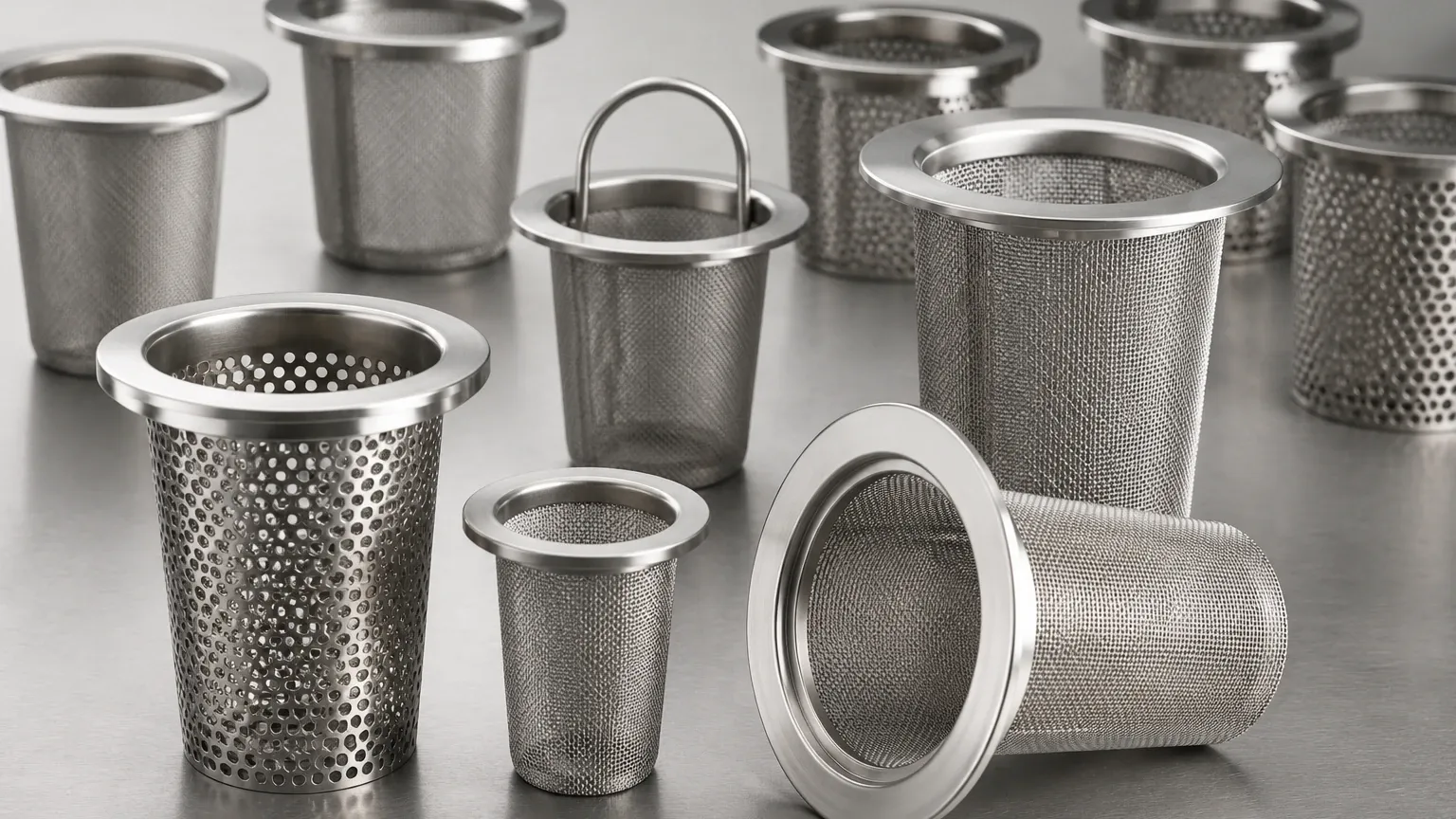
The performance of a strainer 4 inch is defined by its ability to capture specific particle sizes. This is achieved through the selection of the straining element, which can be perforated metal, wire mesh, or a combination of both.
Perforated Metal
Perforated baskets are used for coarse filtration, typically capturing particles 1/32" to 1/4" in size. They serve as a robust primary barrier. In many 4-inch industrial strainers, a perforated basket acts as the structural support for a finer wire mesh lining.
Wire Mesh
For finer filtration (down to 5 microns), stainless steel wire mesh is employed. The mesh is woven from fine wires to create precise openings. When specifying a strainer 4 inch, engineers must determine the required micron rating based on the sensitivity of downstream components. For example, a high-precision pump might require a 100-mesh (150 micron) strainer to prevent internal scoring.
Calculating Pressure Drop and Flow Rates
One of the most common engineering errors in specifying a strainer 4 inch is failing to account for the pressure drop (ΔP). Every strainer introduces a restriction to the flow. The clean pressure drop is calculated based on the fluid's viscosity, specific gravity, and velocity.
As the strainer basket collects debris, the effective open area decreases, and the pressure drop increases. It is standard practice to install differential pressure gauges across the inlet and outlet of a 4-inch strainer. A general rule of thumb is to clean or replace the basket when the pressure drop reaches 5-10 psi above the clean drop level. If the pressure drop is allowed to exceed the structural limits of the basket, the element may collapse, bypassing the filtration and potentially sending debris into the downstream system.
Installation and Maintenance Best Practices
Proper installation of a strainer 4 inch is essential for both performance and safety.
1. Orientation: Ensure the strainer is installed in the correct direction of flow, usually indicated by an arrow on the housing. For Y-strainers in horizontal lines, the "leg" should point downward to allow debris to collect in the pocket.
2. Access Clearance: When installing a 4-inch basket strainer, ensure there is sufficient overhead or side clearance to remove the basket. A 4-inch basket, when full of fluid and debris, can be heavy and requires adequate space for ergonomic handling.
3. Venting and Draining: High-quality strainers include vent plugs on the cover and drain plugs on the bottom. Venting the air before start-up prevents air pockets that can cause cavitation or flow measurement errors. Draining the housing before maintenance is a safety requirement, especially when handling hazardous chemicals.
4. Gasket Integrity: The seal between the strainer cover and the housing must be inspected every time the basket is cleaned. For 4-inch systems, EPDM, Viton, or PTFE gaskets are commonly used depending on the chemical and temperature requirements.
Customization Options for Industrial Applications
Off-the-shelf solutions do not always meet the specific needs of complex industrial processes. Kaifil provides extensive OEM and customization capabilities for 4-inch filtration components. Customization options include:
* Flange Configurations: While ANSI B16.5 is standard in North America, we can manufacture housings with DIN, JIS, or custom flange patterns to match existing infrastructure.
* Reinforced Baskets: For high-pressure differential applications, baskets can be reinforced with internal or external support frames to prevent deformation.
* Magnetic Inserts: In hydraulic or machining applications, magnetic rods can be added to the basket to capture fine ferrous particles that might pass through a standard mesh.
* Specialty Materials: Beyond 304 and 316, we can work with high-nickel alloys for extreme corrosive environments.
Conclusion: Selecting the Right 4-Inch Solution
The implementation of a strainer 4 inch is a strategic decision to ensure the reliability and longevity of an industrial piping system. By understanding the relationship between material science, fluid dynamics, and mechanical design, engineers can select a filtration solution that minimizes downtime and maintenance costs.
When evaluating Strainers & Baskets, consider the total cost of ownership, which includes the initial purchase price, the ease of maintenance, and the durability of the filtration element. Kaifil’s expertise in custom stainless steel filtration ensures that every 4-inch strainer is engineered to the highest standards of precision and performance, providing dependable protection for your most critical industrial assets.
