


Strainer 50 Mesh
In industrial fluid handling and processing, the efficiency of a system often depends on the precision of its primary filtration components. Among the various specifications available, the strainer 50 mesh configuration represents a critical middle ground for medium-fine filtration. This specification is widely utilized across chemical, pharmaceutical, and food processing industries to protect downstream equipment from particulate contamination without causing excessive pressure drop.
Selecting the correct filtration media involves more than just identifying a mesh count. It requires an understanding of the mechanical properties of stainless steel, the hydraulics of flow through wire cloth, and the structural requirements of the housing. This guide examines the technical nuances of 50 mesh strainers, providing engineers and procurement teams with the data necessary to optimize their filtration processes.
Understanding 50 Mesh Specifications in Industrial Filtration
The term "mesh" refers to the number of openings per linear inch of the wire cloth. A 50 mesh screen contains 50 openings in one inch, measured from the center of one wire to the center of the next. However, the mesh count alone does not fully define the filtration capability; the wire diameter is equally significant as it determines the actual aperture size and the structural strength of the media.
Technical Parameters of 50 Mesh
For a standard industrial-grade strainer 50 mesh, the typical technical specifications are as follows:
* Aperture (Opening Size): Approximately 0.297 millimeters (297 microns) or 0.0117 inches. This is the maximum size of a spherical particle that can pass through the mesh.
* Wire Diameter: Usually ranges from 0.21 mm to 0.23 mm. Thicker wires increase durability and resistance to high-pressure differentials but reduce the open area.
* Open Area Percentage: Typically between 30% and 40%. This percentage represents the ratio of the total area of the openings to the total area of the screen, which directly influences flow capacity and the rate of blinding (clogging).
When specifying 50 mesh for Strainers & Baskets, engineers must balance the need for fine particle retention with the requirement for high flow rates. A 297-micron rating is ideal for removing fine sand, scale, and suspended solids that could damage pump seals or clog spray nozzles.
Material Engineering for Stainless Steel Strainers & Baskets
Industrial strainers operate in diverse environments, ranging from cryogenic temperatures to high-heat chemical reactors. The choice of material for the mesh and the supporting basket structure is paramount to ensuring longevity and preventing process contamination.
Stainless Steel 304 vs. 316L
Most industrial 50 mesh strainers are manufactured from austenitic stainless steels due to their excellent corrosion resistance and mechanical strength.
1. Grade 304: This is the standard material for most general-purpose industrial applications. It offers good resistance to atmospheric corrosion and many organic and inorganic chemicals. It is frequently used in water treatment and food processing where chloride concentrations are low.
2. Grade 316L: For more demanding environments, such as chemical processing or marine applications, Grade 316L is preferred. The addition of molybdenum provides enhanced resistance to pitting and crevice corrosion, particularly in chloride-rich environments. The "L" designation (low carbon) is essential for components that require welding, as it prevents carbide precipitation and ensures the integrity of the mesh-to-frame bonds.
Specialty Alloys
In highly aggressive environments involving strong acids or high-temperature oxidation, specialty alloys like Monel, Inconel, or Hastelloy may be required. While 50 mesh is most common in stainless steel, custom manufacturers like Kaifil can provide these components in exotic materials to meet specific chemical compatibility requirements.
Structural Integrity and Reinforcement Techniques
A strainer 50 mesh screen is relatively fine and can be susceptible to deformation under high differential pressure. In industrial strainers and baskets, the mesh is rarely used as a standalone structural element. Instead, it is integrated into a multi-layered or reinforced design.
Perforated Metal Support
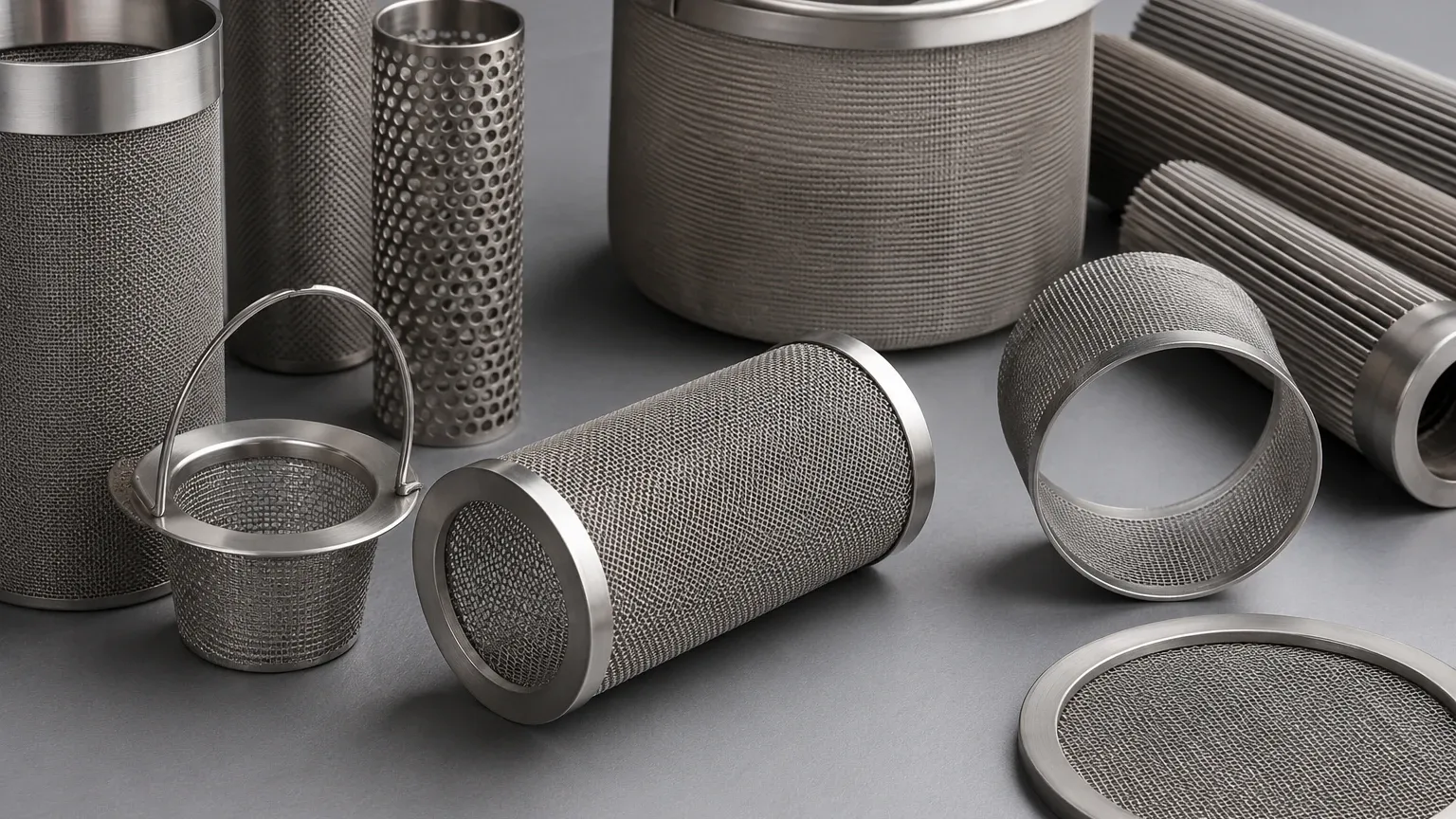
To withstand the mechanical stresses of high-velocity fluid flow, the 50 mesh wire cloth is typically lined inside or wrapped outside a perforated metal basket. The perforated metal provides the "skeleton" of the component, handling the pressure load, while the mesh provides the precision filtration. Common support patterns include staggered round holes, which offer the best balance of strength and open area.
Pleated vs. Cylindrical Designs
For applications requiring a larger effective filtration area (EFA) within a compact footprint, pleated 50 mesh cartridges are utilized. Pleating increases the surface area of the mesh by 2 to 4 times compared to a standard cylindrical basket. This results in:
* Lower initial pressure drop.
* Higher dirt-holding capacity.
* Extended intervals between cleaning or replacement.
In contrast, cylindrical baskets are easier to clean and are often preferred for batch processes where the strainer must be emptied and sanitized frequently.
Flow Dynamics and Pressure Drop Considerations
One of the most critical engineering considerations when implementing a strainer 50 mesh is the impact on system hydraulics. Every filtration element introduces resistance to the flow, known as pressure drop (ΔP).
Calculating Clean Pressure Drop
The initial pressure drop across a clean 50 mesh strainer depends on fluid viscosity, density, and flow velocity. Because 50 mesh has a relatively high open area compared to finer meshes (like 200 or 400 mesh), it allows for efficient flow. However, as particles accumulate on the surface of the mesh, the open area decreases, and the pressure drop rises exponentially.
Effective Filtration Area (EFA)
To minimize the frequency of cleaning, the EFA should be maximized. A common rule of thumb in industrial strainer design is to maintain a ratio of the total open area of the strainer to the cross-sectional area of the inlet pipe of at least 6:1. This ensures that even when the strainer is partially clogged, the system can still maintain the required flow rate without cavitation or pump strain.
Industrial Applications for 50 Mesh Strainers
The versatility of the 50 mesh specification makes it a staple in various sectors. Its ability to capture particles down to approximately 300 microns serves several strategic purposes:
Pump and Valve Protection
In hydraulic systems and cooling water loops, a 50 mesh strainer is often installed upstream of sensitive components. It effectively captures pipe scale, welding slag, and pebbles that could cause catastrophic failure of centrifugal pump impellers or precision control valves.
Food and Beverage Processing
In the production of juices, syrups, and oils, 50 mesh baskets are used to remove pulp, seeds, or large clumps of undissolved ingredients. Stainless steel construction ensures compliance with sanitary standards, as the material is non-reactive and capable of withstanding Clean-in-Place (CIP) procedures.
Chemical and Petrochemical Refining
During the processing of intermediate chemicals, 50 mesh strainers act as "police filters," ensuring that large contaminants do not enter reactors or distillation columns. They are also used in the loading and unloading of bulk chemicals to prevent debris from the transport tanks from entering the plant’s storage system.
Selection Criteria for Custom Filtration Components
When purchasing or designing a custom strainer 50 mesh, engineers should confirm several factors with the manufacturer to ensure the component is fit for purpose.
1. Micron Rating vs. Mesh Count: Always verify the micron rating. While 50 mesh is standardly ~297 microns, variations in wire diameter can change this value. Ensure the aperture size is smaller than the smallest particle you need to remove.
2. Differential Pressure (DP) Limit: What is the maximum pressure the basket can withstand before the mesh collapses or the welds fail? This is critical for systems with high-head pumps.
3. Seal Configuration: For inline strainers, the method of sealing the basket into the housing (e.g., O-rings, flat gaskets, or metal-to-metal seats) determines whether bypass can occur. Even a small gap can allow large particles to bypass the 50 mesh screen.
4. Custom Dimensions: Standard baskets may not fit existing housings. Custom manufacturers like Kaifil specialize in producing bespoke dimensions, flange types, and handle configurations to simplify the installation process.
Maintenance and Cleaning for Longevity
The durability of a stainless steel strainer 50 mesh is one of its primary advantages over disposable filters. However, improper maintenance can lead to mesh fatigue or permanent blinding.
Cleaning Procedures
* Manual Cleaning: For removable baskets, high-pressure water or steam cleaning is usually effective. It is important to spray from the "clean" side (backwashing) to push particles out of the mesh openings rather than wedging them deeper.
* Ultrasonic Cleaning: For stubborn contaminants or when the mesh is used in pharmaceutical applications, ultrasonic baths can remove microscopic particles trapped within the wire intersections.
* Chemical Cleaning: If the strainer is used with resins or oils, solvent cleaning may be necessary. Ensure the chemical agent is compatible with the stainless steel grade (e.g., avoiding high concentrations of hydrochloric acid on SS304).
Monitoring for Replacement
While stainless steel strainers are designed for long-term use, they are not indestructible. Regular inspections should look for:
* Mesh Fraying: Often occurs at the weld points or where the mesh meets the support cage.
* Permanent Deformation: A sign that the strainer has been subjected to pressure differentials exceeding its design limit.
* Corrosion: Pitting or discoloration can indicate that the fluid chemistry has changed or the wrong grade of stainless steel was selected.
By following these engineering principles and maintenance protocols, industrial facilities can ensure that their 50 mesh filtration systems provide reliable, cost-effective protection for their critical infrastructure.
