


Strainer 7
In industrial fluid handling and process engineering, the selection of filtration components is governed by precise mechanical specifications and environmental requirements. The term "strainer 7" often refers to a specific size designation—most commonly associated with Size 7 basket strainers or filter housings—that serves as a critical component in protecting downstream equipment from particulate contamination. As a specialized manufacturer of high-performance filtration solutions, Kaifil provides engineered Strainers & Baskets designed to meet the rigorous demands of chemical processing, water treatment, and industrial manufacturing.
Understanding the technical nuances of a strainer 7 configuration requires an analysis of flow dynamics, material compatibility, and structural integrity. This guide examines the engineering considerations essential for selecting, customizing, and maintaining these vital filtration components.
Understanding the Strainer 7 Specification in Industrial Filtration
The designation of a "Size 7" strainer typically refers to the physical dimensions and volume capacity of the internal basket or the housing it occupies. In the context of liquid filtration standards, a Size 7 basket is a compact yet high-capacity solution, often featuring a diameter of approximately 7 inches and a specific length tailored to standard industrial housings.
These units are primarily utilized as coarse filtration or pre-filtration stages. Their role is to intercept larger solids—such as scale, debris, or undissolved process materials—before the fluid reaches more sensitive components like high-pressure pumps, spray nozzles, or fine membrane filters. Because the strainer 7 footprint is standardized across many OEM systems, it is a frequent choice for engineers looking for a balance between space-saving design and sufficient surface area for effective debris retention.
From an engineering perspective, the "7" designation acts as a baseline for calculating flow capacity. However, the actual performance of the strainer is determined by the internal media, whether it be perforated metal, woven wire mesh, or a combination of both. Selecting the correct configuration involves evaluating the viscosity of the fluid, the expected solids loading, and the allowable pressure drop across the system.
Material Engineering: Selecting Alloys for Durability and Corrosion Resistance
The longevity of a strainer 7 unit is directly tied to the metallurgy of its construction. Industrial environments often expose filtration components to corrosive chemicals, extreme temperatures, and abrasive particles. At Kaifil, we emphasize the use of high-grade stainless steel to ensure structural reliability and chemical inertness.
Stainless Steel 304
This is the standard grade for many industrial applications. It offers excellent strength and good corrosion resistance for water treatment, food and beverage, and general industrial fluids. It is cost-effective for environments where highly acidic or alkaline conditions are not present.
Stainless Steel 316 and 316L
For more demanding applications, such as pharmaceutical processing or chemical manufacturing involving chlorides, SS316 is the preferred choice. The addition of molybdenum enhances resistance to pitting and crevice corrosion. The low-carbon version (316L) is often specified for components requiring extensive welding to prevent carbide precipitation, ensuring the integrity of the basket seams and flanges.
Specialized Alloys
In extreme cases involving highly aggressive media or high-temperature steam, specialized alloys like Hastelloy or Monel may be required. These materials ensure that the strainer 7 maintains its geometric stability and filtration accuracy even under mechanical stress that would cause standard steels to fail.
Design Considerations: Flow Rates and Pressure Drop for Size 7 Baskets
One of the most critical factors in strainer selection is the relationship between flow rate and pressure drop ($ΔP$). An undersized strainer 7 will lead to excessive pressure loss, increased energy consumption for pumps, and frequent maintenance intervals. Conversely, an oversized system may lead to unnecessary capital expenditure and inefficient space utilization.
When evaluating Strainers & Baskets, engineers must calculate the "Clean Pressure Drop." This is the resistance offered by the strainer when it is free of debris. As the basket collects particles, the open area decreases, and the pressure drop increases.
Key engineering variables include:
- Viscosity: Higher viscosity fluids require larger open areas or slower flow velocities to maintain acceptable pressure levels.
- Velocity: Maintaining a fluid velocity below 10 feet per second (fps) is a common guideline to prevent erosion and excessive turbulence within the housing.
- Open Area Ratio (OAR): A high-performance strainer 7 should ideally offer an OAR of at least 4:1 or 6:1 relative to the cross-sectional area of the inlet pipe. This ensures that even as the basket begins to fill, the system can continue to operate without a significant spike in backpressure.
Filtration Precision: Wire Mesh and Perforation Options
The "strainer 7" designation defines the envelope, but the filtration precision is defined by the media. Kaifil specializes in the integration of precision wire mesh and perforated metals to achieve specific micron ratings.
Perforated Metal Baskets
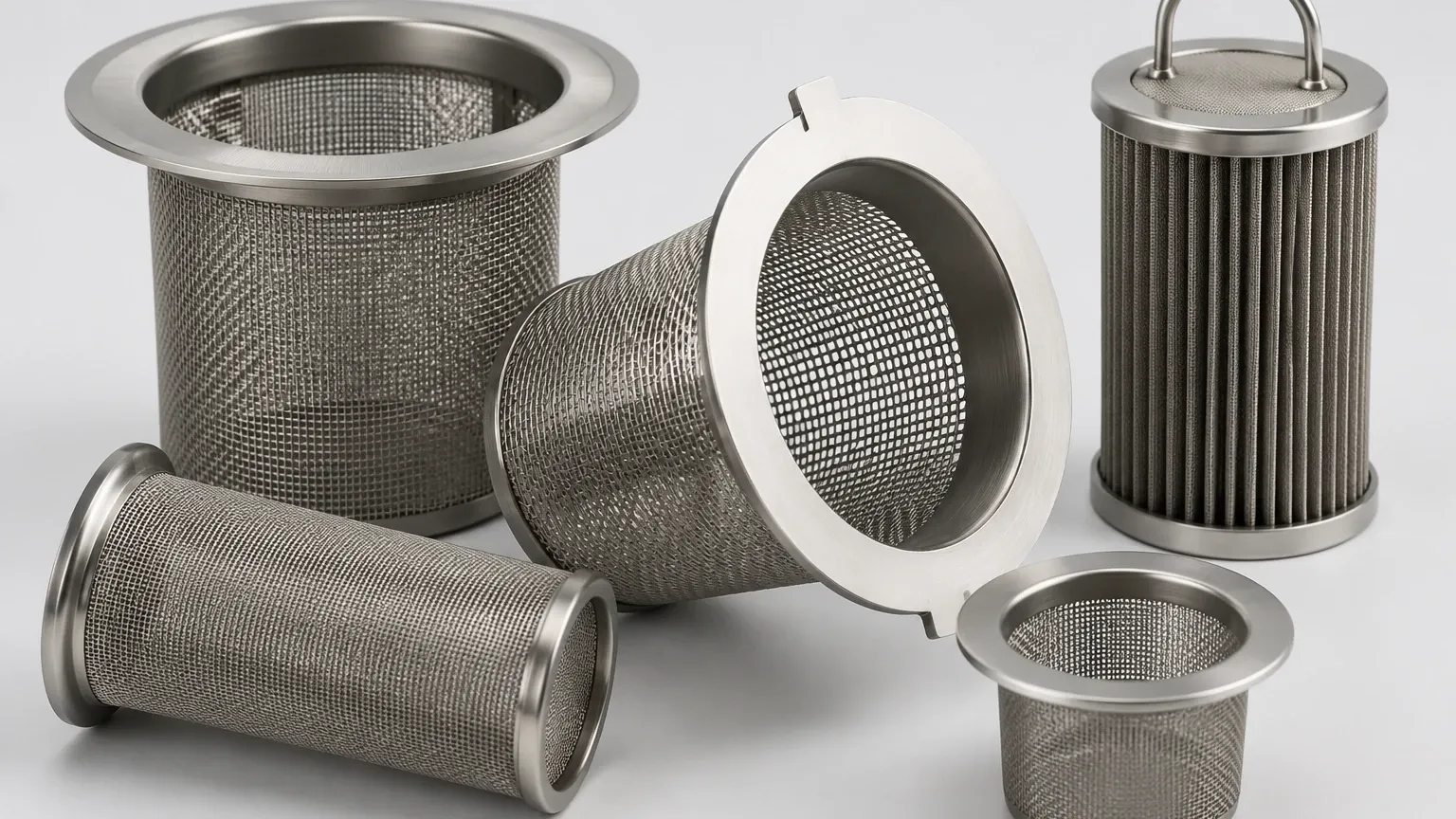
These serve as the primary structural element. Perforation patterns (staggered or straight) and hole sizes (ranging from 1/32" to 1/2") are selected based on the size of the largest permissible particle. Perforated baskets are exceptionally robust and can withstand high differential pressures.
Wire Mesh Linings
When finer filtration is required, the perforated basket is lined with woven stainless steel wire mesh. This allows the strainer 7 to achieve filtration levels down to 20 microns or finer. The mesh is sintered or multi-layered to provide mechanical support and prevent the mesh from migrating or deforming under flow pressure.
Wedge Wire Construction
For applications involving high-viscosity fluids or sticky solids, wedge wire (V-wire) construction offers a non-clogging surface. The outward-widening slots ensure that particles only contact two points of the wire, making them easier to backwash or clean manually.
Customization and OEM Solutions for Specific Industrial Requirements
Standard off-the-shelf components often fall short in specialized industrial processes. Customization is where the technical expertise of a manufacturer like Kaifil becomes essential. For a strainer 7 application, customization can take several forms:
1. Reinforced Structures: In high-pressure hydraulic or steam systems, standard baskets may collapse. We design reinforced support frames and heavy-duty handles to ensure the basket can be safely extracted even when fully loaded with heavy debris.
2. Custom Flanging and Connections: While the internal basket size might be a standard Size 7, the housing connections may require specific ANSI, DIN, or JIS flange ratings to match existing piping infrastructure.
3. Magnetic Inserts: For systems prone to fine metallic wear particles (such as in engine testing or metalworking), magnetic rods can be integrated into the center of the basket to capture sub-micron ferrous contaminants that would otherwise pass through the mesh.
4. Surface Finishes: In the food, beverage, and pharmaceutical sectors, the internal and external surfaces of the strainer must be polished to a specific Ra (Roughness Average) to prevent bacterial growth and facilitate CIP (Clean-In-Place) processes.
Maintenance and Operational Longevity of Strainers & Baskets
The total cost of ownership (TCO) for a strainer 7 system is influenced more by maintenance and downtime than by the initial purchase price. Engineers should look for designs that facilitate rapid servicing.
Differential Pressure Monitoring
Installing pressure gauges on the inlet and outlet of the strainer housing is the most effective way to monitor performance. A predetermined $ΔP$ limit should trigger a cleaning cycle. Neglecting this can lead to basket rupture, allowing contaminants to bypass the filter and potentially damage expensive downstream equipment.
Cleaning Protocols
Unlike disposable filter cartridges, stainless steel Strainers & Baskets are designed for reuse. Cleaning methods vary by application:
- Manual Cleaning: Removing the basket and using high-pressure water or air to dislodge particles.
- Ultrasonic Cleaning: For fine mesh liners where particles may be wedged in the weave, ultrasonic baths can restore the original flow characteristics without damaging the delicate wires.
- Chemical Soaking: Used when the contaminants are oils, resins, or biological films that require solvent-based removal.
Replacement Cycles
While stainless steel is durable, it is not infinite. Fatigue from pressure cycling and erosion from high-velocity abrasive particles will eventually degrade the mesh. Regular inspection for broken wires, thinning metal, or compromised welds is essential. Keeping a spare strainer 7 basket on-site is a standard best practice to minimize downtime during deep-cleaning cycles.
Selecting the Right Partner for Industrial Filtration
Choosing a strainer 7 solution involves more than just matching a part number. It requires a partner who understands the engineering principles of fluid dynamics and material science. At Kaifil, we combine advanced manufacturing capabilities with deep technical knowledge to deliver filtration components that perform reliably in the most demanding environments.
Whether you are designing a new system or looking to optimize an existing process, confirming the specific requirements of your application is the first step. Consider the chemical nature of your fluid, the maximum operating pressure, the desired filtration micron rating, and the physical constraints of your installation site.
By focusing on quality materials and precision engineering, Kaifil ensures that every strainer and basket we produce contributes to the efficiency and safety of your industrial operations. For technical assistance in selecting the optimal configuration for your needs, we invite you to consult with our engineering team to explore our full range of customizable filtration solutions.
