


Strainer 8 Digit Hsn Code
In the complex landscape of industrial procurement and international trade, technical accuracy extends beyond physical dimensions and material grades. For engineers and purchasing managers sourcing filtration components, understanding the regulatory framework—specifically the strainer 8 digit hsn code—is essential for ensuring seamless logistics, accurate tax assessment, and compliance with global trade standards.
Industrial Strainers & Baskets are critical components in piping systems, designed to protect downstream equipment like pumps, valves, and meters from particulate contamination. However, the classification of these items for customs and taxation purposes requires a granular understanding of the Harmonized System of Nomenclature (HSN). This guide provides a technical overview of how these components are classified, the engineering factors that influence their performance, and the procurement considerations necessary for high-stakes industrial applications.
The Role of HSN Codes in Industrial Filtration Procurement
The HSN system is a multipurpose international product nomenclature developed by the World Customs Organization (WCO). While the first six digits are consistent globally, the 8-digit HSN code provides a higher level of specificity required by national tax authorities, such as the GST framework in India or customs departments in other regions.
For a technical professional, the strainer 8 digit hsn code serves as a unique identifier that dictates the applicable duty rates and import/export regulations. Misclassification can lead to significant delays in the supply chain, unexpected costs, or legal non-compliance. In the context of stainless steel filtration, classification often depends on whether the product is viewed as a finished machine part or an article of metal.
Typically, industrial strainers and baskets fall under two primary chapters:
1. Chapter 73: Articles of iron or steel. This is often used for simple fabricated metal components like wire mesh baskets or perforated plates that do not contain moving parts.
2. Chapter 84: Nuclear reactors, boilers, machinery, and mechanical appliances. Specifically, heading 8421 covers filtering or purifying machinery and apparatus for liquids or gases.
Identifying the Correct Strainer 8 Digit Hsn Code for Metal Components
Determining the precise 8-digit code requires evaluating the primary function and the material of construction. For custom-manufactured stainless steel strainers, the following codes are frequently referenced in B2B transactions:
HSN 8421: Filtering and Purifying Machinery
Under this heading, sub-classification 8421 29 is common for "other" liquid filtering equipment. The 8-digit code 8421 29 00 is often applied to industrial liquid filters that are integrated into a larger mechanical system. If the strainer is considered a functional part of a filtering apparatus, it may also be classified under 8421 99 00, which covers parts of filtering or purifying machinery.
HSN 7326: Other Articles of Iron or Steel
If the strainer is a simple basket or a wire mesh insert without a complex housing or mechanical assembly, it may be classified under 7326 90 99. This code is a "catch-all" for fabricated steel products. Choosing between Chapter 84 and Chapter 73 often depends on the specific end-use and the complexity of the assembly. Engineers should consult with their logistics department or a customs broker to confirm which strainer 8 digit hsn code aligns with their local regulations and the specific design of the component.
Engineering Considerations for Selecting Industrial Strainers & Baskets
Beyond the administrative requirements of the strainer 8 digit hsn code, the technical selection of Strainers & Baskets is driven by the demands of the process environment. A strainer is not a one-size-fits-all component; its design must account for fluid dynamics, pressure constraints, and the nature of the contaminants.
1. Pressure Drop (Delta P)
Every strainer introduces a restriction in the flow path, resulting in a pressure drop. Engineers must calculate the clean pressure drop to ensure the system pump can handle the additional load. As the strainer basket collects debris, the pressure drop increases. Selecting a basket with a high open area ratio (the ratio of the total hole area to the total pipe area) is critical for minimizing energy loss and extending the time between cleaning cycles.
2. Flow Rate and Velocity
The velocity of the fluid through the strainer element affects both the filtration efficiency and the structural integrity of the mesh or perforated plate. High-velocity systems may require reinforced baskets to prevent the filter media from collapsing under the force of the flow.
3. Micron Rating and Retention Requirements
The primary purpose of a strainer is to remove particles of a specific size. This is defined by the micron rating. For coarse filtration, perforated plates with holes ranging from 1/16" to 1/4" are common. For finer filtration, a wire mesh lining is added to the basket. In these cases, the strainer 8 digit hsn code remains the same, but the internal engineering becomes significantly more complex to ensure the mesh is securely bonded to the support structure.
Material Selection and Its Impact on Classification and Performance
The material of construction is a primary driver of both the cost and the durability of industrial strainers. In sectors like chemical processing or food and beverage, stainless steel is the industry standard due to its corrosion resistance and ease of sterilization.
* SS304/304L: Suitable for general-purpose applications, water treatment, and mildly corrosive environments. It offers excellent weldability and structural strength.
* SS316/316L: The preferred choice for pharmaceutical and marine applications. The addition of molybdenum provides superior resistance to chlorides and pitting corrosion.
* Duplex Stainless Steel: Used in highly aggressive chemical environments where both high strength and extreme corrosion resistance are required.
When documenting the strainer 8 digit hsn code for international shipping, the material composition must be clearly stated in the commercial invoice. Customs authorities use the material description to verify the HSN classification, particularly for items falling under Chapter 73 (Articles of Iron or Steel).
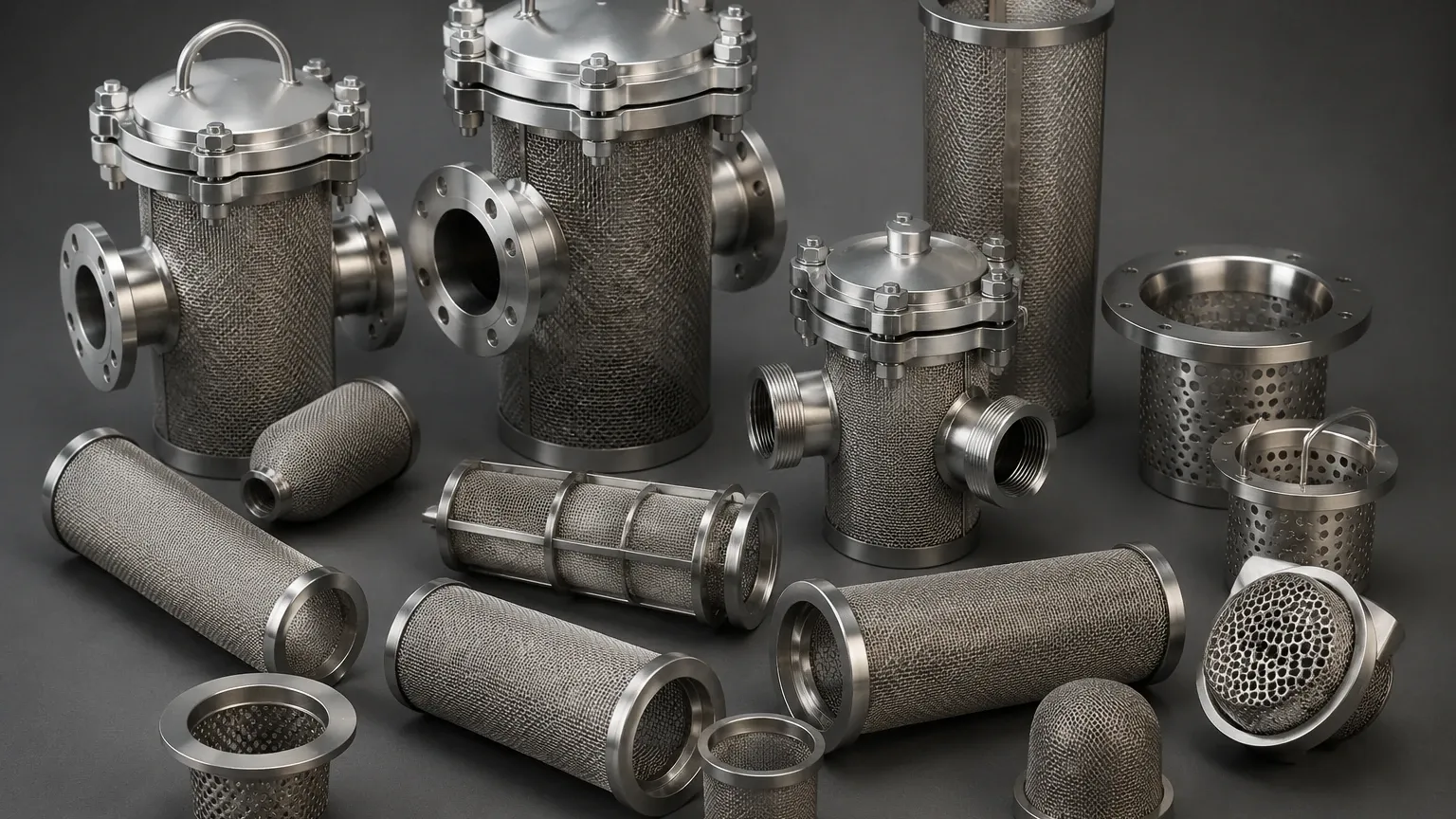
Evaluating Filtration Efficiency: Mesh Types and Construction
The internal element of a strainer basket can be constructed in several ways, depending on the required precision and the mechanical load.
Perforated Metal Baskets
These are the most robust types of strainers, typically used for removing large debris like scale, weld slag, or stones. They are made by punching holes into a metal sheet, which is then rolled and welded into a basket shape. The durability of perforated metal makes it ideal for high-pressure applications.
Wire Mesh Lined Baskets
For finer filtration, a stainless steel wire mesh is layered over a perforated metal support. This provides the fine particle retention of the mesh with the structural rigidity of the perforated plate. This "dual-layer" approach is common in hydraulic systems and oil filtration where protecting sensitive components is paramount.
Wedge Wire Screens
Wedge wire (or V-wire) offers a non-clogging surface and high mechanical strength. It is particularly effective in continuous flow applications where backwashing or automated cleaning is utilized. While the strainer 8 digit hsn code for wedge wire components often follows the same rules as standard baskets, the manufacturing process is more specialized, involving the resistance welding of V-shaped wires onto support rods.
Custom OEM Solutions for Complex Filtration Challenges
In many industrial scenarios, off-the-shelf strainers cannot meet the specific spatial or performance constraints of a system. This is where custom OEM manufacturing becomes vital. A professional manufacturer can tailor the dimensions, connection types (flanged, threaded, or socket weld), and filtration media to match the exact requirements of the project.
Customization options often include:
* Magnetic Inserts: To capture fine iron or steel particles that might pass through the mesh.
* Reinforced Handles: For easier removal and maintenance of large-scale baskets.
* Special Coatings: Such as PTFE lining for extreme chemical resistance.
When ordering custom components, providing the manufacturer with the intended strainer 8 digit hsn code can help align the documentation with your internal ERP system and simplify the procurement process across different regional branches.
Procurement Best Practices: Documentation and Compliance
For purchasing teams, the procurement of Strainers & Baskets involves more than just comparing unit prices. The total cost of ownership (TCO) includes maintenance frequency, replacement part availability, and the administrative costs of compliance.
Verifying Documentation
Ensure that the supplier provides material test reports (MTRs) to verify the grade of stainless steel. Additionally, the commercial invoice must clearly list the strainer 8 digit hsn code to prevent delays at the border. If you are importing components for a specific project, verify if the code qualifies for any trade agreements or duty exemptions.
Maintenance and Replacement Cycles
Industrial strainers are wear items. Over time, the mesh can become blinded or damaged by high-pressure surges. Establishing a clear maintenance schedule and keeping spare baskets on hand is essential for avoiding unplanned downtime. When sourcing replacement baskets, ensure they are built to the original OEM specifications to maintain the integrity of the filtration system.
Conclusion: Ensuring Precision in Product and Paperwork
Navigating the technicalities of industrial filtration requires a dual focus on engineering excellence and regulatory precision. Identifying the correct strainer 8 digit hsn code is a fundamental step in the B2B supply chain, ensuring that high-quality Strainers & Baskets reach their destination without administrative friction.
By understanding the nuances of HSN classification—whether under Chapter 73 or Chapter 84—and combining that knowledge with rigorous engineering standards for material selection, micron ratings, and pressure management, technical professionals can optimize their filtration processes. Whether you are designing a new chemical processing line or maintaining a municipal water treatment plant, the right strainer, backed by the correct documentation, is the first line of defense for your critical infrastructure.
