


Strainer 8
In high-volume industrial fluid systems, the implementation of a strainer 8 (8-inch nominal pipe size) is a critical engineering decision for protecting downstream infrastructure. As pipelines scale in diameter, the mechanical stresses, flow velocities, and potential debris loads increase exponentially. Selecting the correct configuration for Strainers & Baskets at this scale requires a deep understanding of fluid dynamics, material compatibility, and the specific filtration requirements of the process media.
Industrial filtration at the 8-inch threshold typically serves as the primary line of defense for expensive equipment such as centrifugal pumps, flow meters, heat exchangers, and control valves. A failure to correctly specify the strainer can lead to catastrophic pump cavitation, eroded valve seats, or unplanned system shutdowns. This guide examines the technical parameters, design variations, and selection criteria essential for engineers and purchasing teams evaluating 8-inch filtration solutions.
Understanding the Engineering Requirements of 8-Inch Strainers
An 8-inch strainer is designed to handle significant flow rates, often ranging from 1,000 to over 3,000 gallons per minute (GPM) depending on the allowable pressure drop and fluid viscosity. At these volumes, the velocity of the fluid exerts substantial force on the internal filtration element. Consequently, the structural integrity of the basket or screen is as important as the filtration accuracy itself.
When specifying a strainer 8, engineers must prioritize the "Open Area Ratio" (OAR). The OAR is the relationship between the internal cross-sectional area of the pipe and the total net open area of the strainer screen. For high-capacity industrial applications, an OAR of at least 6:1 is recommended. This ensures that even as the basket begins to collect debris, the pressure drop (differential pressure) remains within operational limits, preventing strain on the pumping system.
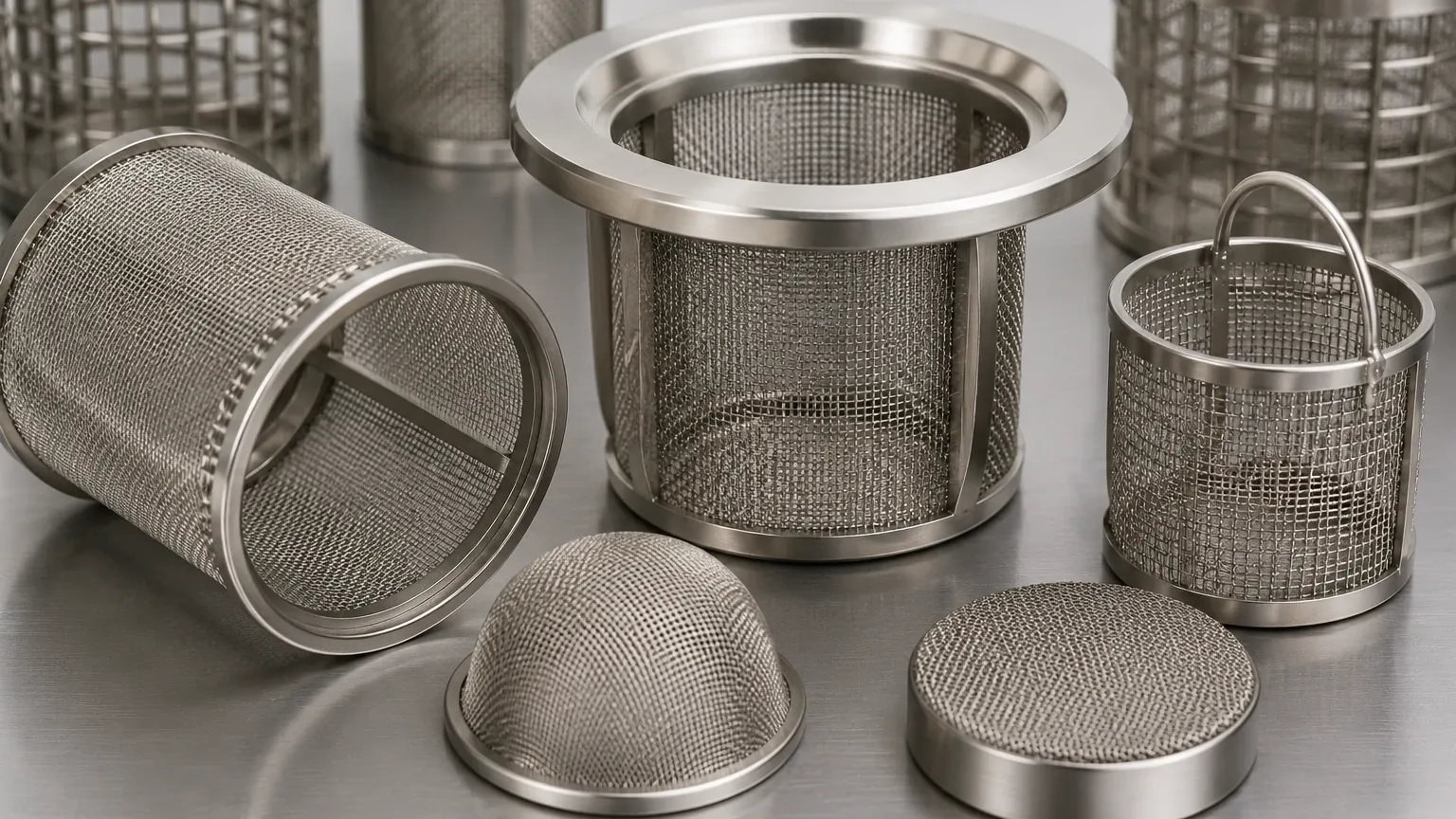
Kaifil specializes in manufacturing high-performance Strainers & Baskets that utilize precision-engineered wire mesh and perforated metals to achieve these ratios while maintaining the durability required for heavy-duty industrial environments.
Material Selection and Corrosion Resistance
The choice of material for both the housing and the internal element of a strainer 8 is dictated by the chemical composition of the fluid, the operating temperature, and the external environment. In most industrial B2B sectors—including chemical processing, pharmaceuticals, and food production—stainless steel is the gold standard.
Stainless Steel 304 vs. 316L
Stainless steel 304 is suitable for general-purpose applications involving water treatment or non-corrosive industrial fluids. However, for environments involving chlorides, acids, or high-purity requirements (such as in the pharmaceutical or food and beverage sectors), Type 316L stainless steel is preferred. The addition of molybdenum in 316L provides superior resistance to pitting and crevice corrosion, which is vital when a strainer 8 is used in continuous-flow processes where downtime for replacement is costly.
Specialized Alloys
In extreme cases, such as seawater filtration or highly aggressive chemical batching, specialized alloys like Duplex stainless steel or Monel may be required. Kaifil’s expertise in custom stainless steel filtration solutions allows for the selection of materials that balance cost-effectiveness with long-term durability, ensuring the strainer body and the mesh element can withstand the specific rigors of the application.
Design Configurations: Basket vs. Y-Strainer at 8-Inch Scale
The physical configuration of the strainer is a primary factor in its maintenance cycle and performance. For an 8-inch line, the two most common designs are the Basket (Simplex) Strainer and the Y-Strainer.
Basket Strainers
Basket strainers are the preferred choice for a strainer 8 when high dirt-holding capacity is required. Because the basket is oriented vertically, it can hold significantly more debris than a Y-strainer before the pressure drop becomes excessive. This is particularly advantageous in cooling water systems or intake lines where large particulates are common. Furthermore, basket strainers are easier to service; the top cover can be removed, and the basket lifted out without spilling the process fluid, provided the system is depressurized.
Y-Strainers
Y-strainers are typically used in 8-inch lines where space is a constraint or where the amount of debris is expected to be minimal, such as in steam or gas lines. While they have a lower dirt-holding capacity, they can be installed in both horizontal and vertical orientations. For a strainer 8 in a Y-configuration, it is essential to include a blow-off valve on the strainer cap to allow for the flushing of accumulated solids without interrupting the flow.
Filtration Accuracy and Mesh Selection
The performance of a strainer 8 is ultimately defined by its internal element. This element is usually a combination of a perforated metal support sheet and a fine wire mesh liner. The selection of the mesh count or micron rating must be a balance between the level of protection required and the maintenance frequency.
* Coarse Filtration: Used for removing large scale, pebbles, or welding slag. Perforated plates with holes ranging from 1/16" to 1/4" are common.
* Fine Filtration: Used for protecting sensitive instruments or ensuring product purity. This involves stainless steel wire mesh liners that can filter down to 50 microns or less.
Engineers must be cautious not to "over-filter." Specifying a mesh that is too fine for the application will lead to rapid clogging and frequent maintenance intervals. In a strainer 8, where the surface area is large, a multi-layered sintered mesh or a reinforced wire mesh basket can provide the necessary mechanical strength to prevent the mesh from collapsing under the weight of the debris and the force of the high-velocity flow.
Maintenance Protocols and Differential Pressure Monitoring
For any industrial strainer 8 installation, monitoring differential pressure (ΔP) is the most effective way to determine the cleaning cycle. As debris accumulates in the basket, the pressure at the outlet decreases relative to the inlet.
1. Clean Pressure Drop: The initial ΔP when the strainer is first installed or cleaned. This should ideally be less than 2 PSI.
2. Alarm Level: Most systems are designed for a cleaning cycle to trigger when the ΔP reaches 5 to 8 PSI.
3. Critical Threshold: If the ΔP exceeds 15-20 PSI, the structural integrity of the basket may be compromised, leading to "bypass" where the mesh ruptures and contaminants pass through to downstream equipment.
To facilitate efficient maintenance, 8-inch strainers should be equipped with differential pressure gauges and, where possible, a duplex configuration. A duplex strainer consists of two separate strainer chambers connected by a diverting valve, allowing one side to be cleaned while the other remains in operation, ensuring zero downtime.
Customization and OEM Capabilities
Standard off-the-shelf strainers often fail to meet the specific geometric or performance requirements of complex industrial layouts. Customization is often necessary for a strainer 8 to ensure it fits within existing piping footprints or handles unique fluid characteristics.
Kaifil provides comprehensive OEM and customized filtration solutions, allowing for modifications such as:
* Custom Flange Ratings: Matching ANSI, DIN, or JIS standards for seamless integration.
* Reinforced Baskets: Adding internal supports or heavy-duty perforated backing for high-pressure or high-viscosity applications.
* Magnetic Inserts: Incorporating magnetic rods within the basket to capture fine ferrous particles that might otherwise pass through the mesh.
* Specialized Coatings: Applying epoxy or PTFE coatings for enhanced chemical resistance.
By working closely with global customers, Kaifil ensures that each strainer 8 is engineered for its specific environment, whether it is a pharmaceutical cleanroom or a rugged chemical processing plant.
Total Cost of Ownership (TCO) Considerations
When evaluating a strainer 8, the purchase price is only one component of the total cost of ownership. Procurement teams should also consider:
* Durability: A high-quality stainless steel strainer from a reputable manufacturer like Kaifil will outlast cheaper cast-iron alternatives, especially in corrosive environments.
* Operational Efficiency: A well-designed basket with a high OAR reduces energy consumption by minimizing the work the pump must do to overcome pressure resistance.
* Maintenance Labor: Ease of access and the availability of replacement baskets directly impact the labor costs associated with system upkeep.
Selecting a reliable manufacturer ensures that replacement parts, such as gaskets and spare baskets, are readily available, preventing extended outages due to simple component failures.
Conclusion
The selection and implementation of a strainer 8 is a fundamental aspect of industrial fluid management. By focusing on material integrity, appropriate design configuration, and precise filtration accuracy, engineers can significantly extend the lifespan of their downstream equipment and optimize process efficiency. Whether the application requires a standard basket strainer or a highly customized OEM solution, understanding these technical boundaries is essential for achieving reliable, long-term filtration performance in demanding industrial sectors.
