


Strainer Basket 3d Print
In the realm of industrial filtration, the integration of additive manufacturing has revolutionized how engineers approach component design and system integration. Utilizing a strainer basket 3d print as a functional prototype or a conceptual model allows technical teams to verify fitment, flow paths, and structural clearances before committing to the full-scale production of stainless steel components. However, transitioning from a digital model to a high-performance industrial filter requires a deep understanding of material limitations, fluid dynamics, and the rigorous demands of industrial environments.
For engineers and purchasing managers, the journey often begins with a 3D model to solve a specific spatial or hydraulic challenge. While 3D printing provides immediate physical feedback, the ultimate goal in sectors like chemical processing, food and beverage, and pharmaceuticals remains the procurement of durable, high-precision Strainers & Baskets that can withstand the rigors of continuous operation.
Understanding the Role of a Strainer Basket 3D Print in Engineering
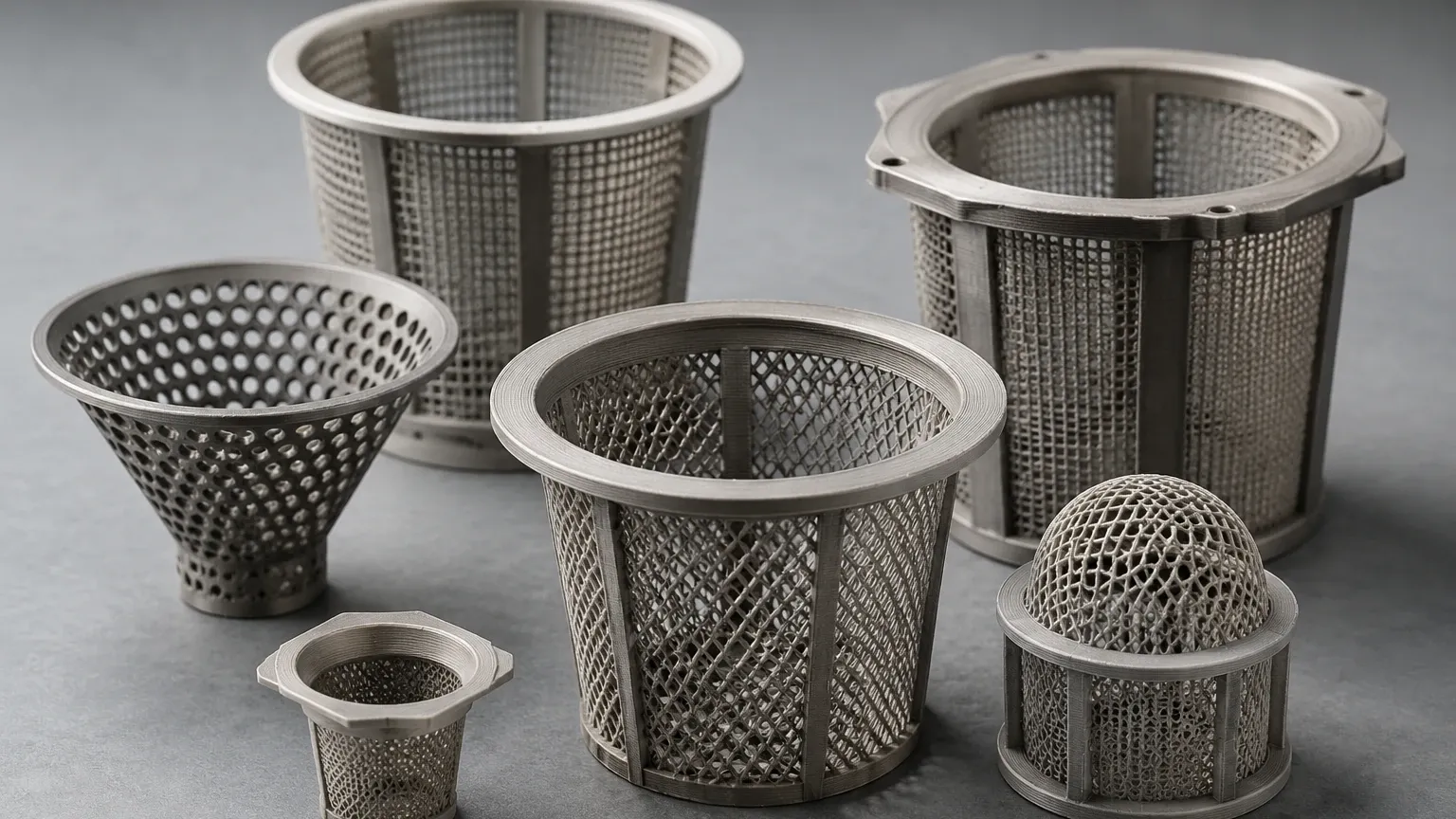
A strainer basket 3d print serves several critical functions in the early stages of system design. Its primary value lies in rapid prototyping, allowing engineers to test the physical interface between the strainer and the housing. In complex piping systems where space is at a premium, a 3D-printed model can confirm that a basket can be easily removed for maintenance without hitting overhead obstructions or adjacent equipment.
Beyond spatial verification, 3D printing allows for the exploration of non-standard geometries. Traditional manufacturing of baskets often relies on cylindrical or conical shapes due to the limitations of rolling and welding perforated plate or wire mesh. With additive manufacturing, engineers can experiment with irregular shapes designed to optimize flow distribution or increase surface area within a constrained volume. While these complex shapes may eventually be fabricated in stainless steel, the 3D print acts as the proof-of-concept for the hydraulic design.
Material Limitations: Polymer vs. Stainless Steel
When discussing a strainer basket 3d print, it is essential to distinguish between the prototype and the final industrial product. Most common 3D printing materials, such as PLA, ABS, or PETG, lack the mechanical properties required for industrial filtration.
Thermal Resistance
Industrial processes often involve high-temperature fluids. Polymers used in standard 3D printing begin to soften or deform at temperatures as low as 60°C (140°F). In contrast, stainless steel strainers maintain structural integrity at temperatures exceeding 400°C, depending on the alloy grade. A 3D-printed basket may suffice for a cold-water fitment test, but it cannot be used in steam cleaning or high-temperature chemical filtration.
Chemical Compatibility
In chemical processing and water treatment, the strainer is often exposed to corrosive agents or extreme pH levels. While some specialized filaments like PVDF or PEEK offer chemical resistance, they are expensive and difficult to print with the precision required for fine filtration. Stainless steel (304, 316L, or Duplex) remains the industry standard due to its predictable corrosion rates and compatibility with a wide range of industrial solvents and acids.
Structural Strength and Pressure Differentials
Filters are subject to significant pressure drops (ΔP) as they accumulate debris. A strainer basket 3d print produced via Fused Deposition Modeling (FDM) has inherent weaknesses between layers. Under the stress of a high-pressure system, these layers can delaminate, leading to catastrophic failure and downstream contamination. Industrial-grade metal baskets are engineered to withstand specific collapse pressures, a feat rarely achievable with standard polymer 3D prints.
Engineering Considerations for Industrial Strainers & Baskets
When moving from a strainer basket 3d print to a production-ready component, several engineering parameters must be finalized. These factors ensure that the final product meets the performance expectations of the application.
Filtration Accuracy and Micron Ratings
One of the greatest challenges with 3D printing a strainer is achieving a consistent and fine micron rating. Most FDM printers struggle to create precise holes smaller than 500 microns without compromising the structural wall. Industrial Strainers & Baskets utilize precision-woven wire mesh or laser-perforated plates that can achieve filtration levels down to 5 microns. Engineers must determine the exact particle size that needs to be captured and select the appropriate mesh count or perforation pattern accordingly.
Open Area and Flow Velocity
The efficiency of a strainer is largely determined by its "open area ratio." This is the ratio of the total area of the holes to the total surface area of the basket. A higher open area results in a lower initial pressure drop and longer intervals between cleanings. When designing a strainer basket 3d print, engineers often find that the wall thickness required for 3D printing stability reduces the available open area. Professional manufacturing allows for thinner, high-strength wires or plates, maximizing flow efficiency.
Surface Finish and Sanitation
In the food, beverage, and pharmaceutical industries, surface finish is a critical safety factor. 3D prints are naturally porous and have visible layer lines, which can harbor bacteria and are nearly impossible to sanitize to industry standards. Industrial stainless steel baskets can be electropolished to a mirror finish, ensuring they are compatible with Clean-In-Place (CIP) protocols and meet stringent hygiene requirements.
Transitioning from Prototype to Industrial Production
Once the design has been validated using a strainer basket 3d print, the next step is to translate that design into a high-quality metal component. This transition requires collaboration with a manufacturer capable of handling custom specifications and material requirements.
Customization and OEM Capabilities
Industrial applications rarely follow a "one size fits all" approach. Whether it is a unique flange mounting, a specific handle design for ergonomic removal, or a multi-layered mesh construction for graduated filtration, customization is key. Manufacturers like Kaifil specialize in taking these custom requirements and producing reliable filtration solutions. By providing the CAD data used for the 3D print, engineers can ensure that the final stainless steel product matches the validated dimensions exactly.
Evaluating Total Cost of Ownership
While a strainer basket 3d print is inexpensive to produce in-house, the total cost of ownership (TCO) for a filtration system depends on the durability of the basket. A low-quality or improperly specified strainer can lead to frequent replacements, system downtime, and potential damage to downstream equipment like pumps and spray nozzles. Investing in a professionally manufactured stainless steel basket ensures a service life that often spans years, rather than weeks or months.
Maintenance and Replacement Cycles
Even the most robustly engineered Strainers & Baskets require a maintenance strategy. Engineers should consider the following when finalizing their design:
1. Cleaning Methods: Will the basket be cleaned manually, via ultrasonic bath, or backwashing? The mechanical strength of the mesh must be sufficient to withstand the chosen cleaning method.
2. Gasket and Seal Integrity: The interface between the basket and the housing must be leak-proof. Professional baskets often include machined seats or integrated O-rings that are difficult to replicate accurately in a 3D print.
3. Debris Loading: The design must account for the weight of the captured material. In heavy-duty applications, the basket may require internal reinforcements or a heavier gauge perforated support cylinder.
Conclusion: The Path to Reliable Filtration
The use of a strainer basket 3d print is a valuable tool in the modern engineer's toolkit, providing a low-risk method for design verification and spatial testing. However, the transition to a functional industrial environment necessitates a shift toward professional materials and manufacturing techniques.
By focusing on filtration accuracy, material compatibility, and structural integrity, technical teams can ensure that their systems operate efficiently and without interruption. When the design moves from the 3D printer to the production line, choosing a manufacturer with expertise in custom stainless steel solutions is the most effective way to guarantee performance. For those ready to move beyond the prototyping stage, reviewing professional Strainers & Baskets options is the essential next step in achieving optimized industrial filtration.
