


Strainer Basket 8
In industrial fluid handling, the term "strainer basket 8" typically refers to one of two critical specifications: an 8-inch nominal pipe size (NPS) basket designed for large-scale flow or an 8-mesh filtration grade used for coarse particulate removal. Both interpretations are vital in the engineering of Strainers & Baskets intended for high-capacity systems. Selecting the correct configuration requires a deep understanding of fluid dynamics, material compatibility, and the mechanical stresses exerted on the filtration media during operation.
As a core component in protecting downstream equipment such as pumps, valves, and heat exchangers, the strainer basket must be engineered to withstand differential pressures while maintaining a high open-area ratio. This article examines the technical nuances of the strainer basket 8, providing engineers and procurement teams with the factual data needed to optimize their filtration processes.
Understanding the Role of 8-Inch Strainer Baskets in Industrial Systems
An 8-inch strainer basket is a heavy-duty component designed for high-flow applications where significant volumes of liquid or gas must be processed with minimal interruption. These units are commonly found in municipal water treatment, large-scale chemical processing, and oil and gas refineries. Because of the sheer volume of fluid moving through an 8-inch pipeline, the basket must be structurally reinforced to prevent collapse or bypass.
From an engineering perspective, the 8-inch designation implies a specific set of physical dimensions. These baskets are usually housed in simplex or duplex strainers. The design must account for the "dirt-holding capacity," which is the volume of solids the basket can retain before the pressure drop (Delta P) reaches a critical threshold. For an 8-inch system, the surface area of the basket is significantly larger than smaller units, allowing for longer run times between cleaning cycles, provided the mesh or perforation size is correctly matched to the contaminant profile.
Technical Specifications: Material Selection and Structural Integrity
Material selection is the foundation of a reliable strainer basket 8. Most industrial applications demand stainless steel due to its balance of mechanical strength and corrosion resistance. The two most common grades utilized are:
* AISI 304 Stainless Steel: Suitable for general-purpose applications, including water filtration and non-corrosive chemical handling. It offers excellent weldability and structural stability.
* AISI 316/316L Stainless Steel: Preferred for marine environments, pharmaceutical production, and aggressive chemical processing. The addition of molybdenum provides enhanced resistance to pitting and crevice corrosion, especially in chloride-rich environments.
For specialized applications, manufacturers like Kaifil may utilize exotic alloys such as Monel, Hastelloy, or Duplex stainless steel. Beyond the base material, the structural integrity of the basket is reinforced through heavy-gauge perforated plate backings. In an 8-inch basket, the internal pressure can be substantial; therefore, the longitudinal seams and the bottom plate must be precision-welded to ensure no bypass occurs under high-velocity flow conditions.
Filtration Efficiency: Mesh Size vs. Perforation Patterns
The "8" in strainer basket 8 often refers to 8-mesh, which denotes eight openings per linear inch. This is a relatively coarse filtration level, typically used for primary straining to remove large debris such as pebbles, scale, or plastic fragments. However, industrial baskets are often multi-layered.
1. Perforated Support: The outer layer is usually a perforated metal sheet with hole diameters ranging from 1/16" to 1/2". This provides the mechanical skeleton of the basket.
2. Fine Mesh Lining: If finer filtration is required (e.g., 100 mesh or 200 mesh), a stainless steel wire cloth is lined inside the perforated basket. In an 8-mesh configuration, the wire diameter is typically thicker to handle the physical impact of larger solids.
Engineers must calculate the "Open Area Ratio" (OAR). A well-designed strainer basket 8 should ideally have an OAR of at least 6:1 relative to the internal cross-sectional area of the inlet pipe. This ratio ensures that even when the basket is 50% clogged, the system does not experience a catastrophic drop in flow or pressure.
Hydraulic Performance and Pressure Drop Considerations
Pressure drop is the most critical metric when evaluating a strainer basket 8. Every basket introduces a restriction in the flow path, resulting in a loss of kinetic energy. This is measured as the difference between the upstream and downstream pressure.
Several factors influence the pressure drop in an 8-inch basket:
* Fluid Viscosity: Thicker fluids (like heavy oils) require larger basket surface areas or coarser mesh to maintain flow.
* Velocity: As flow velocity increases, the pressure drop increases exponentially (following the square law).
* Contaminant Loading: As the basket collects debris, the available open area decreases, causing the pressure drop to rise.
In industrial settings, it is standard practice to install differential pressure gauges across the strainer housing. For an 8-inch system, a clean pressure drop of 2 PSI is often acceptable, while a jump to 10-15 PSI usually signals the need for immediate cleaning or replacement. Overlooking these metrics can lead to pump cavitation or mechanical failure of the basket itself.
Customization and Engineering for Specialized Applications
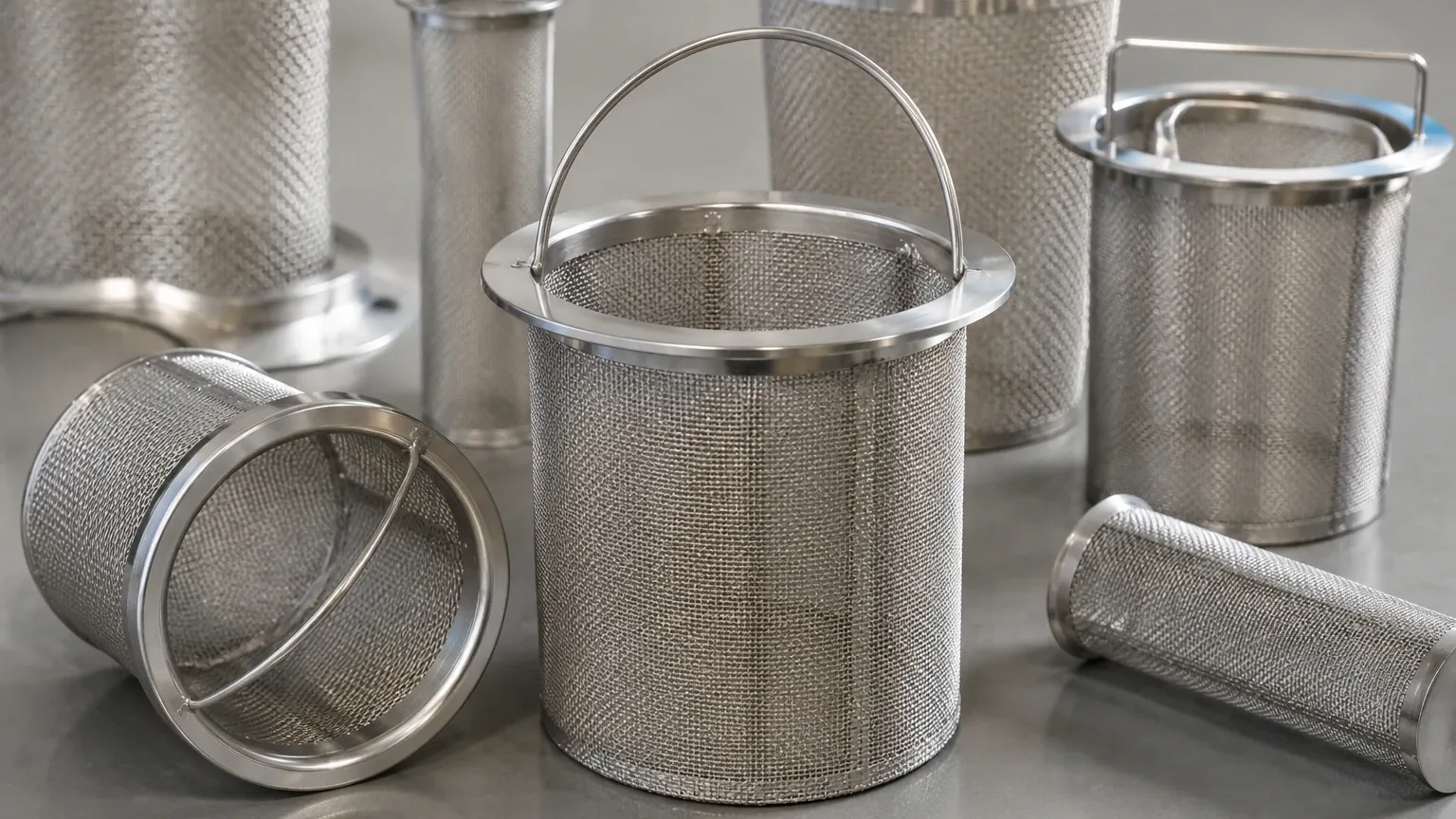
Standard off-the-shelf baskets often fail to meet the specific demands of complex industrial processes. Customization is where engineering expertise becomes essential. When specifying a strainer basket 8, several custom features can be integrated:
* Reinforced Handles: For 8-inch baskets, which can be heavy when filled with debris, heavy-duty lifting handles or bails are necessary for safe extraction.
* Magnetic Inserts: In systems where fine iron or steel particles (black brown) are present, magnetic rods can be suspended within the basket to capture sub-micron metallic contaminants that would otherwise pass through the mesh.
* Sloping Bottoms: To facilitate easier cleaning and ensure all debris is captured in a central location, baskets can be designed with conical or slanted bottoms.
* Custom Flanges and Seals: Depending on the housing, the top ring of the basket may require specific gaskets (EPDM, Viton, or PTFE) to ensure a 100% seal against the housing wall, preventing any liquid from bypassing the filtration media.
Kaifil specializes in these types of OEM and customized filtration solutions, ensuring that the dimensions and material properties align perfectly with the existing infrastructure of the plant.
Maintenance, Cleaning, and Operational Longevity
The service life of a strainer basket 8 depends heavily on the maintenance protocol. Unlike disposable filter cartridges, stainless steel baskets are designed to be cleaned and reused. However, improper cleaning can damage the mesh and compromise filtration integrity.
Cleaning Procedures:
* Backwashing: In some automated systems, flow is reversed to flush contaminants off the mesh.
* Manual Cleaning: For simplex strainers, the basket is removed and cleaned using high-pressure water or air. It is vital to avoid using wire brushes that could distort the mesh openings or cause cross-contamination of metals.
* Ultrasonic Cleaning: For baskets used in the food, beverage, or pharmaceutical industries, ultrasonic baths are used to remove microscopic residues trapped within the wire intersections.
Replacement cycles should be determined by inspecting the integrity of the mesh-to-perforation welds and checking for signs of metal fatigue or corrosion. Even a small pinhole in the mesh can allow bypass, rendering the entire filtration stage ineffective.
Key Selection Criteria for Procurement Teams
When sourcing a strainer basket 8, procurement teams should move beyond price and focus on the total cost of ownership (TCO). A lower-quality basket may save on initial costs but lead to frequent replacements, higher energy costs due to pressure drops, and potential damage to expensive downstream machinery.
Checklist for Confirming Specifications:
1. Dimensional Accuracy: Confirm the outside diameter (OD), total height, and the dimensions of the seating flange or ring.
2. Micron/Mesh Rating: Clearly define the required filtration level. Is it for coarse protection (8-mesh) or fine polishing?
3. Material Certification: Request mill test reports (MTRs) to verify the grade of stainless steel.
4. Flow Rate Requirements: Ensure the basket's open area is compatible with the system's maximum GPM (gallons per minute).
5. Operating Environment: Account for temperature fluctuations and chemical exposure that might necessitate specific alloy treatments.
By focusing on these technical boundaries, engineers can ensure that their Strainers & Baskets provide reliable, long-term performance in even the most demanding industrial environments. Whether the requirement is for a standard 8-mesh replacement or a custom-engineered 8-inch high-flow basket, the emphasis must always remain on precision manufacturing and structural durability.
