


Strainer Basket Bathroom Sink
In the realm of commercial plumbing and industrial fluid management, the humble strainer basket bathroom sink component represents a critical point of intersection between user-facing hardware and backend infrastructure protection. While residential applications often prioritize aesthetics, B2B procurement for high-traffic environments—such as hospitals, hotels, airports, and industrial laboratories—demands a level of engineering precision and material durability that standard consumer products cannot provide.
As a specialized manufacturer of high-performance filtration solutions, Kaifil approaches the design and production of Strainers & Baskets with a focus on technical excellence. Understanding the engineering considerations behind these components is essential for facility managers and design engineers who must ensure long-term reliability and efficient maintenance cycles.
The Engineering Behind Industrial-Grade Strainer Baskets
At its core, a strainer basket is a mechanical filtration device designed to remove solids from a liquid stream. In the context of a commercial bathroom sink, the strainer basket serves as the primary defense against debris that could cause downstream blockages in complex piping systems.
Unlike standard gravity-fed residential drains, commercial systems often handle higher volumes and a wider variety of particulates. The design of a professional-grade strainer basket bathroom sink assembly involves several engineering variables:
1. Open Area Ratio: This is the ratio of the total area of the holes in the basket to the total area of the basket itself. A higher open area ratio ensures minimal pressure drop and prevents slow drainage, which is a common complaint in high-traffic facilities.
2. Structural Integrity: Industrial baskets must withstand the mechanical stress of frequent removal and cleaning. This requires robust welding techniques, such as TIG (Tungsten Inert Gas) or spot welding, to ensure the mesh or perforated plate remains securely attached to the frame.
3. Sealing Mechanisms: For applications where the strainer must also act as a plug, the precision of the center post and the quality of the rubber or silicone gasket are paramount to prevent slow leaks.
Material Selection: Why Stainless Steel Dominates Commercial Applications
Material science plays a pivotal role in the longevity of filtration components. While plastic or zinc-alloy strainers are common in retail markets, they often fail under the rigors of commercial use. Kaifil specializes in stainless steel solutions because of the material's inherent advantages in demanding environments.
SS304 vs. SS316
Most high-quality strainer basket bathroom sink components are fabricated from Type 304 stainless steel. This alloy provides excellent corrosion resistance and durability for standard water-based applications. However, in environments where the sink may be exposed to harsh cleaning chemicals, saline solutions, or laboratory reagents, Type 316 stainless steel is often specified. The addition of molybdenum in SS316 significantly enhances resistance to pitting and crevice corrosion, particularly in chloride-rich environments.
Surface Finishing and Passivation
Beyond the alloy itself, the surface finish is critical. Industrial strainers often undergo passivation—a process that removes free iron from the surface and enhances the protective chromium oxide layer. For pharmaceutical or food-service environments, electropolishing may be employed to create a microscopically smooth surface that resists bacterial growth and is easier to sanitize.
Technical Specifications: Mesh Count, Micron Rating, and Flow Capacity
When engineers select Strainers & Baskets, they must balance filtration efficiency with flow capacity. This balance is defined by two primary technical metrics:
Mesh Count and Perforation Size
The "mesh count" refers to the number of openings per linear inch. In a strainer basket bathroom sink application, the goal is typically to catch hair, jewelry, and large organic debris without impeding the flow of water.
* Coarse Filtration: Often achieved through perforated metal with hole diameters ranging from 1mm to 3mm. This is ideal for general-purpose drainage where flow rate is the priority.
* Fine Filtration: Achieved through woven wire mesh liners. This is necessary in specialized industrial sinks where even small particulates must be captured before the water enters a treatment system.
Flow Rate and Pressure Drop
In any filtration system, the introduction of a barrier causes a pressure drop ($ΔP$). For gravity-fed bathroom sinks, an incorrectly specified strainer can lead to standing water. Engineers must calculate the expected flow rate (measured in Gallons Per Minute or Liters Per Second) and ensure that the basket's effective filtration area is sufficient to handle peak loads without overflow.
Customization and OEM Capabilities for Specialized Drainage
One of the primary challenges in commercial retrofitting or specialized industrial design is the lack of standardization across different manufacturers' sink basins. This is where custom manufacturing becomes a necessity.
Kaifil provides extensive OEM services for customers requiring non-standard strainer basket bathroom sink dimensions. Customization options include:
* Variable Basket Depths: Deep-well baskets for high-sediment applications or shallow baskets for compact plumbing configurations.
* Handle Designs: Fixed posts, ball-lock handles, or drop-handles designed for ergonomic removal by maintenance staff wearing protective equipment.
* Integrated Secondary Filters: In some laboratory settings, a primary basket may be paired with a secondary fine-mesh insert to ensure multi-stage debris capture.
By working directly with a manufacturer, procurement teams can specify the exact tolerances required for their specific hardware, reducing the risk of bypass—where fluid flows around the filter rather than through it.
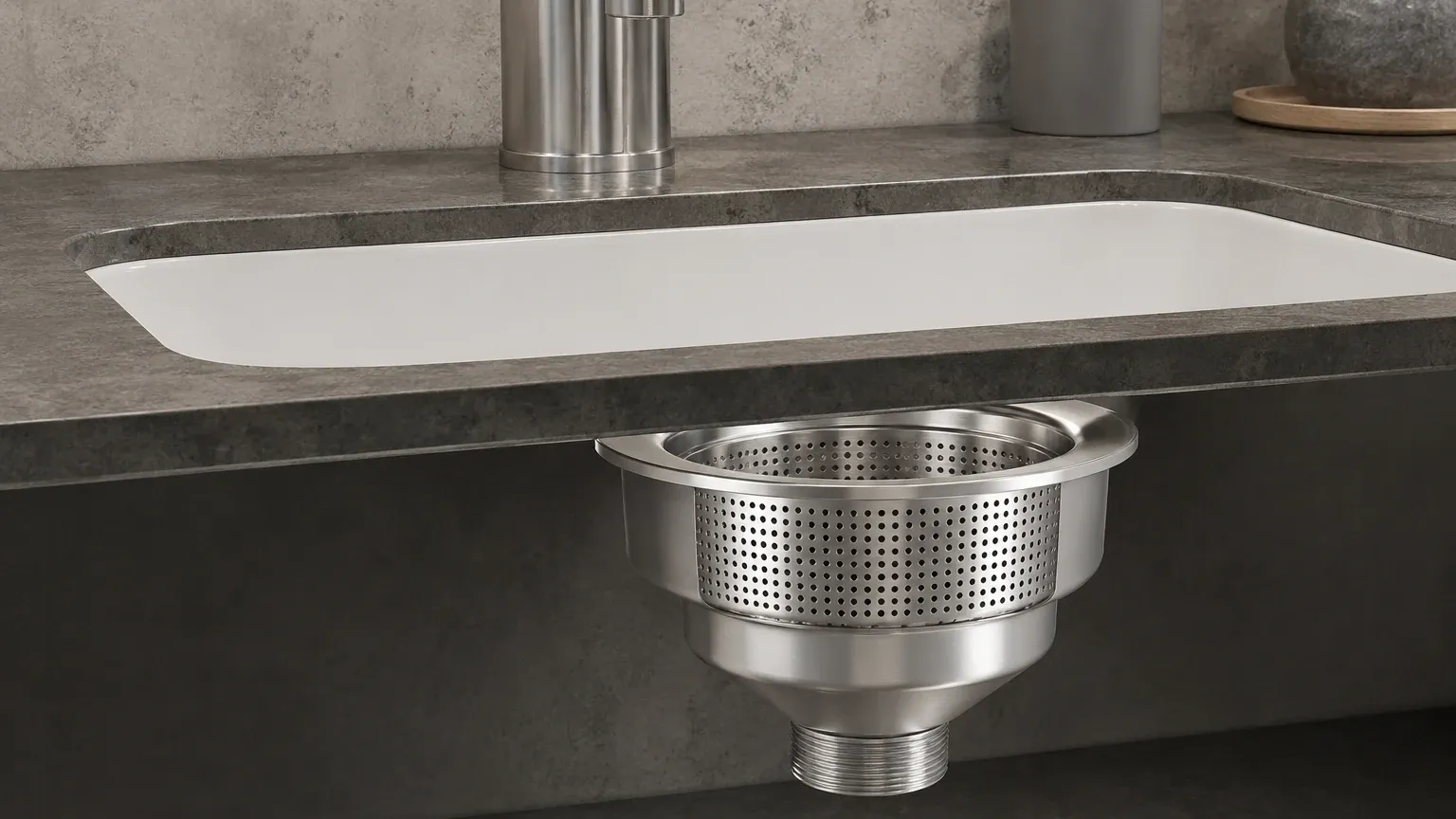
Maintenance and Durability: Reducing the Total Cost of Ownership
From a B2B perspective, the initial purchase price of a strainer basket is often less important than the Total Cost of Ownership (TCO). A low-quality component that requires frequent replacement or, worse, leads to a major plumbing blockage, can cost a facility thousands of dollars in labor and downtime.
Ease of Cleaning
Industrial-grade baskets are designed for rapid maintenance. Features such as smooth interior surfaces and reinforced edges allow maintenance crews to quickly dump debris and sanitize the component without damaging the mesh. This is particularly important in healthcare settings where infection control protocols require frequent sterilization of all sink components.
Durability and Replacement Cycles
A high-quality stainless steel strainer basket bathroom sink component can last for years, even in high-use environments. In contrast, chrome-plated brass or plastic alternatives often suffer from plating peel, thread stripping, or structural cracking within months. By investing in precision-engineered Strainers & Baskets, facility managers can significantly extend their replacement cycles and reduce the volume of waste generated by their operations.
Common Risks in Substandard Filtration Components
When sourcing filtration components, it is vital to recognize the risks associated with substandard manufacturing. These include:
* Material Impurities: Lower-grade "stainless" steels may contain impurities that lead to rusting within weeks of installation, especially when exposed to municipal water treated with chlorine.
* Poor Weld Quality: In baskets that use a combination of perforated plate and wire mesh, weak welds can fail under the weight of wet debris, causing the basket to fall apart during cleaning.
* Inaccurate Micron Ratings: If the mesh is not woven to precise specifications, it may allow larger particles to pass through, defeating the purpose of the strainer and risking damage to downstream pumps or valves.
Conclusion: Selecting the Right Filtration Partner
The selection of a strainer basket bathroom sink component may seem like a minor detail in a large-scale construction or industrial project, but it is a critical element of a functional fluid management system. For technical professionals, the focus must remain on material quality, engineering precision, and the ability to customize solutions for specific application needs.
Kaifil's expertise in manufacturing custom stainless steel filtration solutions ensures that every component, from large-scale industrial cartridges to precision-engineered sink strainers, meets the highest standards of durability and performance. By prioritizing technical specifications over generic marketing claims, engineers can ensure their facilities remain operational, efficient, and easy to maintain.
For those seeking reliable, industrial-grade filtration components, reviewing specialized Strainers & Baskets is the first step toward a more robust and dependable infrastructure.
