


Strainer Basket Commercial
In industrial fluid handling and processing, the integrity of downstream equipment often depends on the efficiency of primary filtration components. A strainer basket commercial unit serves as a critical line of defense, removing oversized particulates, debris, and contaminants from liquid streams before they can reach sensitive pumps, valves, or heat exchangers. For engineers and procurement professionals, selecting the appropriate Strainers & Baskets requires a deep understanding of material compatibility, flow dynamics, and the specific mechanical stresses of the application environment.
Industrial-grade strainer baskets are not merely passive components; they are engineered tools designed to balance filtration precision with system throughput. Whether utilized in chemical processing, food and beverage production, or large-scale water treatment, the choice of a strainer basket impacts the total cost of ownership, maintenance frequency, and overall process reliability.
Understanding the Engineering of Commercial Strainer Baskets
The primary function of a commercial strainer basket is to provide a high-capacity collection point for solids. Unlike simple inline filters, basket strainers are designed for easy removal and cleaning, making them ideal for systems where significant particulate loading is expected. The efficiency of these components is determined by several engineering factors, including the open area ratio, the type of filtration media, and the structural reinforcement used to withstand differential pressure.
The Open Area Ratio
One of the most important metrics in strainer design is the ratio of the open area of the basket to the cross-sectional area of the inlet pipe. A standard strainer basket commercial application typically requires an open area ratio of at least 6:1. This high ratio ensures that even as the basket begins to fill with debris, the pressure drop across the unit remains within acceptable limits. If the ratio is too low, the system will experience a rapid increase in backpressure, which can lead to pump cavitation or mechanical failure of the strainer itself.
Filtration Media: Perforated Metal vs. Wire Mesh
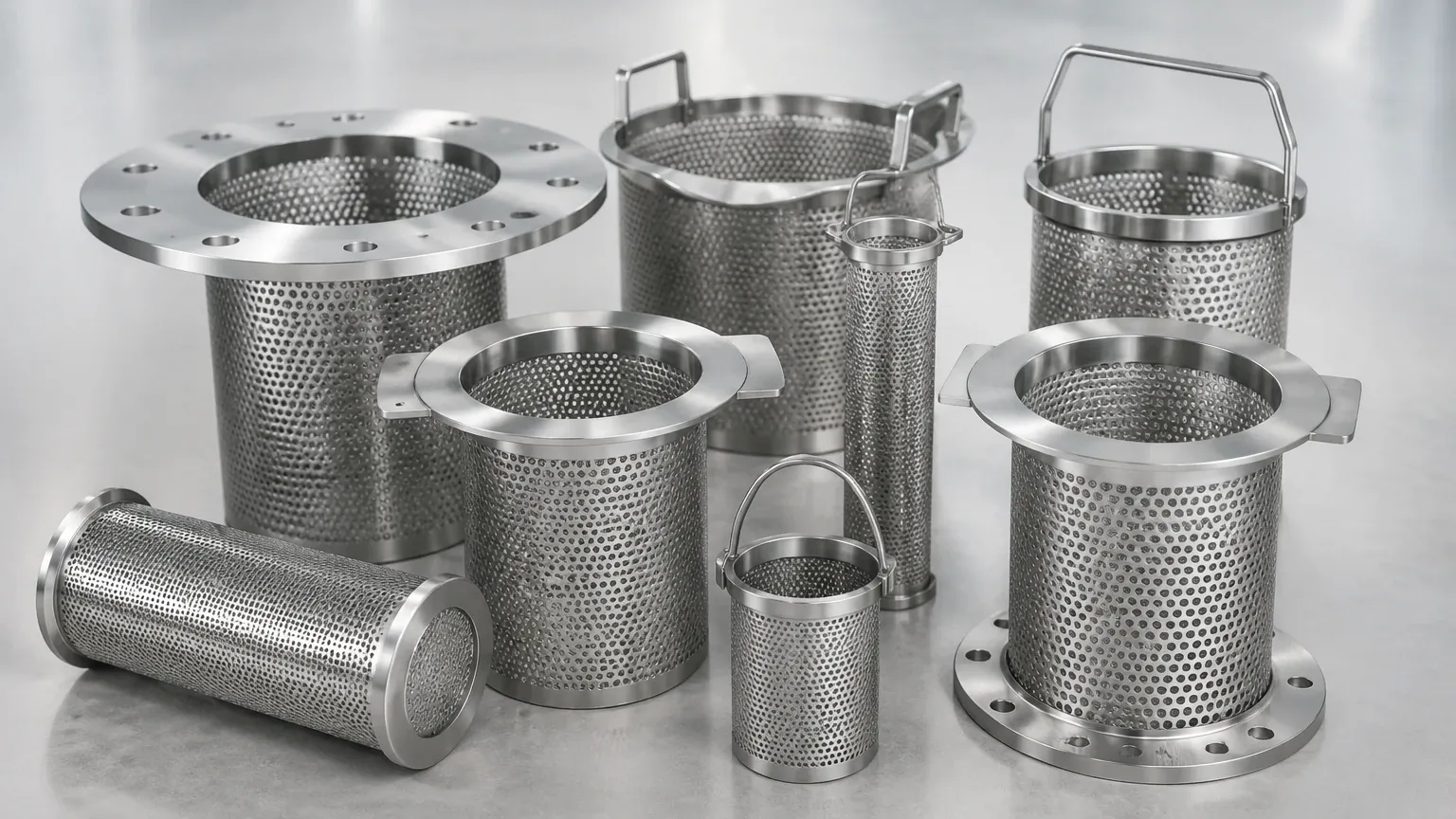
Most commercial strainer baskets utilize a two-tier construction. The outer structure is usually made from perforated metal, providing the necessary mechanical strength to resist the force of the fluid flow. For finer filtration requirements, a stainless steel wire mesh liner is added to the interior of the perforated basket.
* Perforated Metal: Used for coarse filtration (typically 1/32" to 1/2" holes). It is robust and easy to clean.
* Wire Mesh: Used for fine filtration (down to 5 microns). Mesh is measured by the number of openings per linear inch. In high-pressure applications, the mesh must be securely bonded or welded to the perforated support to prevent bypass or collapse.
Material Selection for Industrial Environments
Material science is at the core of Kaifil’s manufacturing process. For a strainer basket commercial solution to be effective, it must be chemically compatible with the process fluid and resistant to the operating temperature. Stainless steel is the industry standard due to its durability and corrosion resistance.
304 Stainless Steel
Grade 304 is the most common material for general industrial applications. It offers excellent resistance to atmospheric corrosion and is suitable for most water treatment and food processing applications where high acidity or chloride levels are not present.
316 Stainless Steel
For more demanding environments, such as chemical processing or marine applications, 316 stainless steel is preferred. The addition of molybdenum enhances its resistance to pitting and crevice corrosion, particularly in environments containing chlorides or sulfuric acid. In pharmaceutical and high-purity food applications, 316L (low carbon) may be specified to prevent sensitization during welding, ensuring the longevity of the filter component.
Specialized Alloys
In extreme cases involving highly corrosive chemicals or high temperatures, specialized alloys like Monel, Hastelloy, or Titanium may be required. While more expensive, these materials prevent premature failure and ensure that the Strainers & Baskets do not contaminate the process fluid with metallic byproducts.
Performance Criteria and Selection Factors
When specifying a strainer basket commercial unit, engineers must evaluate several performance variables to ensure the component meets the system's operational demands. Failure to account for these variables can result in frequent downtime or equipment damage.
Flow Rate and Pressure Drop
The relationship between flow rate and pressure drop (delta P) is non-linear. As the velocity of the fluid increases, the pressure drop across the strainer increases exponentially. It is essential to select a basket size that maintains a low initial pressure drop—typically less than 2 PSI in a clean state. This provides a "buffer" for particulate accumulation before the basket requires cleaning.
Viscosity Considerations
The viscosity of the fluid significantly impacts the performance of the strainer. Thicker fluids, such as oils, syrups, or resins, require larger mesh openings or a larger total surface area to maintain flow. When dealing with high-viscosity liquids, the standard 6:1 open area ratio may need to be increased to prevent excessive flow resistance.
Retention Requirements
Defining the "micron rating" or the size of the smallest particle to be removed is critical. However, over-specifying filtration (choosing a mesh that is too fine) can lead to rapid clogging and unnecessary maintenance. The general rule is to select a mesh size that is slightly smaller than the smallest orifice or clearance in the downstream equipment being protected.
Customization and OEM Solutions
In many commercial and industrial settings, off-the-shelf strainer baskets may not fit existing housings or meet specific process requirements. Customization is a core strength of Kaifil, allowing for the development of filtration components tailored to unique mechanical constraints.
Dimensional Customization
Custom strainer baskets can be manufactured to specific diameters, heights, and flange configurations. This is particularly useful for retrofitting older systems where the original manufacturer no longer provides replacement parts. Precision manufacturing ensures a tight seal within the housing, preventing "bypass," where fluid flows around the basket rather than through it.
Structural Reinforcements
For high-pressure systems or applications involving heavy debris, standard baskets may require additional reinforcement. This can include:
* Heavy-duty support bands: Welded to the top and bottom of the basket to prevent deformation.
* Internal or external skeletons: Providing rigid support for fine wire mesh liners.
* Reinforced handles: Ensuring the basket can be safely extracted even when heavily loaded with debris.
Specialized Handle Designs
Ease of maintenance is a key consideration for commercial operations. Handles can be designed as simple bails, slanted handles for easier gripping, or heavy-duty lifting lugs for large baskets that require mechanical assistance for removal.
Maintenance, Cleaning, and Total Cost of Ownership
The longevity of a strainer basket commercial unit is directly tied to its maintenance cycle. Unlike disposable filter cartridges, stainless steel baskets are designed to be cleaned and reused, which significantly reduces the long-term operational cost.
Cleaning Protocols
Regular cleaning prevents the buildup of a "filter cake" that can become compacted and difficult to remove. In many industries, ultrasonic cleaning is used to remove fine particulates trapped within the wire mesh. For coarser debris, high-pressure water washing or chemical soaking may be sufficient. It is vital to inspect the mesh during each cleaning cycle for signs of fraying, holes, or structural fatigue.
When to Replace
While durable, strainer baskets are wear items. Signs that a basket needs replacement include:
* Permanent Deformation: If the basket has been crushed or warped due to a high-pressure event.
* Mesh Separation: If the wire mesh has detached from the perforated support.
* Corrosion Pitting: Even stainless steel can eventually succumb to harsh chemicals, leading to thin spots or holes that compromise filtration integrity.
Total Cost of Ownership (TCO)
When evaluating Strainers & Baskets, procurement teams should look beyond the initial purchase price. A high-quality, custom-engineered basket may have a higher upfront cost but can offer a lower TCO through extended service life, reduced bypass risks, and easier cleaning, which minimizes labor costs and system downtime.
Industry-Specific Applications
The requirements for a strainer basket commercial solution vary widely across different sectors. Understanding these nuances is essential for proper selection.
Food and Beverage
In this industry, sanitary design is paramount. Baskets must be manufactured with smooth welds and polished surfaces (often 3-A or FDA compliant) to prevent bacterial growth in crevices. They are used to remove pulp from juices, seeds from preserves, or charred particles from frying oils.
Chemical Processing
Chemical applications demand high material integrity. Strainers are used to protect expensive catalysts or to remove undissolved solids from reagents. Compatibility with aggressive solvents and acids is the primary engineering focus here.
Water Treatment and Desalination
Large-scale water systems use strainer baskets to remove sand, shells, and aquatic debris from intake water. Due to the high volume of water and the presence of abrasive materials, these baskets often feature heavy-duty perforated metal with high-strength reinforcement.
Hydraulic and Lube Oil Systems
In power generation and heavy machinery, strainer baskets protect pumps and bearings from metal shavings or scale. These systems often operate at high pressures, requiring baskets that can withstand significant differential pressure without collapsing.
Conclusion: Selecting the Right Filtration Partner
Choosing the right strainer basket commercial solution involves more than just matching a part number. It requires a collaborative approach between the end-user and the manufacturer to ensure all technical variables—from fluid chemistry to mechanical stress—are addressed.
Kaifil’s expertise in custom stainless steel filtration allows for the creation of Strainers & Baskets that are not only durable but also optimized for the specific flow and retention needs of a commercial operation. By focusing on precision manufacturing and high-grade materials, industrial facilities can ensure their processes remain efficient, their equipment stays protected, and their maintenance costs remain controlled. When technical performance and reliability are the priorities, a custom-engineered strainer basket is an essential investment in the longevity of the entire fluid system.
