


Strainer Basket Design
In industrial fluid handling systems, the efficiency and longevity of downstream equipment—such as pumps, valves, and heat exchangers—depend heavily on the primary filtration stage. The core of this stage is the strainer basket. While often viewed as a simple mechanical component, effective strainer basket design requires a sophisticated understanding of fluid dynamics, material science, and mechanical engineering. For engineers and procurement teams, selecting the right design is not merely about fitting a housing; it is about optimizing flow rates, minimizing pressure drops, and ensuring structural integrity under varying operational loads.
As a specialized manufacturer, Kaifil focuses on providing precision-engineered Strainers & Baskets that meet the rigorous demands of chemical processing, food production, and hydraulic systems. This guide explores the critical technical parameters and engineering considerations that define high-performance strainer basket design.
The Fundamentals of Strainer Basket Geometry
The primary function of a strainer basket is to remove unwanted solids from a liquid stream. Unlike temporary start-up strainers, basket strainers are designed for long-term use and high-capacity debris collection. The geometry of the basket—specifically its shape, size, and the configuration of its filtration media—determines how effectively it can perform this task without impeding the process flow.
Perforated Metal vs. Wire Mesh
Most industrial strainer baskets utilize one of two primary media types, or a combination of both:
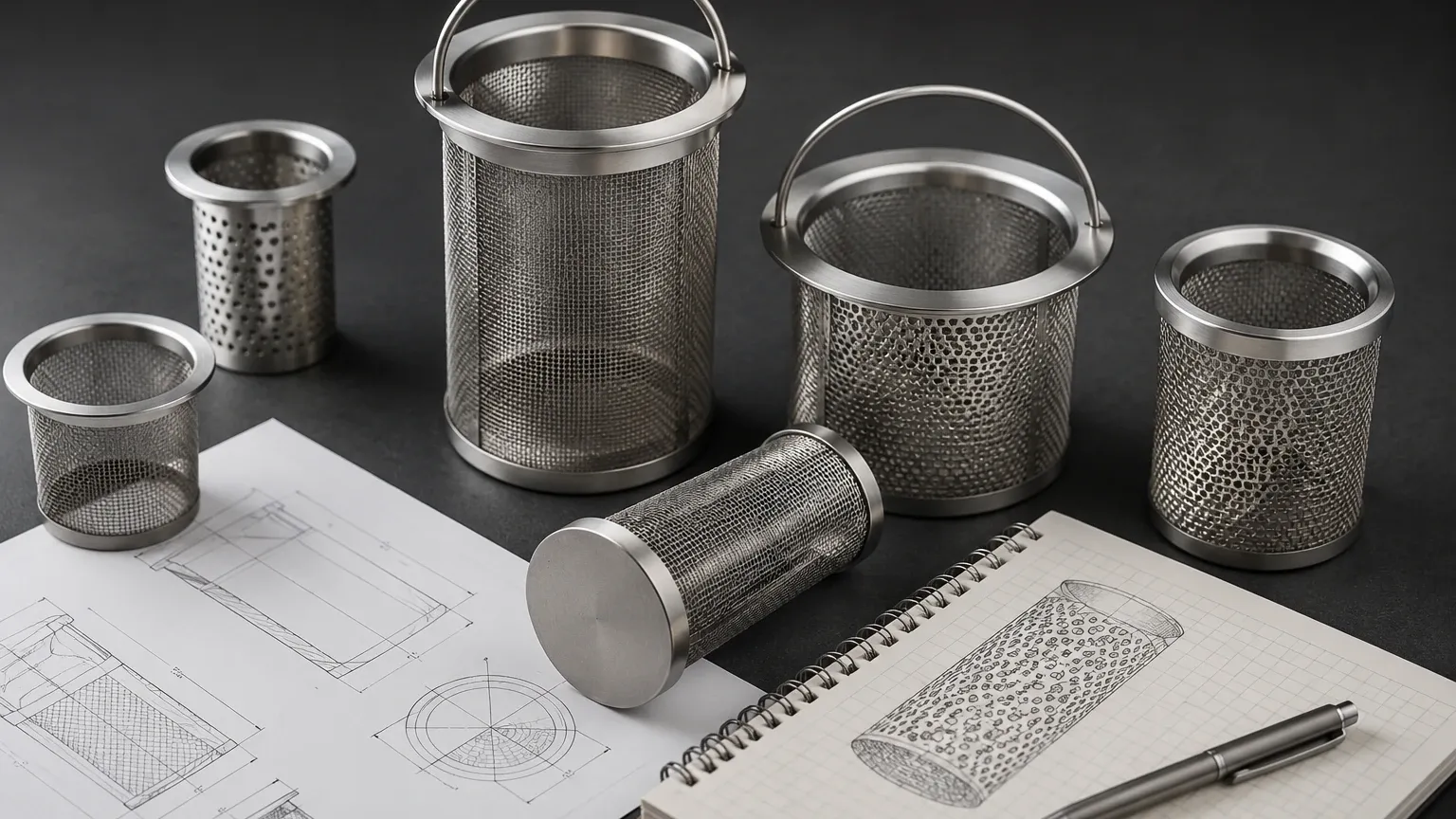
1. Perforated Metal: This serves as the structural foundation for most baskets. The hole size, shape (round, square, or slotted), and staggered pattern are engineered to provide a specific "open area." Perforated metal is typically used for coarse filtration (above 1/32 inch or 800 microns).
2. Wire Mesh (Lined Baskets): For finer filtration requirements, a stainless steel wire mesh is layered inside or outside the perforated metal support. The mesh provides the necessary micron rating, while the perforated metal provides the mechanical strength to withstand differential pressure. In advanced strainer basket design, multi-layer sintered mesh may be used for applications requiring extreme durability and precise particle retention.
Bottom Design and Flow Patterns
The bottom of the basket can be flat, rounded, or slanted. A flat bottom is standard for most vertical housings, providing a stable base and maximum volume for debris collection. However, in high-velocity systems, a rounded or "conical" bottom may be preferred to reduce turbulence and guide the flow more efficiently through the filtration media.
Engineering the Open Area Ratio
One of the most critical metrics in strainer basket design is the "Open Area Ratio" (OAR). This is the ratio between the total area of the holes in the basket and the cross-sectional area of the inlet pipe.
Why OAR Matters
A common industry standard is an OAR of 6:1 or 8:1. An OAR of 6:1 means the basket has six times the surface area of the pipe entering the strainer. This high ratio is essential for several reasons:
* Reduced Pressure Drop (Delta P): A larger open area allows the fluid to pass through the basket with minimal resistance. As the basket fills with debris, the available open area decreases. Starting with a high OAR ensures that the system can operate longer before the pressure drop reaches a critical level.
* Extended Cleaning Cycles: By providing more surface area for particle entrapment, a well-designed basket reduces the frequency of maintenance shutdowns, thereby lowering the total cost of ownership.
* Lower Velocity: High OAR reduces the velocity of the fluid as it passes through the mesh, which prevents "particle bypass" (forcing solids through the mesh) and reduces the wear and tear on the filtration media.
Material Selection and Chemical Compatibility
Industrial environments often involve corrosive fluids, extreme temperatures, and high pressures. Therefore, material selection is a cornerstone of robust strainer basket design. Kaifil utilizes high-grade alloys to ensure compatibility with diverse industrial media.
Stainless Steel 304 and 316/316L
* Type 304: The standard for general-purpose industrial applications. It offers excellent strength and good corrosion resistance for water treatment and non-acidic chemical processes.
* Type 316/316L: Contains molybdenum, which provides superior resistance to chlorides and pitting. This is the preferred choice for marine environments, pharmaceutical manufacturing, and the food and beverage industry where sanitary conditions and aggressive cleaning agents are common.
Specialty Alloys
In highly specialized chemical processing, standard stainless steels may be insufficient. Designs may incorporate Monel, Hastelloy, or Titanium for applications involving concentrated acids or high-salinity fluids. Engineers must evaluate the pH levels, temperature fluctuations, and the presence of oxidizing agents before finalizing the material specifications for their Strainers & Baskets.
Mechanical Integrity and Structural Reinforcement
A strainer basket is a pressure-retaining component in a broader sense. When a basket becomes clogged, the differential pressure across the media increases. If the strainer basket design does not account for this "burst pressure," the basket can collapse, sending debris and metal fragments downstream into sensitive equipment.
Reinforcement Techniques
To prevent structural failure, several reinforcement methods are employed:
* Heavy-Duty Frames: For large-diameter baskets or high-pressure systems, a heavy-duty longitudinal and circumferential frame is welded to the perforated metal.
* Double-Stitched Seams: The vertical seams of the basket are often the weakest point. Using double-welded or reinforced seams ensures the basket maintains its cylindrical shape under load.
* Banding: Top and bottom bands provide rigid sealing surfaces and prevent the basket from distorting when being seated into the strainer housing.
Handle and Lifting Configurations
Ease of maintenance is a key aspect of functional design. Baskets can be equipped with various handle types:
* Bail Handles: Standard for easy manual removal.
* Slant Handles: Designed for housings with side-entry or specific lid clearances.
* Flat Straps: Used when vertical space is limited.
For very large industrial baskets, lifting lugs or threaded inserts may be integrated to allow for mechanical lifting equipment, ensuring safety during maintenance cycles.
Customization for Specific Industrial Applications
No two industrial processes are identical, which is why custom strainer basket design is often required to achieve optimal performance. Customization goes beyond simple dimensions; it involves tailoring every aspect of the component to the specific fluid characteristics and operational goals.
Food and Beverage Requirements
In the food and beverage sector, "sanitary design" is paramount. This involves ensuring that all welds are ground smooth (crevice-free) to prevent bacterial growth. The materials must be FDA-compliant, and the basket must be capable of withstanding Clean-In-Place (CIP) procedures.
Chemical and Petrochemical Processing
These industries often deal with high-viscosity fluids or slurries. In these cases, the strainer basket design might include internal baffles to distribute flow or specialized coatings to prevent the adhesion of sticky resins or polymers.
Hydraulic and Lube Oil Systems
In hydraulic applications, the focus is often on removing fine metallic particles that can cause catastrophic pump failure. These baskets often utilize magnetic inserts alongside fine wire mesh to capture ferrous particles that might otherwise pass through the filtration media.
Performance Evaluation: What Engineers Should Confirm
Before finalizing a purchase or specifying a design for a new project, engineers should evaluate the following technical criteria to ensure the selected Strainers & Baskets are fit for purpose:
1. Maximum Allowable Differential Pressure (PSID): At what pressure drop will the basket deform or burst? The design should always exceed the expected maximum pressure drop before cleaning.
2. Micron Rating vs. Efficiency: Is the mesh size appropriate for the smallest particle that needs to be removed? Remember that a finer mesh increases the frequency of cleaning.
3. Seal Integrity: How does the basket seal against the housing? Whether using an O-ring, a machined flange, or a spring-loaded seat, the seal must prevent "fluid bypass," where contaminated liquid flows around the basket rather than through it.
4. Flow Velocity: Ensure the velocity through the basket does not exceed recommended limits (typically 5-10 feet per second for liquids) to prevent erosion of the mesh.
Maintenance and Total Cost of Ownership
The initial cost of a strainer basket is only one part of the economic equation. A poorly designed basket that is difficult to clean or prone to damage will lead to higher labor costs and more frequent replacements.
High-quality strainer basket design focuses on "cleanability." For example, using a smooth perforated metal exterior with an internal mesh liner allows for easier back-flushing or manual scrubbing. Furthermore, choosing a robust design that can withstand multiple cleaning cycles without losing its shape or filtration accuracy significantly reduces the long-term operational expenditure.
Conclusion
Strainer basket design is a balance of structural strength, filtration precision, and fluid dynamics. By focusing on the open area ratio, material compatibility, and mechanical reinforcement, engineers can ensure their systems remain protected and efficient. Whether dealing with standard water filtration or complex chemical processing, the right basket design is essential for minimizing downtime and protecting high-value downstream assets.
Kaifil remains committed to providing technical expertise and high-quality manufacturing for custom industrial filtration needs. By understanding the nuances of strainer basket design, purchasing teams and engineers can make informed decisions that lead to reliable, long-term performance in even the most demanding environments.
