


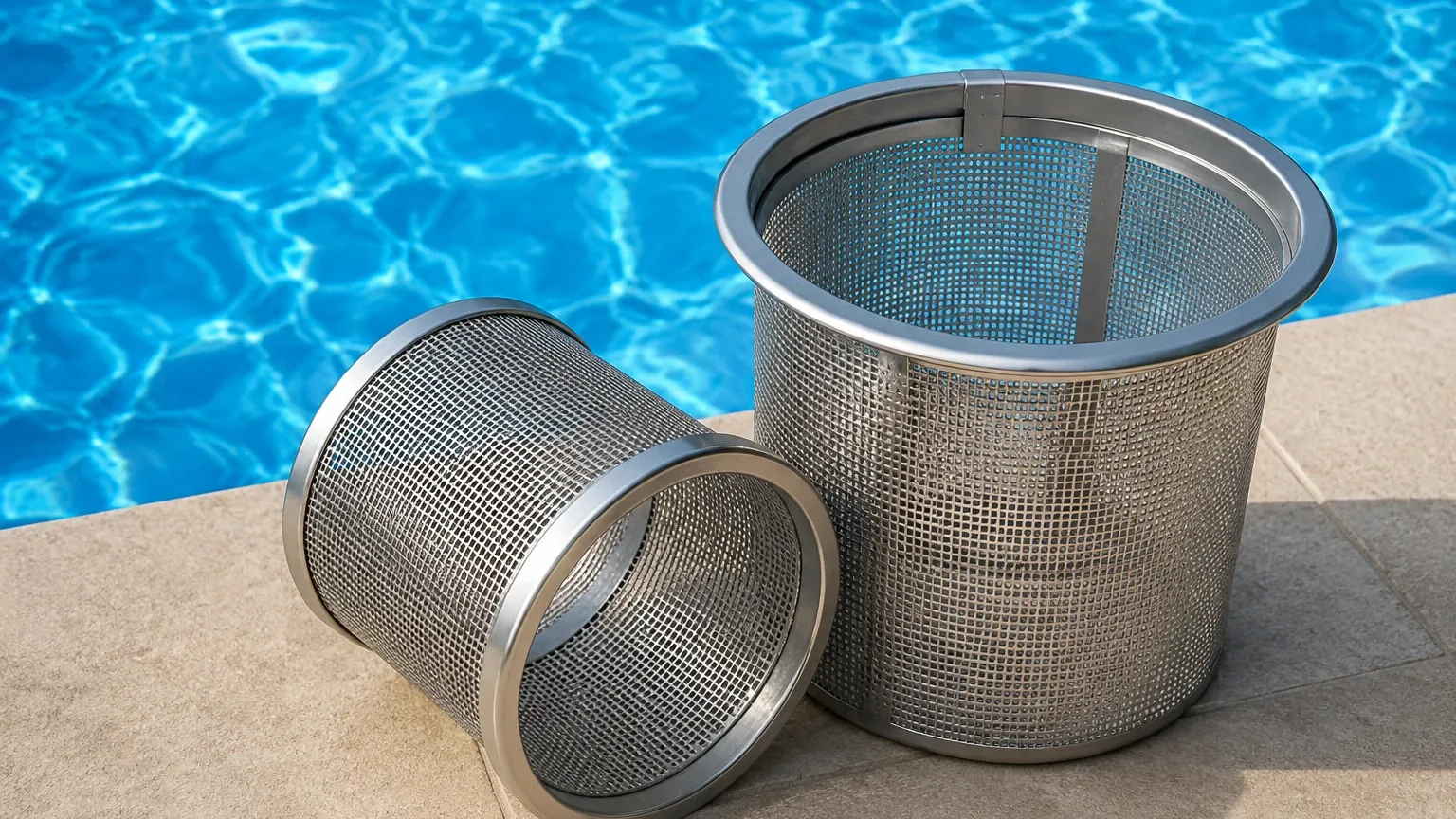
Strainer Basket for Pool
In commercial and industrial water management, the efficiency of a filtration system is often determined by its primary defense mechanism. For large-scale aquatic facilities, municipal water parks, and industrial cooling systems that utilize pool-like reservoirs, the strainer basket for pool applications serves as a critical pre-filtration component. Unlike residential counterparts, industrial-grade strainers must withstand high flow rates, chemical exposure, and significant mechanical stress to protect downstream equipment, particularly centrifugal pumps and fine-filtration membranes.
As a specialized manufacturer of custom stainless steel filtration solutions, Kaifil understands that the selection of Strainers & Baskets is not merely a matter of size, but a complex engineering decision involving metallurgy, fluid dynamics, and maintenance cycles. This guide examines the technical requirements, material considerations, and performance metrics that engineers and purchasing teams must evaluate when specifying filtration components for high-demand water systems.
The Role of Pre-Filtration in Industrial Aquatic Systems
In any high-volume water circulation system, the primary goal is to maintain water quality while ensuring the longevity of the mechanical infrastructure. The strainer basket acts as the first line of defense, capturing large particulates—such as organic debris, plastics, and metallic fragments—before they can enter the pump impeller or the heat exchanger.
Failure at this stage can lead to several catastrophic system issues:
1. Pump Cavitation: If a basket becomes clogged or is improperly sized, the resulting pressure drop can cause cavitation, leading to pitted impellers and premature motor failure.
2. Downstream Contamination: If the mesh or perforation size is too large, debris can pass through and clog fine-media filters or damage sensitive sensors.
3. Energy Inefficiency: A poorly designed strainer increases the Total Dynamic Head (TDH) of the system, forcing the pump to consume more energy to maintain the required flow rate.
For these reasons, industrial engineers prioritize the "Open Area Ratio" (OAR) of a strainer basket for pool environments, ensuring that the total area of the holes in the basket is significantly larger than the cross-sectional area of the inlet pipe.
Engineering Specifications: Open Area and Flow Dynamics
When specifying Strainers & Baskets, the most critical metric is the ratio of the open area to the pipe area. A standard industrial recommendation for a strainer basket is a minimum 4:1 ratio. This ensures that even when the basket is 50% full of debris, the system does not experience a significant increase in backpressure.
Perforation vs. Mesh Lining
Industrial strainers are typically constructed using one of two methods, or a combination thereof:
* Perforated Metal: These baskets are punched from stainless steel sheets. They offer high structural integrity and are ideal for capturing larger debris. Common hole sizes range from 1/8" to 1/2".
* Wire Mesh Lining: For applications requiring finer filtration (down to 50 microns), a perforated basket is lined with a precision-woven wire mesh. This provides the structural strength of the perforated plate with the fine-filtering capability of the mesh.
Engineers must balance the "Micron Rating" with the "Flow Velocity." In a commercial pool environment, high flow velocities can cause "wire drawing" or erosion of the mesh if the material is not sufficiently durable. Kaifil specializes in welding these components to ensure that the mesh lining remains bonded to the support structure under high-pressure pulses.
Material Selection: The Case for Stainless Steel
While plastic or nylon baskets are common in residential settings, industrial and commercial applications demand the durability of metal. The chemical environment of a pool—characterized by high concentrations of chlorine, bromine, or ozone—is highly corrosive.
AISI 304 vs. AISI 316L
* Grade 304 Stainless Steel: Suitable for standard freshwater applications with low chloride levels. It offers excellent strength and cost-effectiveness.
* Grade 316L Stainless Steel: This is the industry standard for commercial pool environments and saltwater systems. The addition of molybdenum provides superior resistance to pitting and crevice corrosion caused by chlorides. For long-term ROI, 316L is the preferred choice for a strainer basket for pool systems as it significantly extends the replacement cycle.
In addition to corrosion resistance, stainless steel baskets offer thermal stability. In industrial processes where water temperatures may fluctuate, metal baskets maintain their structural dimensions, whereas plastic components may warp, leading to bypass—where water flows around the basket rather than through it.
Customization and Structural Integrity
Every industrial pump housing has unique dimensions, and a "one-size-fits-all" approach often leads to bypass or vibration issues. Custom-manufactured Strainers & Baskets allow for precise tolerances. Key customization features include:
* Flange and Gasket Surfaces: Ensuring a tight seal at the top of the basket to prevent debris from bypassing the filter media.
* Reinforced Handles: In large systems, a full basket can be extremely heavy. Reinforced, ergonomically designed handles are essential for safe and quick maintenance.
* Heavy-Duty Bottoms: The bottom of the basket often bears the brunt of the hydraulic force. Kaifil designs baskets with reinforced base plates to prevent "blow-outs" during high-pressure surges.
* Magnetic Inserts: For industrial pools used in manufacturing or metalworking environments, magnetic rods can be integrated into the basket to capture fine ferrous particles that might otherwise pass through the mesh.
Maintenance Protocols and Total Cost of Ownership
From a procurement perspective, the initial cost of a high-quality stainless steel strainer basket for pool use is offset by the reduction in Total Cost of Ownership (TCO). A durable basket reduces the frequency of replacements and, more importantly, protects the most expensive components of the water system—the pumps.
Cleaning and Inspection Cycles
Maintenance teams should establish a differential pressure monitoring schedule. A pressure gauge installed before and after the strainer housing provides an immediate indication of the basket’s status.
* Standard Cleaning: Baskets should be removed and hosed down when the pressure differential reaches a predetermined limit (typically 5-10 psi over the clean baseline).
* Ultrasonic Cleaning: For baskets lined with fine wire mesh, periodic ultrasonic cleaning can remove deeply embedded particulates that manual rinsing cannot reach, restoring the original flow characteristics.
Selection Guide for Engineers
When contacting a manufacturer like Kaifil for a strainer basket for pool applications, technical buyers should have the following data points ready to ensure an accurate quote and optimal performance:
1. Flow Rate (GPM/m³/h): Determines the required open area to prevent excessive pressure drop.
2. Maximum Operating Pressure: Influences the thickness of the stainless steel and the need for structural reinforcement.
3. Debris Profile: What is the smallest particle that must be captured? This determines the perforation size or mesh count.
4. Chemical Composition: Is the water chlorinated, saline, or treated with specific industrial chemicals? This dictates the grade of stainless steel (304, 316, or even Duplex for extreme environments).
5. Housing Dimensions: Precise measurements of the strainer pot, including the height, diameter, and the configuration of the seating lip.
Why Precision Manufacturing Matters
In the B2B sector, the reliability of a filtration component is a reflection of the manufacturing process. Precision welding, such as TIG or spot welding, ensures that there are no sharp edges that could catch debris or cause injury during maintenance. Furthermore, professional finishing (such as electropolishing) can further enhance the corrosion resistance of stainless steel by removing surface impurities and creating a more robust chromium oxide layer.
Kaifil’s expertise in custom metal filtration allows us to bridge the gap between standard catalog items and the specific needs of complex industrial systems. Whether it is a replacement basket for an existing system or a new design for a large-scale project, focusing on the engineering fundamentals of Strainers & Baskets ensures long-term operational success.
Conclusion
The strainer basket for pool is a deceptively simple component that plays a vital role in the health of industrial water systems. By moving away from commodity-grade plastic and toward engineered stainless steel solutions, facilities can achieve higher flow efficiency, better equipment protection, and reduced maintenance costs. When specifying these components, engineers must prioritize material grade, open area ratios, and structural reinforcement to meet the rigorous demands of modern aquatic and industrial environments.
For technical teams seeking to optimize their filtration performance, selecting a manufacturing partner with deep expertise in custom stainless steel fabrication is the first step toward a more resilient system. Explore the full range of industrial Strainers & Baskets to find the right configuration for your specific application requirements.
