


Strainer Basket Hsn Code
In the landscape of industrial procurement and international trade, technical specifications and regulatory compliance often intersect at the point of classification. For engineers and purchasing managers sourcing filtration components, understanding the strainer basket hsn code is essential not only for tax and customs documentation but also for ensuring that the components meet the specific mechanical and material standards required for industrial applications.
Industrial Strainers & Baskets are critical components used to protect downstream equipment—such as pumps, valves, and meters—from damage caused by particulate matter. While the HSN (Harmonized System of Nomenclature) code provides a standardized numerical method for classifying traded products, the selection of these components requires a deep dive into metallurgy, filtration efficiency, and structural engineering.
Understanding the Strainer Basket HSN Code for Industrial Procurement
The Harmonized System of Nomenclature is an internationally standardized system of names and numbers to classify traded products. For stainless steel filtration components, the classification typically falls under Chapter 84 or Chapter 73 of the HSN system, depending on the complexity and the primary function of the item.
Common HSN Classifications
1. HSN Code 8421: This is the most common heading for filtering or purifying machinery and apparatus for liquids or gases. Specifically, HSN 8421.29 covers "Other" liquid filtering or purifying machinery. When a strainer basket is imported or exported as a part of a larger filtration system, it often falls under HSN 8421.99, which is designated for parts of filtering or purifying machinery.
2. HSN Code 7326: If the strainer is viewed strictly as an "article of iron or steel" (specifically fabricated stainless steel) and does not contain moving parts or complex mechanical assemblies, it may sometimes be classified here. However, for industrial-grade filtration, 8421 is generally preferred as it acknowledges the functional role of the component in a process system.
3. HSN Code 7314: This code applies to cloth, grill, netting, and fencing of iron or steel wire. While strainer baskets are made from these materials, this code is usually reserved for the raw mesh rather than the finished, fabricated basket.
Correctly identifying the strainer basket hsn code ensures that the landed cost of the product is calculated accurately, accounting for the correct Basic Customs Duty (BCD), Integrated Goods and Services Tax (IGST), and other regional levies. For B2B buyers, this precision prevents delays in customs clearance and ensures compliance with global trade regulations.
Engineering Considerations for Industrial Strainers & Baskets
Beyond the administrative requirements of HSN codes, engineers must focus on the technical parameters that dictate the performance of a strainer basket. A basket is not merely a container; it is a precision-engineered barrier designed to withstand high differential pressures while maintaining a specific flow rate.
Material Selection and Metallurgy
The choice of material is the first line of defense against corrosion and mechanical failure. In industrial environments, stainless steel is the standard due to its durability and resistance to various chemical agents.
* AISI 304/304L: Suitable for general-purpose applications, food and beverage processing, and water treatment where corrosion risk is moderate.
* AISI 316/316L: The addition of molybdenum provides superior resistance to chlorides and acids, making it the preferred choice for chemical processing, pharmaceutical manufacturing, and marine environments.
* Duplex Stainless Steels: For high-pressure or highly corrosive environments (such as desalinization or oil and gas), duplex alloys offer higher yield strength and localized corrosion resistance compared to austenitic grades.
Structural Integrity and Reinforcement
In high-flow systems, the strainer basket is subjected to significant mechanical stress. If the basket fails, the debris it was meant to catch will bypass the filter and potentially destroy expensive downstream equipment. Engineering a reliable basket involves:
* Perforated Support: A heavy-gauge perforated metal sheet usually forms the outer skeleton of the basket, providing the necessary structural rigidity.
* Mesh Lining: A fine wire mesh (woven or non-woven) is sintered or welded to the interior of the perforated support to achieve the required micron rating.
* Reinforcement Bands: For large-diameter baskets, longitudinal and circumferential bands are added to prevent collapsing under high differential pressure (ΔP).
Types of Industrial Strainer Baskets and Their Applications
Different industrial processes require different basket configurations. The design of the basket directly impacts the "dirt-holding capacity" and the frequency of maintenance cycles.
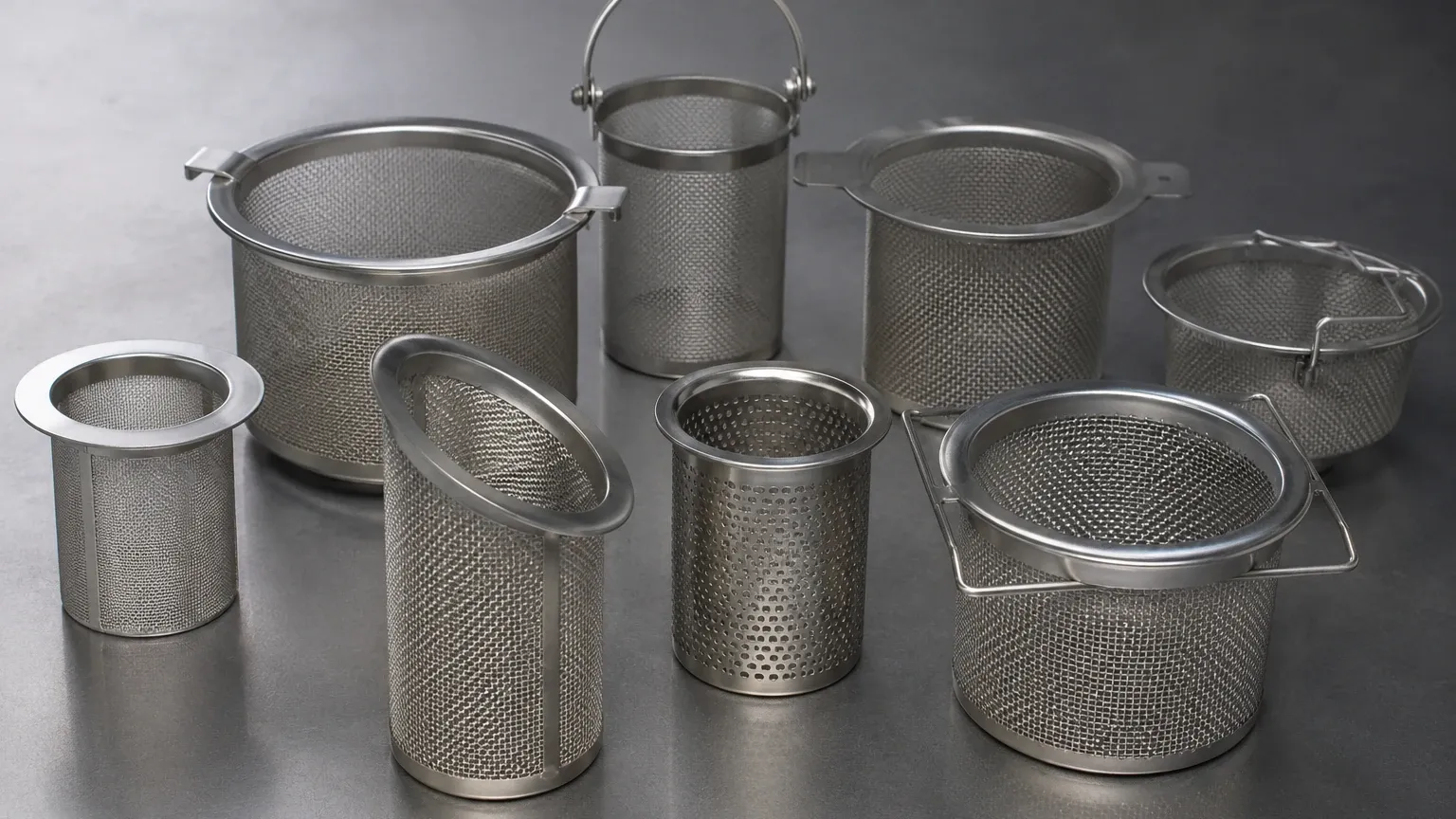
Standard Single Baskets
Used in simplex strainers, these are designed for batch processes where the system can be shut down temporarily to clean or replace the basket. They are common in cooling water systems and fuel oil lines.
Multi-Basket Designs
In large-diameter pipelines, a single large basket may be difficult to handle. Multi-basket configurations distribute the flow across several smaller baskets, increasing the total filtration area and making manual cleaning safer and more efficient for operators.
Slant-Top Baskets
Designed for use in Y-strainers or specific basket strainer housings, the slant-top design optimizes the flow path to minimize turbulence and pressure drop. This is particularly important in hydraulic systems where maintaining consistent pressure is vital for tool performance.
Custom OEM Filter Baskets
Many industrial machines require non-standard dimensions. Custom manufacturing allows for the integration of specific flange types, handle designs (such as heavy-duty lifting bails for crane removal), and specialized sealing surfaces (O-rings or flat gaskets) to ensure zero-bypass filtration.
Key Factors Influencing Filtration Efficiency
When evaluating Strainers & Baskets, engineers must look beyond the physical dimensions and consider the fluid dynamics of the application.
Micron Rating vs. Mesh Count
The micron rating defines the smallest particle size the strainer is intended to capture. However, in the B2B sector, it is important to distinguish between "nominal" and "absolute" ratings. A nominal rating indicates the basket will trap a major percentage of particles of a given size, while an absolute rating (often achieved through high-precision wire mesh) guarantees the retention of all particles above that size.
Open Area Ratio
The "Open Area Ratio" is the ratio of the total area of the holes in the basket to the cross-sectional area of the inlet pipe. A common engineering standard is a 6:1 ratio. A higher ratio means the strainer can operate longer before the pressure drop reaches a critical level, thereby extending the time between cleaning intervals.
Pressure Drop (ΔP) Management
Every strainer introduces a restriction to the flow. Engineers must calculate the clean pressure drop to ensure the pump has sufficient head to overcome the resistance. As the basket collects debris, the ΔP increases. High-quality baskets are designed with smooth internal surfaces and optimized perforation patterns to keep the initial ΔP as low as possible.
Maintenance and Replacement Cycles for Stainless Steel Filters
The longevity of a strainer basket is determined by the operating environment and the maintenance regime. Even the most robust stainless steel basket is a wear item in certain applications.
Cleaning Protocols
For stainless steel baskets, ultrasonic cleaning is often the most effective method for removing fine particulates trapped within the mesh pores. In chemical applications, backwashing or chemical soaking may be required. It is essential to inspect the mesh for "blinding" (permanent clogging) or mechanical fatigue (wire breakage) during every cleaning cycle.
Identifying the Need for Replacement
Signs that a strainer basket requires replacement include:
* Deformation: Any bowing or crushing of the perforated support indicates that the basket has been subjected to pressures exceeding its design limit.
* Erosion: In high-velocity systems with abrasive particles, the wire mesh can thin over time, leading to a loss of filtration accuracy.
* Corrosion: Pitting or stress-corrosion cracking, particularly near weld points, suggests that the material grade is not suitable for the chemical composition of the fluid.
Custom OEM Solutions for Complex Filtration Needs
In many B2B scenarios, off-the-shelf components fail to meet the rigorous demands of specialized machinery. This is where custom manufacturing becomes a strategic advantage. Working with a manufacturer that understands the nuances of both the strainer basket hsn code for logistics and the engineering requirements for performance allows for the development of optimized solutions.
Customization options include:
* Variable Micron Gradation: Using multiple layers of mesh with different openings to provide depth filtration within a single basket.
* Magnetic Inserts: Adding magnetic rods to the center of the basket to capture fine ferrous particles that might otherwise pass through the mesh.
* Specialized Coatings: Applying PTFE or other fluoropolymer coatings to reduce friction or prevent sticky substances from adhering to the mesh.
Conclusion: Selecting the Right Partner for Filtration Solutions
Choosing the correct industrial strainer involves a balance of regulatory knowledge and engineering expertise. While the strainer basket hsn code is a vital piece of the procurement puzzle for international shipping and tax compliance, the true value lies in the component's ability to perform reliably under pressure.
For engineers and purchasing professionals, the goal is to minimize the Total Cost of Ownership (TCO). This is achieved by selecting high-quality stainless steel Strainers & Baskets that offer durability, high dirt-holding capacity, and ease of maintenance. By partnering with an experienced manufacturer like Kaifil, companies can ensure they receive filtration components that are precision-engineered to their exact specifications, backed by the technical documentation necessary for global trade and industrial safety standards.
