


Strainer Basket Kit
In industrial fluid handling systems, the integrity of downstream equipment—such as pumps, heat exchangers, and spray nozzles—depends heavily on the efficiency of primary filtration components. A strainer basket kit serves as a critical assembly designed to remove coarse solids from liquid or gas streams. Unlike simple filter inserts, a comprehensive kit typically includes the basket itself, specialized sealing components, and structural reinforcements tailored to specific flow conditions and housing geometries.
For engineers and procurement teams, selecting a strainer basket kit involves more than matching dimensions. It requires a technical evaluation of material compatibility, pressure drop (ΔP) thresholds, and the specific rheological properties of the process fluid. As a manufacturer of Strainers & Baskets, Kaifil focuses on providing precision-engineered solutions that meet the rigorous demands of chemical processing, food production, and hydraulic systems.
Components of an Industrial Strainer Basket Kit
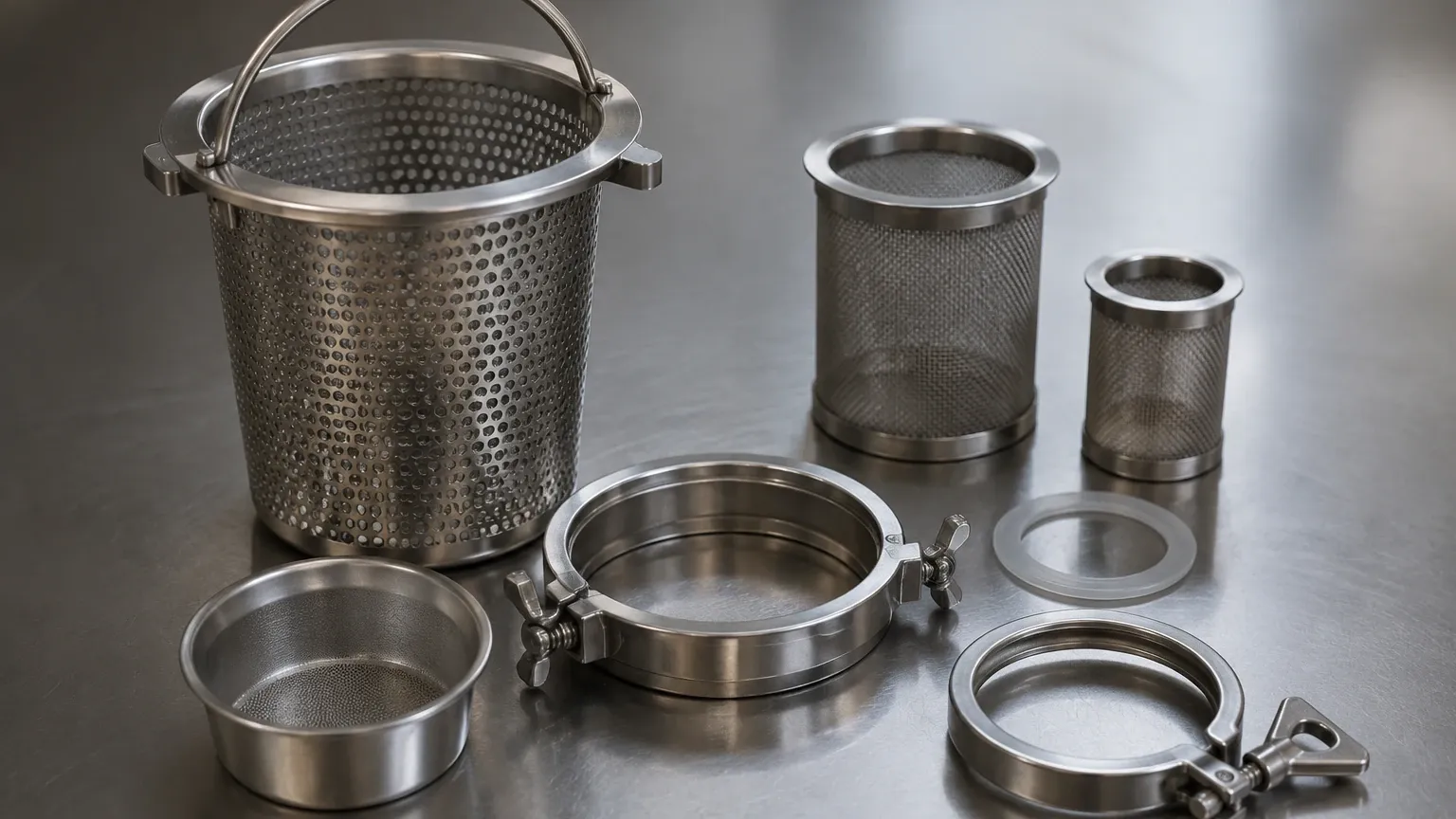
A professional-grade strainer basket kit is designed to ensure a complete seal and reliable performance within a strainer housing. While configurations vary by application, most high-performance kits consist of several key elements:
1. The Primary Strainer Basket
The core of the kit is the basket, which is usually constructed from perforated stainless steel. Depending on the required filtration fineness, this perforated shell may be lined with a fine wire mesh. The structural integrity of the basket is paramount, as it must withstand the differential pressure created as debris accumulates.
2. Sealing Gaskets and O-Rings
By-pass is the primary failure mode in industrial filtration. A strainer basket kit includes precision-cut gaskets or O-rings made from materials such as EPDM, Viton (FKM), or PTFE. These components ensure that the fluid is forced through the filtration media rather than escaping around the edges of the basket flange.
3. Handle and Lifting Mechanisms
In heavy-duty industrial environments, ease of maintenance is essential. Baskets are often equipped with heavy-duty handles or bail bars. Some kits include specialized lifting tools or spring-loaded handles that ensure the basket remains seated firmly at the bottom of the housing during high-flow events.
4. Reinforcement Strips and Bottom Plates
For high-viscosity fluids or applications with high surge pressures, baskets may feature longitudinal reinforcement strips and thickened bottom plates to prevent deformation or "bursting" of the mesh lining.
Engineering Material Selection for Durability
The longevity of a strainer basket kit is dictated by its material composition. In industrial filtration, stainless steel is the industry standard due to its mechanical strength and resistance to corrosion. However, the specific grade must be selected based on the chemical environment.
* Grade 304 Stainless Steel: Suitable for general-purpose applications, including water treatment and non-corrosive industrial fluids. It offers excellent strength and cost-effectiveness.
* Grade 316L Stainless Steel: The "L" denotes low carbon, which improves weldability and resistance to intergranular corrosion. This grade is essential for the pharmaceutical and chemical industries, where exposure to chlorides or acidic solutions is common.
* Specialty Alloys: In extreme environments, such as seawater filtration or highly concentrated chemical processing, materials like Monel, Hastelloy, or Duplex stainless steel may be required to prevent pitting and stress corrosion cracking.
Beyond the metal, the selection of the elastomer for the kit’s seals must account for temperature limits and chemical compatibility. For instance, while EPDM is excellent for steam and water, it fails rapidly when exposed to petroleum-based oils, where Nitrile (Buna-N) or Viton would be required.
Technical Considerations: Micron Ratings and Flow Dynamics
When specifying a strainer basket kit, engineers must balance the need for fine filtration with the requirement for low pressure drop. The performance of the kit is defined by its open area ratio—the ratio of the total area of the holes to the total area of the basket.
Perforation vs. Mesh Lining
Most baskets use a perforated metal sheet as the structural base. Common perforation sizes range from 1/32" to 1/4". If the application requires finer filtration (measured in microns), a stainless steel wire mesh is sintered or spot-welded to the interior or exterior of the perforated basket. A typical kit might offer filtration levels from 20 mesh (approx. 840 microns) down to 400 mesh (approx. 37 microns).
Pressure Drop (ΔP) Management
As fluid passes through the strainer basket kit, a natural drop in pressure occurs. If the mesh is too fine for the flow rate, the ΔP will increase rapidly, leading to potential basket collapse or pump cavitation. Engineers should aim for a clean pressure drop of less than 2 PSI. The "dirt-holding capacity" of the basket determines how long the system can run before the pressure drop reaches the terminal limit (usually 10-15 PSI), signaling the need for cleaning.
Customization and OEM Integration
Standard off-the-shelf strainer baskets often fail to meet the specific needs of specialized industrial equipment. Customization is a core capability at Kaifil, where we develop strainer basket kit solutions tailored to unique operational parameters.
Customization options include:
* Variable Geometries: Conical, slanted, or flat-bottom designs to fit proprietary housings.
* Multi-Stage Filtration: Kits featuring nested baskets with different micron ratings to capture a wide range of particle sizes in a single pass.
* Magnetic Inserts: The addition of magnetic rods within the basket to capture fine ferrous particles that might otherwise pass through the mesh.
* Reinforced Flanges: Custom flange thicknesses and machining to ensure a precision fit in high-pressure systems where standard tolerances are insufficient.
Maintenance Protocols and Replacement Cycles
The total cost of ownership (TCO) of a strainer basket kit is heavily influenced by maintenance practices. Unlike disposable filter cartridges, stainless steel baskets are designed to be cleaned and reused. However, the cleaning process itself must be handled with care to avoid damaging the delicate wire mesh.
Cleaning Best Practices
1. Back-flushing: Using high-pressure water or air from the outside-in to dislodge particles trapped in the mesh.
2. Ultrasonic Cleaning: For baskets used in the food or pharmaceutical industries, ultrasonic baths can remove microscopic residues from the wire intersections without mechanical abrasion.
3. Chemical Soaking: Utilizing compatible solvents to dissolve resins or oils that have hardened on the basket surface.
When to Replace the Kit
Even with meticulous cleaning, a strainer basket kit will eventually require replacement. Signs of terminal wear include:
* Mesh Blinding: Permanent clogging of the mesh pores that cannot be removed by cleaning, resulting in a high baseline pressure drop.
* Structural Fatigue: Cracks in the welds or deformation of the perforated support.
* Seal Degradation: Hardening or cracking of the O-rings, which can lead to fluid by-pass.
It is recommended that critical facilities keep at least one spare strainer basket kit on-site for every active housing to minimize downtime during cleaning cycles.
Selecting the Right Kit: A Guide for Purchasing Teams
To ensure the procurement of an effective strainer basket kit, purchasing teams should confirm several technical details with their supplier:
1. Fluid Properties: What is the viscosity, temperature, and pH of the liquid?
2. Flow Rate: What is the maximum and normal operating flow rate (GPM or m³/h)?
3. Contaminant Profile: Is the debris hard, soft, fibrous, or abrasive? What is the expected loading concentration?
4. Housing Compatibility: Provide exact measurements of the housing's internal diameter, depth, and seat configuration.
5. Certification Requirements: Does the kit need to meet FDA, 3A, or ASME standards?
By addressing these factors, engineers can select a kit that not only protects their equipment but also optimizes the efficiency of the entire process. Whether for a standard water line or a complex chemical reactor, the right strainer basket kit is a fundamental component of industrial reliability.
For more information on customized designs and technical specifications, explore our full range of Strainers & Baskets to find the solution that fits your specific industrial application.
