


Strainer Basket Marine
In the demanding environment of marine engineering, the integrity of fluid handling systems is paramount. Whether it is the cooling system for a massive container ship's propulsion engine or the ballast water treatment system on a specialized offshore vessel, the presence of debris—ranging from seaweed and plastic to small stones and marine organisms—poses a constant threat to downstream equipment. The primary defense against these contaminants is the strainer basket marine assembly, a specialized component designed to protect pumps, heat exchangers, and valves from mechanical damage and clogging.
Selecting and maintaining the correct Strainers & Baskets is not merely a matter of part replacement; it is a critical engineering decision that affects the operational efficiency, safety, and lifespan of marine assets. This guide explores the technical considerations, material requirements, and design parameters essential for high-performance marine filtration.
The Role of Marine Strainer Baskets in Shipboard Systems
Marine vessels rely on sea water for a variety of critical functions. Unlike land-based industrial systems that may use treated or filtered municipal water, marine systems draw directly from the surrounding environment. This introduces a high volume of suspended solids and biological matter into the intake piping.
Sea Water Intake and Cooling Systems
The most common application for a strainer basket marine is in the sea chest or sea water intake line. These strainers protect the main engine cooling system, auxiliary generators, and HVAC condensers. If debris bypasses the strainer, it can lodge in the narrow tubes of a heat exchanger, leading to localized overheating and potential engine failure. In these applications, the strainer must handle high flow rates with minimal pressure drop to ensure the cooling pump operates within its designed performance curve.
Ballast and Bilge Water Management
Ballast systems require robust filtration to prevent the accumulation of sediment in ballast tanks and to protect treatment systems (such as UV or electro-chlorination units) from large particles that could reduce treatment efficacy. Similarly, bilge strainers must be capable of handling oily water and various solids without frequent blinding, ensuring that emergency pumping systems remain operational when needed most.
Firefighting and General Service
Fire pumps draw directly from the sea. A clogged strainer in a fire main can have catastrophic consequences. Therefore, marine strainers in these systems are often designed for rapid inspection and cleaning, frequently utilizing duplex configurations that allow for cleaning without interrupting the flow.
Material Engineering for Seawater Environments
The choice of material for a strainer basket marine is perhaps the most critical factor in its longevity. Seawater is a highly corrosive electrolyte, and the presence of dissolved oxygen, varying temperatures, and high flow velocities accelerates material degradation.
Stainless Steel 316L and Beyond
While 304 stainless steel is common in many industrial applications, it is generally unsuitable for permanent immersion in seawater due to its susceptibility to pitting and crevice corrosion. 316L stainless steel, containing molybdenum, offers significantly better resistance. However, in stagnant seawater or high-temperature zones, even 316L can fail over time. For these reasons, high-performance marine strainers often utilize:
* Duplex and Super Duplex Stainless Steel: These alloys offer superior strength and much higher resistance to stress corrosion cracking and pitting (PREN values >40). They are ideal for high-pressure systems and deep-sea applications.
* Monel and Cupro-Nickel: These alloys are traditional favorites in marine engineering due to their inherent resistance to biofouling and excellent corrosion resistance in moving seawater, though they are often more costly than stainless steel options.
Surface Treatments and Passivation
To maximize the lifespan of a stainless steel strainer basket, proper passivation is essential. This process removes free iron from the surface and enhances the protective chromium oxide layer. In some specialized marine applications, coatings or electropolishing are also employed to reduce the adhesion of marine growth and make the cleaning process more efficient.
Design Parameters and Filtration Efficiency
Engineering a strainer basket for marine use requires a balance between filtration fineness and hydraulic performance. Engineers must consider several key variables during the specification phase.
Open Area Ratio (OAR)
The Open Area Ratio is the relationship between the total area of the openings in the basket and the cross-sectional area of the inlet pipe. For marine applications, a high OAR (typically 6:1 or higher) is preferred. A larger open area ensures that even as the basket begins to collect debris, the pressure drop remains low, preventing pump cavitation and ensuring consistent flow to cooling systems.
Perforation and Mesh Selection
Marine strainers often use a two-stage design: a heavy-duty perforated metal basket for structural integrity, lined with a finer wire mesh for precise filtration. The perforation size (e.g., 1/8" or 1/4") provides the mechanical strength to withstand high differential pressures, while the mesh lining (ranging from 20 mesh to 400 mesh) determines the size of the particles captured. In sea water intakes, a coarser mesh is often sufficient to protect pumps, whereas downstream of a pump, a finer mesh might be required to protect sensitive instrumentation or spray nozzles.
Structural Integrity and Burst Pressure
In marine environments, strainers can be subjected to sudden pressure surges or "water hammer." The strainer basket must be engineered to withstand the maximum differential pressure of the system without collapsing. This is achieved through reinforced seams, heavy-gauge materials, and sometimes internal support ribs. A collapsed basket not only allows debris to pass but can also become a significant obstruction itself, leading to system shutdown.
Operational Challenges: Biofouling and Corrosion
Beyond simple mechanical filtration, a strainer basket marine must contend with the biological reality of the ocean. Biofouling—the accumulation of microorganisms, algae, and animals like barnacles—is a constant challenge.
Managing Biofouling
Biological growth can quickly blind a strainer mesh, significantly reducing the open area. Engineers often specify larger mesh sizes where possible to mitigate this, or they integrate chemical dosing systems (such as chlorine generators) near the intake. Some advanced strainer designs incorporate anti-fouling materials or specialized coatings that inhibit the attachment of larvae and spores.
Pitting and Crevice Corrosion
In marine strainers, the areas where the mesh is welded to the basket frame or where the basket sits against the housing are prime locations for crevice corrosion. This occurs when oxygen is depleted in a small gap, preventing the stainless steel from maintaining its protective oxide layer. High-quality manufacturing involves minimizing these crevices through smooth welding techniques and ensuring that the basket is properly seated and occasionally rotated or inspected to prevent stagnant zones.
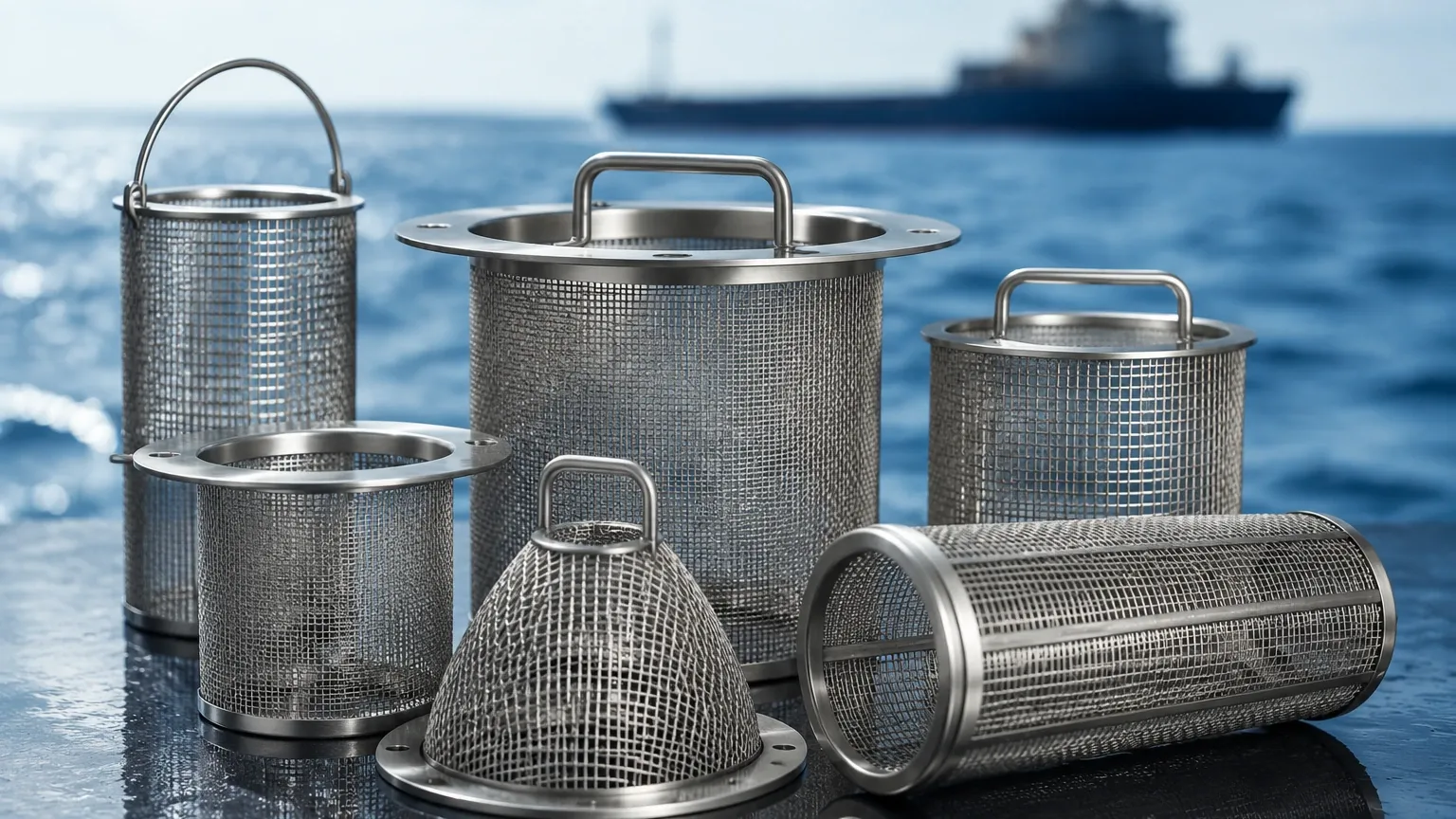
Selecting the Right Strainer Basket for Marine Applications
When sourcing a replacement or designing a new system, purchasing teams and engineers should confirm several technical details to ensure the strainer basket marine is fit for purpose. Relying on generic specifications can lead to premature failure or insufficient protection.
Technical Specifications Checklist
1. Flow Rate and Velocity: Ensure the basket can handle the peak flow without exceeding the maximum allowable pressure drop.
2. Micron Rating: Define the smallest particle that must be captured to protect downstream components.
3. Housing Compatibility: Confirm the flange type, basket height, and diameter. Custom manufacturers like Kaifil can produce baskets to fit existing housings from various OEM brands.
4. Handle Design: In cramped engine rooms, the ease of removal is vital. Options include bail handles, slant handles, or heavy-duty lifting lugs for larger baskets.
5. Gasket and Seal Material: Ensure that the seals used in the strainer housing are compatible with seawater and any chemicals used in the system (e.g., EPDM or Viton).
For organizations looking to optimize their filtration systems, reviewing professional Strainers & Baskets options is the first step toward reducing maintenance overhead and preventing unplanned downtime.
Total Cost of Ownership and Maintenance
While the initial cost of a high-grade stainless steel or duplex strainer basket may be higher than lower-quality alternatives, the total cost of ownership (TCO) is significantly lower. A cheap, poorly manufactured basket may suffer from rapid corrosion, mesh detachment, or structural failure, leading to expensive repairs of the pumps or heat exchangers it was meant to protect.
Monitoring and Cleaning Cycles
Modern marine systems often employ differential pressure (DP) sensors across the strainer housing. A rise in DP indicates that the basket is filling with debris. Establishing a clear protocol for cleaning—whether it is a manual process during a watch rotation or an automated backwash cycle—is essential. For manual systems, having a spare basket on hand allows for a quick swap, ensuring the system is back online immediately while the dirty basket is cleaned and inspected in a controlled environment.
Inspection Protocols
Regular inspection should look for:
* Signs of erosion: High-velocity water can wear down the metal over time, especially near the inlet.
* Weld integrity: Ensure the mesh remains securely attached to the perforated support.
* Deformation: Any bowing or twisting of the basket indicates it has been subjected to pressures beyond its design limit.
Conclusion
The strainer basket marine is a small but vital component in the complex machinery of a sea-going vessel. By understanding the engineering nuances—from material science and open area ratios to the challenges of biofouling—engineers can ensure their systems remain robust in the face of the ocean's harsh conditions. Investing in high-quality, custom-engineered filtration solutions is a proven strategy for maintaining operational readiness and extending the service life of critical marine infrastructure.
