


Strainer Basket Mesh Sizes
In industrial fluid handling systems, the selection of filtration components is a critical engineering decision that directly impacts the longevity of downstream equipment such as pumps, valves, and spray nozzles. Among the various parameters involved in specifying Strainers & Baskets, the mesh size is perhaps the most significant. It determines the balance between filtration efficiency and system hydraulic performance.
Selecting the correct strainer basket mesh sizes requires a technical understanding of particle size distribution, fluid rheology, and the mechanical limits of the filter media. This guide provides a factual overview of the engineering considerations necessary for optimizing strainer performance in industrial environments.
Understanding Mesh, Microns, and Inches
The term "mesh" refers to the number of openings per linear inch of the filter media. For example, a 20-mesh screen has 20 openings across one inch. As the mesh count increases, the size of the individual openings decreases, allowing for the capture of finer particles. However, mesh count alone does not define the absolute filtration rating because the diameter of the wire used in the weave also affects the size of the opening.
To standardize measurements across different industries, engineers often convert mesh sizes into microns (one-millionth of a meter) or decimal inches.
* Mesh Count: The number of wires per inch.
* Micron Rating: The physical distance between the wires, representing the largest particle that can pass through the opening.
* Wire Diameter: The thickness of the stainless steel wire, which determines the structural strength and the total open area of the basket.
In high-precision applications, such as those found in the pharmaceutical or chemical processing sectors, specifying the micron rating is often preferred over mesh count to ensure exact particle retention levels.
Engineering Criteria for Selecting Strainer Basket Mesh Sizes
Selecting the optimal mesh size is not simply a matter of choosing the finest possible screen. Over-filtration can lead to excessive pressure drops and frequent maintenance cycles. Engineers must evaluate several variables to determine the appropriate strainer basket mesh sizes for a specific application.
1. Particle Size and Nature
The primary goal of a strainer is to protect downstream equipment. The rule of thumb in industrial filtration is to select a mesh opening that is approximately 1/2 to 1/3 the size of the smallest orifice or clearance in the protected equipment. For instance, if a spray nozzle has an aperture of 1,000 microns, a strainer basket with a 300 to 500-micron opening (roughly 30 to 50 mesh) is typically recommended.
Furthermore, the nature of the contaminant matters. Rigid, spherical particles are easily trapped by wire mesh, while fibrous or deformable particles may "bridge" across openings or be forced through the mesh under high pressure, requiring a finer or more complex mesh structure.
2. Fluid Viscosity
Viscosity significantly influences the flow characteristics through a strainer basket. High-viscosity fluids, such as heavy oils, resins, or syrups, experience greater resistance when passing through fine mesh. If the mesh is too fine for a viscous fluid, the pressure drop will be unacceptably high even when the basket is clean. In these cases, engineers often specify larger mesh sizes or increase the total surface area of the strainer to compensate for the flow resistance.
3. Flow Rate and Velocity
High flow velocities increase the force exerted on the mesh. If the mesh size is very fine, the individual wires are thinner and more susceptible to mechanical failure or "blow-through" if a pressure surge occurs. For high-velocity systems, a multi-layered approach is often used, where a fine mesh liner is supported by a heavy-duty perforated metal basket.
The Relationship Between Mesh Size and Pressure Drop
The pressure drop ($ΔP$) across a strainer is the difference in pressure between the inlet and the outlet. Every strainer basket introduces some level of restriction. As the mesh size becomes finer, the percentage of open area typically decreases, leading to a higher initial pressure drop.
In a well-designed system, the initial (clean) pressure drop should generally not exceed 2 psi (0.14 bar). If the initial pressure drop is too high, it leaves very little room for the buildup of contaminants before the system reaches its terminal pressure drop—the point at which the basket must be cleaned or replaced to prevent equipment damage or flow cessation.
Open Area and Dirt Holding Capacity
The efficiency of a strainer basket is often measured by its "Open Area Ratio." This is the ratio of the total area of the openings in the mesh to the cross-sectional area of the inlet pipe.
* Standard Protection: A ratio of 2:1 is common for general industrial water applications.
* High Solids Loading: In systems with high levels of debris, a ratio of 4:1 or higher is required to ensure adequate dirt-holding capacity and longer intervals between cleanings.
Finer strainer basket mesh sizes naturally have lower open area percentages if the wire diameter remains constant. To maintain a high open area ratio with fine filtration, manufacturers like Kaifil often utilize specialized weaves or larger basket geometries to ensure the system remains operational for longer periods.
Structural Integrity: Perforated Backing and Mesh Liners
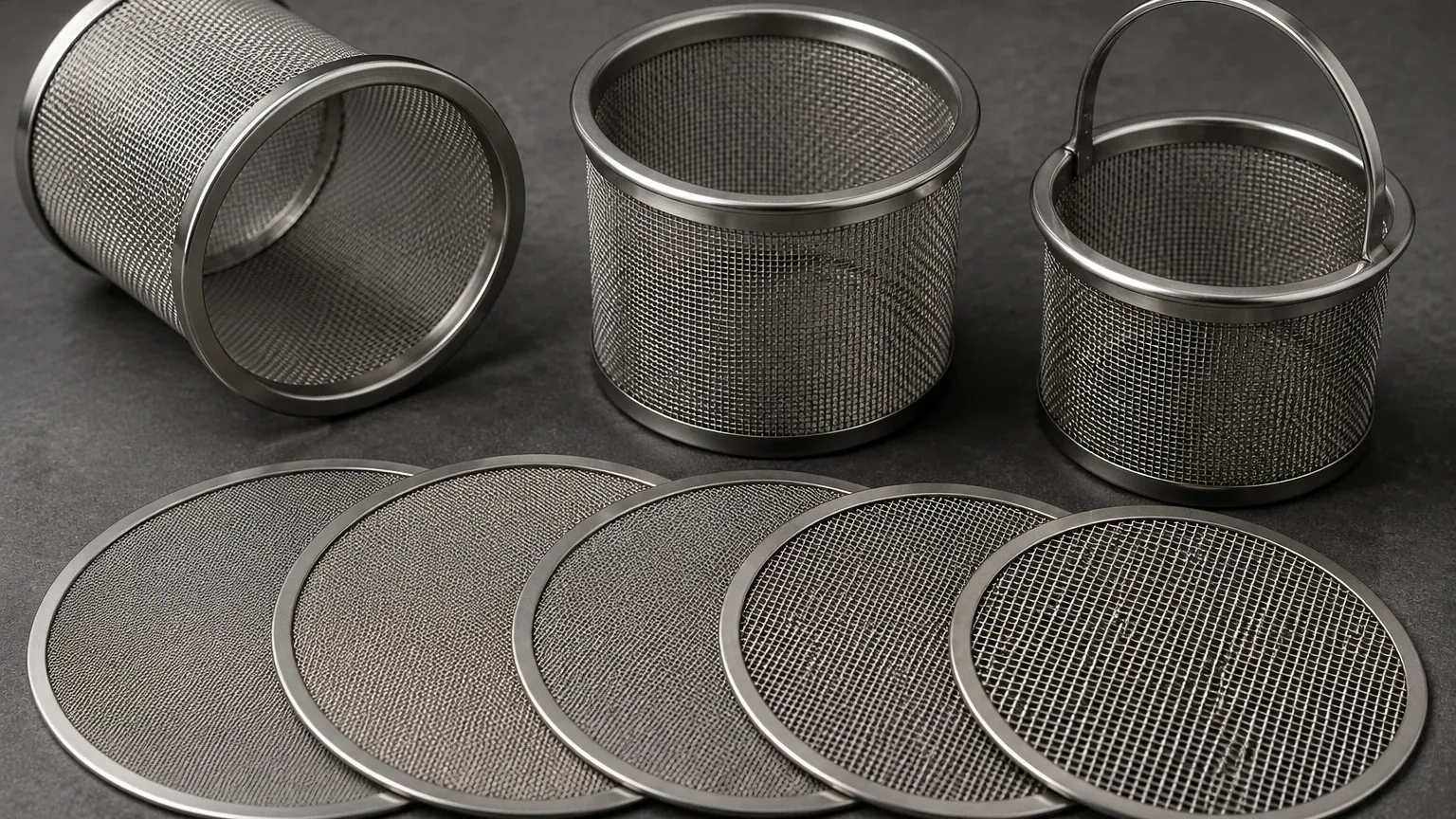
For industrial applications, a standalone wire mesh is rarely sufficient due to the high differential pressures encountered during operation. Strainer baskets are typically constructed using a two-part design:
1. The Perforated Basket: A heavy-gauge stainless steel plate with punched holes (ranging from 1/16" to 1/2") provides the primary structural framework. This component handles the mechanical loads and pressure differentials.
2. The Mesh Liner: A fine wire mesh is spot-welded or mechanically fastened to the inside of the perforated basket. This liner performs the actual filtration to the specified micron level.
This "lined basket" configuration allows for the use of very fine mesh sizes (up to 400 mesh or finer) while maintaining the structural integrity required to withstand the stresses of industrial pumping systems.
Material Selection for Demanding Environments
While the mesh size dictates what particles are caught, the material dictates how long the strainer will last. Stainless steel is the industry standard due to its corrosion resistance and mechanical strength.
* Type 304 Stainless Steel: Suitable for general-purpose applications, including water, oils, and mild chemicals.
* Type 316/316L Stainless Steel: Contains molybdenum, providing superior resistance to chlorides and acetic acids. It is the preferred choice for marine environments, food and beverage processing, and pharmaceutical applications where sanitation and corrosion resistance are paramount.
For highly corrosive environments involving concentrated acids or high temperatures, specialized alloys may be required, though 316L remains the most versatile material for custom filtration components.
Maintenance and Operational Considerations
Determining the correct strainer basket mesh sizes is only part of the engineering challenge; maintaining the system is equally vital. Most industrial strainers should be equipped with differential pressure gauges.
* Cleaning Threshold: A common industry standard is to clean the basket when the differential pressure reaches 5–10 psi over the clean reading.
* Total Cost of Ownership (TCO): Specifying a mesh that is too fine increases the frequency of manual cleanings, leading to higher labor costs and potential downtime. Conversely, a mesh that is too coarse may allow particles to damage expensive downstream components, leading to high repair costs.
Engineers must find the "sweet spot" where the mesh is fine enough to protect the system but coarse enough to allow for a reasonable service interval.
Customization and OEM Solutions
In many industrial OEM scenarios, standard off-the-shelf strainer baskets do not meet the specific spatial or performance requirements of a machine. Custom manufacturing allows for the optimization of basket geometry, material grade, and mesh sizing to fit unique housings or flow conditions.
As a professional manufacturer, Kaifil specializes in developing custom stainless steel filtration solutions that address these specific engineering challenges. By working closely with purchasing teams and engineers, manufacturers can provide tailored Strainers & Baskets that ensure reliable performance in chemical processing, hydraulic systems, and water treatment applications.
Conclusion
Selecting the appropriate strainer basket mesh sizes is a technical process that balances protection requirements against hydraulic efficiency. By considering fluid viscosity, flow rate, and the specific tolerances of downstream equipment, engineers can specify a filtration solution that minimizes maintenance while maximizing system uptime. Whether using a standard perforated basket for coarse straining or a fine mesh-lined basket for precision filtration, the integrity of the material and the accuracy of the mesh size remain the foundations of effective industrial fluid management.
